
Debt Collection Software: The Recovery Priority Test for Choosing or Building One
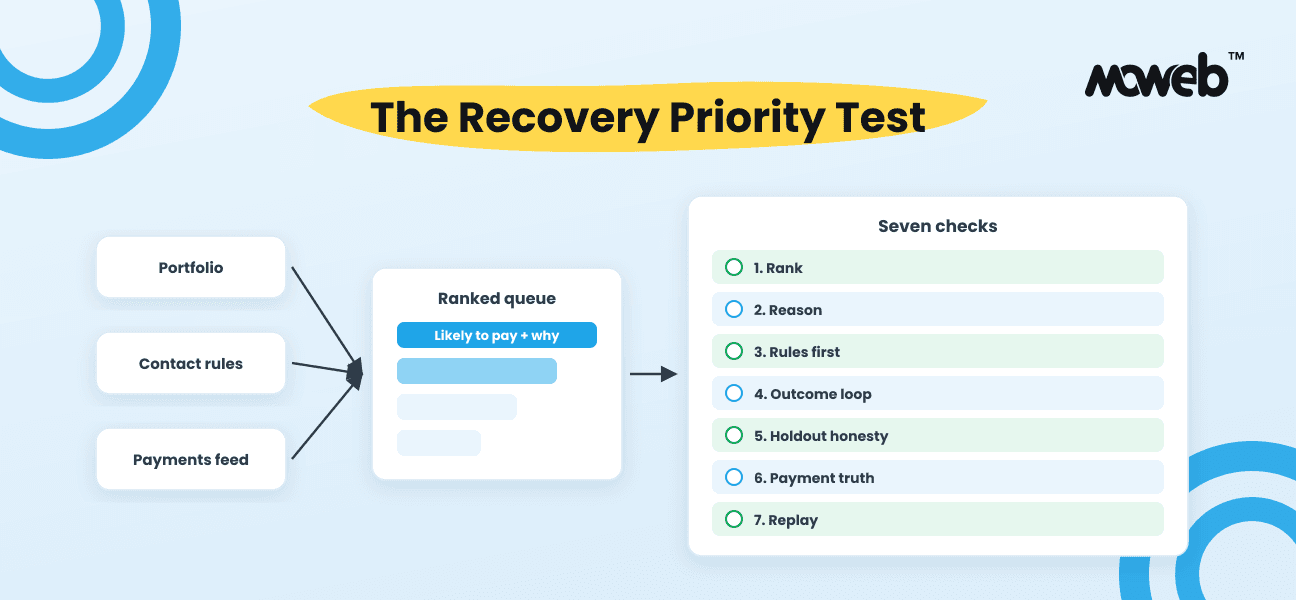
Debt collection software is judged on its queue, not its dialler. Use the Recovery Priority Test, seven checks scored pass, workaround or fail, to decide whether to buy, extend or build a custom collections platform.
Most buyers evaluate debt collection software the way vendors demo it: a dialler, a payment link, a promise-to-pay dashboard, a letter template library. All of that matters, and almost none of it decides how much of a portfolio is ever recovered.
What decides it is the order in which a fixed team works a list that is always longer than the day. A recovery operation can only make so many contacts per shift, and every one spent on an account that was never going to resolve is one not spent on an account that would have. That is a queue problem before it is a collections problem, and it is where most collections platforms, bought or built, quietly fail.
This guide is for lenders, NBFCs, collection agencies and B2B finance teams deciding whether to buy, extend or build. It gives you the **Recovery Priority Test**, a checkable framework you can run against a vendor shortlist or your current system in an afternoon.
Where debt collection software actually fails
The failures we see are rarely missing features. They are mechanisms that look fine in a demo and break under a real portfolio:
- **The queue is sorted by balance or days past due.** Both are easy to compute and both are weak proxies for whether contact today will produce a payment. A large, old balance with no working phone number sits at the top every morning.
- **Compliance is checked after the call is queued.** The agent sees an account, then a warning. Under pressure, warnings get clicked through, and every override becomes a regulatory exposure.
- **Outcomes never reach the ranking.** A broken promise or a dispute is logged as a note, and tomorrow's queue is built like today's.
- **Payments arrive late.** If receipts land a day later, agents chase people who have already paid: wasted capacity and a complaint waiting to happen.
Each of these is a design choice, which means each can be tested before you sign anything.
The Recovery Priority Test
The Recovery Priority Test is seven checks. Score each one **pass** (the system does it natively and you can see it working), **workaround** (it can be done with exports, spreadsheets or manual steps) or **fail** (it cannot be done). Run it with your own data, not the vendor's sample portfolio.
- **Rank:** the queue is ordered by likelihood of resolution, not by balance or age alone.
- **Reason:** an agent can see why an account is ranked where it is.
- **Rules first:** contact eligibility is enforced before an account enters the queue, not after.
- **Outcome loop:** every contact outcome feeds the next scoring run automatically.
- **Holdout honesty:** the scoring is evaluated against held-out cases, not only against accounts the old process chose to work.
- **Payment truth:** a payment received removes the account from active treatment the same day.
- **Replay:** for any account, you can reconstruct why it was contacted on a given date, by whom and under which rule.
Two or more fails means the platform must be extended or replaced, whatever the licence cost. Three or more workarounds means your operations team is the integration layer, a cost no invoice shows.
Checks 1 and 2: rank by likelihood, and show the reason
A scoring layer turns account and payment history into features (payment behaviour, contact responsiveness, promise history, channel preference, not just balance) and scores each account for its likelihood of resolving. The queue is then worked in score order. This is exactly the shape of the debt recovery intelligence system Moweb built for a recovery operation: scoring, a prioritised queue, and the reasoning surfaced alongside each account. That client is unnamed and no performance figures are published, so we cite it for the architecture, not for a result.
The reason matters as much as the rank. An agent who cannot see why an account is at position three will fall back to working the list their own way, and the model becomes a report nobody reads. Good collections software shows a short, plain explanation: "two kept promises in the last year, responds to SMS, balance recently reduced". It also lets a supervisor see the same reasoning when reviewing a complaint.
To test it, ask the vendor to rank 500 of your closed accounts as they stood six months ago and show the top 50 with reasons. No reasons, score check 2 a fail. This is applied machine learning, scoped by our AI and ML development services team; sometimes the honest answer is that a well-designed rule set gets you most of the way, and we say so.
Check 3: rules before rank
Collections is regulated, and the rules are specific enough to encode. In the United States, Regulation F presumes a collector complies with the call-frequency limit if it does not call a person about a particular debt more than seven times within seven consecutive days, or within seven days after having a telephone conversation about that debt (12 CFR 1006.14(b)(2)). It treats contact before 8:00 a.m. or after 9:00 p.m. at the consumer's local time as inconvenient absent contrary knowledge, requires a simple opt-out in electronic communications, and requires collectors to stop contact after a written refusal or cease request, with narrow exceptions (12 CFR 1006.6).
In India, the Reserve Bank directed in 2022 that recovery agents must not call borrowers before 8 a.m. or after 7 p.m. and must not intimidate them (Business Standard report). In February 2026 it published draft directions to harmonise recovery conduct rules across regulated entities, including call documentation and recording, with a proposed effective date of 1 July 2026 (Upstox summary of the draft). Confirm the final text with your compliance team before configuring rules against it.
The design implication is the same in both markets. Compute eligibility first (local-time windows, attempt counts per debt and person, cease and dispute flags, channel opt-outs, hardship holds) and rank only eligible accounts. A system that ranks everything and then warns the agent makes the agent the compliance engine. Ask the vendor to show the rule that blocked a call, not the warning before one.
Checks 4 to 7: outcomes, holdouts, payment truth and replay
**Outcome loop.** Every contact should end with a structured outcome: right-party contact, promise to pay with date and amount, refused, disputed, wrong number, no answer. Those outcomes feed the next scoring run. Free-text notes do not count; nobody retrains a model on notes.
**Holdout honesty.** This is the check vendors most often fail without realising it. Historical data reflects historical behaviour: if your team always called large balances first, a model trained on past recoveries learns that large balances recover, because those were the only ones anyone tried. The fix is to keep a small, randomly selected holdout of accounts worked outside the score, and to compare results against it. Ask how the vendor's model was validated. If the answer is accuracy on past data alone, score this a fail.
**Payment truth.** Receipts from bank statements, payment gateways, UPI or ACH, and lockbox files must post to the collections ledger and suppress treatment the same day. This is an integration problem more than a collections problem, and it is where hidden scope lives; our Integration Surface Test is a useful companion here. Ask for the latency from money landing to the account leaving the queue, measured on a real feed.
**Replay.** Eventually a regulator, auditor, court or customer will ask why a person was contacted at a particular time. The system should answer from its own records: eligibility state at that moment, score and reason, agent, channel, template version, outcome. If the answer needs a dialler export, a CRM note and a spreadsheet stitched together, score it a workaround at best. Replay depends on immutable event history and strong controls over data about people in financial difficulty; Moweb is ISO 27001 certified, and our security practices cover access control, encryption and audit logging on the platforms we build.
Must-have modules and integrations
Whatever you buy or build, a serious debt collection platform needs these modules:
- **Portfolio intake:** placement files or loan feeds, validated and reconciled to the source ledger.
- **Eligibility engine:** versioned contact rules, so you can prove which applied on which date.
- **Scoring and queue:** ranking, reasons, assignment by agent skill and language.
- **Omnichannel contact:** calls, SMS, email, WhatsApp where permitted, letters, all logged against the debt.
- **Self-service payments:** payment links, plans and promise tracking.
- **Disputes and hardship:** workflow, holds and documents.
- **Agency management:** placements, commissions and field visit logs.
- **Reporting and replay:** dashboards plus the account-level audit trail.
Key integrations are the core lending or billing system, payment gateways and bank feeds, the dialler or CPaaS provider, credit bureau reporting where applicable, and your CRM. If you run a lending book, collections should share a ledger view with the loan system; our loan management software work covers that side.
Off-the-shelf, custom, or a scoring layer on top
There are three honest options, and the Recovery Priority Test tells you which fits.
- **Off-the-shelf collections software** wins when your rules are standard and it passes checks 3, 6 and 7. Ranking and holdout validation are usually where packaged products are thinnest.
- **A scoring layer on your existing platform** wins when it passes rules and payments but fails ranking and reasoning. Often the fastest, lowest-risk route, and the shape of our case study.
- **Custom debt collection software** wins when you fail several checks, operate across jurisdictions with different rules, run an unusual product (B2B receivables, microfinance, utilities, buy now pay later) or need collections tightly coupled to your own lending stack. Our fintech software development and enterprise software development teams build these as owned platforms, so the rules and models are yours.
Cost and timeline are driven by placement formats, payment and contact channels, the jurisdictions whose rules you encode, rules-based versus model-based scoring, and the state of your historical data. A scoring layer is far smaller than a full platform, and discovery shows which you need. Where scope is clear, a fixed-cost engagement keeps risk with the builder.
FAQ: buying or building debt collection software
**Can AI improve debt recovery?** It can improve the order in which accounts are worked, which is where capacity is won or lost. It only helps if scores reach the queue with reasons agents trust, and if the model is validated against a holdout rather than past behaviour alone.
**How do we make collections software compliant with Regulation F or RBI rules?** Encode contact rules as an eligibility engine that runs before ranking, version the rules, and keep event-level logs so any contact can be replayed. Have your compliance counsel sign off the rule configuration.
**Should we build custom debt collection software?** Build when you fail several checks in the Recovery Priority Test, when your product or jurisdictions do not fit packaged software, or when collections must sit inside your own lending platform. Otherwise, buy, and consider adding a scoring layer.
**How long does a project take?** It depends on integrations and data quality more than screens. A scoring layer is much shorter than a full multi-channel platform; we commit to a timeline after discovery, not before.
Run the Recovery Priority Test on your collections operation
If your queue is still sorted by balance, or you are comparing vendors and every demo looks the same, we can help you see the difference. Book a free 30-minute review with Moweb's fintech engineers: we will walk through the seven checks against your current system or shortlist, score each one pass, workaround or fail, and tell you plainly whether you need a new platform, a scoring layer or neither.
Talk to Moweb about your collections platform, or read how we approached debt recovery intelligence first.