
Agentic AI for Enterprise Operations
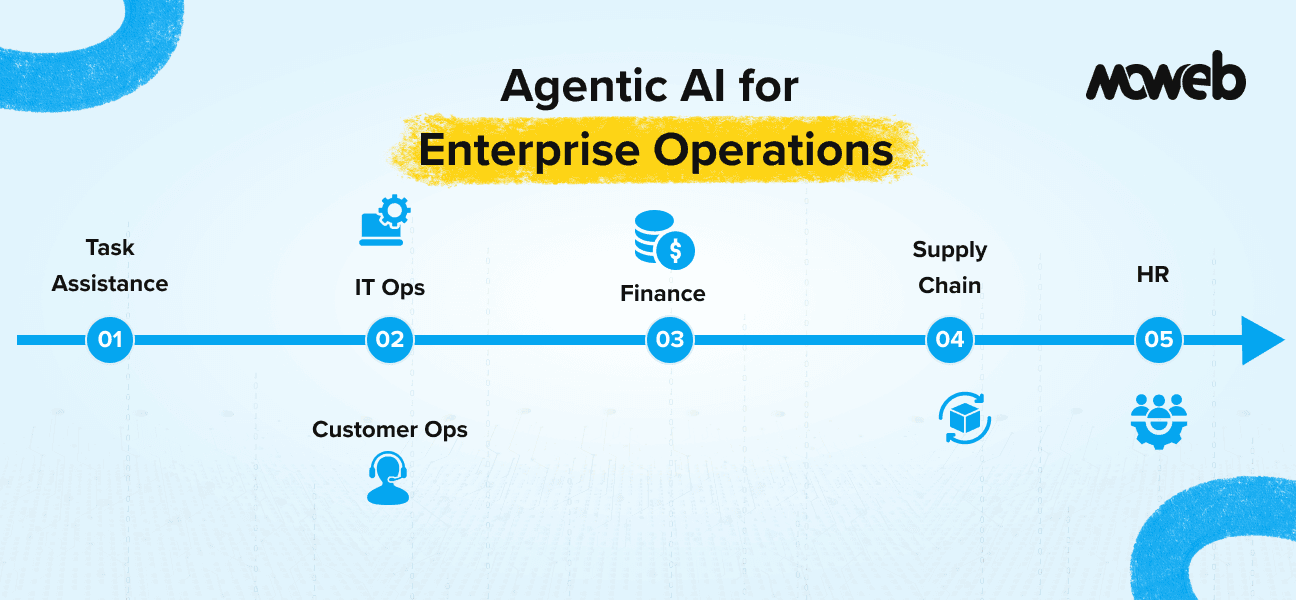
A practical guide to agentic AI for enterprise operations in 2026. Covers the automation-to-autonomy spectrum, the six operational domains with proven ROI, governance requirements, the "agent washing" problem, and a phased implementation roadmap.
What is agentic AI for enterprise operations? Agentic AI for enterprise operations refers to AI systems that independently plan, decide, and execute multi-step operational workflows – not just assisting humans with individual tasks but completing entire operational processes end-to-end with varying degrees of human oversight. Unlike earlier AI tools that augmented human decision-making, agentic AI systems take directive actions: querying systems, updating records, triggering workflows, communicating with external parties, and coordinating with other AI agents to complete complex operational objectives.
What is the difference between workflow automation and agentic AI? Traditional workflow automation executes predefined sequences: if condition A, then action B, then action C. It cannot adapt when conditions change, handle exceptions outside the defined rules, or make judgment calls about how to proceed when a step produces an unexpected result. Agentic AI executes goal-directed workflows: given an objective, it determines the steps needed, selects the appropriate tools, executes each step, evaluates the results, adapts its approach when intermediate steps produce unexpected outcomes, and escalates to a human when it encounters a situation outside its defined scope.
Enterprise operations have relied on the same fundamental model for decades: humans make decisions, humans take actions, and automation handles the most predictable and repetitive subset of both. The scope of what automation could handle was limited to exactly what rule-based systems could model: if X then Y, with defined inputs, defined outputs, and human intervention for everything in between.
Agentic AI is changing this model structurally. Not incrementally – structurally. Directive AI conversations – where enterprise users hand off complete tasks to AI rather than requesting assistance – jumped from over eight months in 2026 (Anthropic product usage data), the first time automation-mode usage has exceeded augmentation-mode.
Yet the gap between stated intent and production reality is wide.
The organisations succeeding with agentic AI and the majority that are not are making the same gap visible that has appeared throughout the history of enterprise AI: the capability exists, the use cases are real, and the execution is where programmes succeed or fail. This guide covers what separates agentic AI programmes that reach production from those that stall.
For the foundational distinction between copilots (which assist) and agents (which execute), see our guide to the difference between AI chatbot, copilot, and AI agent.
An AI agent, properly defined, has three characteristics that distinguish it from rule-based automation and from copilot-style AI assistance:
Goal-directed execution: an agent receives an objective, not a predefined script. It determines the sequence of steps needed to achieve the objective based on the current state of the systems it can access. When the state changes mid-execution, the agent adapts its plan rather than failing or escalating to a human for re-specification.
Tool use and external action: an agent executes real actions in external systems. It does not generate content for a human to act on. It queries a database, updates a record, sends a communication, calls an API, triggers a downstream workflow, or coordinates with another agent – directly, within its defined permission scope.
Adaptive behaviour under uncertainty: an agent encountering a result it did not expect can evaluate whether to retry with a different approach, escalate to human review, or abandon the task with a structured failure report – rather than either continuing incorrectly or stopping without explanation.
Systems that lack these three characteristics are automation, copilots, or chatbots with more sophisticated interfaces – all genuinely useful, but not agents. The commercial importance of the distinction is significant: agent-washing produces deployments that are presented as agentic but have the brittleness of rule-based automation and the opacity of black-box AI, with the governance overhead of both and the operational resilience of neither.
The test for whether a proposed agentic deployment is genuinely agentic: can it handle the realistic variability of production inputs without human intervention for the normal case? If it can only operate on clean, expected inputs and escalates everything else, it is a rule-based system with a more sophisticated front end.
Agentic AI for Enterprise Operations: The Automation-to-Autonomy Spectrum
Agentic AI is not a binary capability – it is a spectrum. Understanding where a specific deployment sits on that spectrum determines its governance requirements, its failure mode profile, and the organisational trust-building work required before expanding its scope.
Level 1 – Task assistance: AI responds to individual requests with information or content. The human initiates, reviews, and acts on every output. Standard copilot capability. No autonomous execution.
Level 2 – Process step automation: AI executes individual process steps autonomously within a defined, narrow scope. A document extraction agent that reads invoices and populates fields in the accounting system without human review of each extraction. Requires confidence thresholds and exception routing to human review.
Level 3 – Multi-step workflow execution: AI executes sequences of connected steps across multiple systems to complete a defined process. A procurement agent that receives a purchase request, checks policy compliance, identifies approved vendors, generates a purchase order, and routes for approval. Requires clearly defined scope boundaries, action logging, and human-in-the-loop gates at high-stakes decision points.
Level 4 – Goal-directed process management: AI receives an objective and determines the workflow needed to achieve it, adapting the approach based on intermediate results. A customer churn prevention agent that identifies at-risk accounts, researches the specific risk factors for each, determines the appropriate retention intervention, executes the outreach, and tracks response. Requires sophisticated governance, careful scope definition, and established trust from validated Level 3 deployments.
Level 5 – Autonomous process optimisation: AI not only executes workflows but monitors their performance over time and modifies its own approach to improve outcomes within defined parameters. Current frontier capability is not yet widely deployed in enterprise contexts.
Most enterprise agentic AI in production in 2026 operates at Levels 2 and 3. The industry concentration reflects a pattern: sectors with the highest transaction volume, the most structured data, and the most recoverable error modes (financial operations, customer service) are where Levels 2–3 have scaled fastest. Level 4 deployments exist at scale in leading organisations. Level 5 is emerging in narrow, high-data-volume domains. The sequencing that works – beginning at Level 2 and building toward Level 4 as trust and governance infrastructure develop – is the pattern that distinguishes programmes that scale from those that stall.
Six Operational Domains with Production Evidence
Domain 1: Customer Operations and Service
Customer service is the highest-adoption agentic AI domain in 2026, with the clearest documented ROI and the most mature deployment playbooks. AI agents in customer operations handle the full range of tier-1 interactions – order status, returns initiation, account queries, FAQ resolution, appointment scheduling – autonomously, with escalation to human agents for tier-2 issues.
The documented outcomes are consistent across deployments. Cost per resolved interaction reduces for autonomous resolution versus human agent handling. First-contact resolution rates improve because agents have access to complete customer data across all systems simultaneously, eliminating the need for customers to repeat context across handoffs.
The governance requirement specific to customer operations: a clearly defined scope boundary specifying which interactions the agent can resolve autonomously, which it can resolve with action triggers (initiating a return, applying a discount code), and which require immediate escalation. This boundary must be technically enforced through tool-level permissions, not just described in the agent’s system prompt.
Domain 2: IT Operations and Infrastructure Management
IT operations is the second-highest-adoption domain, driven by the combination of high volume, well-structured data, and the substantial productivity impact of reducing mean time to resolution on infrastructure incidents.
AIOps deployments in 2026 range from Level 2 (automated incident ticket creation and routing based on monitoring alert patterns) to Level 4 (agents that detect anomalies, correlate with deployment history, run diagnostic checks, implement defined remediation procedures, and only escalate when the root cause exceeds their remediation scope).
The commercial impact is most visible in on-call burden reduction. JPMorgan Chase runs over 450 AI use cases across 200,000 employees, with IT operations among the earliest and highest-volume deployments. This is the production scale available to enterprises that invest in agentic infrastructure early and systematically. This is a workforce quality-of-life improvement with measurable attrition and recruitment implications alongside the direct productivity impact.
Domain 3: Financial Operations and Compliance
Finance is a high-value but more carefully governed agentic AI domain. The highest-volume applications – accounts payable processing, expense report validation, three-way purchase order matching, and regulatory monitoring – are well-suited to Level 2–3 agentic execution.
The specific use case with the strongest production evidence is accounts payable automation. AI agents receive invoice documents, extract structured data, validate against purchase orders and delivery records, check supplier master data and contract terms, route exceptions for human review, and process standard invoices through to payment authorisation without manual touchpoints. The efficiency gain – reduction in manual touchpoints for standard invoices – is quantifiable against a clean baseline. Build the equivalent calculation for your own AP volume before the first board conversation.
Compliance monitoring agents are the fastest-growing financial operations deployment in 2026 as regulatory change volume increases. For the regulatory monitoring and compliance automation use cases in detail, including EU AI Act compliance tracking, see our guide to AI for legal and compliance teams.
Domain 4: Supply Chain and Procurement
Supply chain is the operational domain where agentic AI’s ability to synthesise signals from multiple sources and take time-sensitive actions generates the highest commercial value.
AI agents in supply chain operations monitor inventory levels, demand signals, supplier performance, and logistics disruptions simultaneously – and take defined actions when conditions trigger: adjusting replenishment orders, reallocating inventory between locations, triggering supplier escalations, updating demand plans. These are actions that previously required a supply chain analyst to notice the condition, assess its implications, and take manual action – a cycle that typically takes hours to days. AI agents execute the same cycle in minutes.
The governance complexity in supply chain agentic AI is high because procurement actions have direct financial consequences and supplier relationship implications. The governance design must include financial authorisation thresholds (autonomous action permitted below threshold X, human approval required above threshold X), supplier communication approval requirements for non-standard situations, and full action logging for spend management and audit purposes. For the multi-agent orchestration architecture that coordinates multiple operational agents across supply chain workflows, see our guide to multi-agent systems for enterprise.
Domain 5: Human Resources and Talent Operations
HR operations contains a set of high-volume, rule-based workflows that are well-suited to Level 2-3 agentic execution, alongside sensitive decision-influencing applications that require careful governance and may trigger EU AI Act high-risk category obligations.
The high-volume, lower-risk applications: interview scheduling coordination (AI agents manage the full scheduling workflow across candidate, hiring manager, and panel member calendars with confirmation and rescheduling handled autonomously), onboarding workflow management (agents trigger and track completion of onboarding tasks across IT, legal, HR, and functional team systems), and employee information query resolution (agents answer HR policy questions, benefits queries, and leave management requests from the knowledge base without HR team involvement).
The sensitive applications requiring specific governance: AI-assisted CV screening (falls within EU AI Act high-risk category for AI in employment decisions), performance assessment support, and compensation analysis.
Domain 6: Sales and Revenue Operations
Sales operations agentic AI addresses the productivity gap that has been visible in CRM adoption data for years: sales teams know what they are supposed to do in their CRM systems but find the data entry and administrative burden sufficiently high that CRM hygiene is consistently poor, reducing the data quality that every AI system downstream depends on.
AI agents that automatically capture activity data, update opportunity stages based on communication analysis, generate next-best-action recommendations from the opportunity context, draft follow-up communications for sales rep review, and flag stalled opportunities for management attention address this productivity gap directly. The result is better CRM data quality (which improves every downstream AI use case), reduced administrative time for sales reps, and more consistent opportunity management. The attack surface created by MCP integrations, tool-calling permissions, and memory systems requires a dedicated security architecture that most deployments currently lack.
The governance framework for enterprise agentic AI has five required components, all of which must be in place before Level 3 or above deployment reaches production. These are covered in detail in our guide to AI governance for LLMs and enterprise agents. The summary:
Agent identity and permission scoping: every agent must have a defined identity with explicitly authorised tool access and data permissions. The principle of least privilege applies at the agent level: each agent accesses only the systems and data specifically required for its defined task scope. Service account access with broad permissions is not acceptable for production agentic deployments.
Immutable action logging: every action an agent takes – every tool call, API request, system modification, communication sent – must be logged with timestamp, agent identity, input parameters, and output result. This audit trail is the foundation of incident investigation, compliance review, and the trust-building evidence that allows scope expansion over time.
Human-in-the-loop design: for every agent workflow, there must be explicit design of which decision points require human approval before the agent proceeds, which situations trigger automatic escalation, and what the agent does when it encounters a situation outside its defined scope. Undefined escalation behaviour is the most common source of agent governance failures in production.
Performance and quality monitoring: agents degrade over time as data distributions shift and as conditions diverge from the training or configuration context. Production monitoring that detects quality degradation before it affects business outcomes is an operational requirement, not an optional enhancement.
Incident response procedures: a defined process for what happens when an agent produces an incorrect output, takes an unintended action, or encounters an adversarial input. Who investigates, what evidence is preserved, how the scope of impact is assessed, and how the agent is suspended or modified during investigation.
The organisations that have invested in this governance framework before expanding agentic scope are the ones that can confidently expand to Level 4 deployments because they have the controls and the evidence base to justify the trust. The organisations that have not built this framework are the ones whose agentic initiatives stall after a governance incident. The commercial consequence is real: organisations invest in “agentic” solutions that do not deliver the adaptive, goal-directed execution that genuine agents provide, then conclude that agentic AI does not work for their use case.
The questions that expose agent washing in vendor evaluation:
Can the agent handle input variability? Present the vendor with three realistic variations of the same input – one clean and standard, one with missing fields, and one with ambiguous information. A genuine agent handles all three with appropriate adaptation. An automation system with an agent wrapper typically handles the first, fails or escalates on the second, and fails silently on the third.
Can the agent recover from mid-process failures? Describe a scenario where an API call in step 3 of a 6-step workflow fails. What does the agent do? A genuine agent evaluates whether to retry, whether to use an alternative tool, whether to escalate, and whether to communicate a partial completion. An automation system typically stops and raises an error.
Can the agent explain its decision-making? Ask the vendor to demonstrate the agent’s reasoning trace for a completed workflow. A genuine agent implementation has an auditable record of the decision logic. An automation system produces only a log of executed steps.
What is the agent’s scope boundary behaviour? Ask what happens when the agent receives an input that falls outside its designed scope. A genuine agent recognises out-of-scope situations and escalates them with context. An automation system either processes them incorrectly or fails without explanation.
For the full framework for evaluating AI agent claims from vendors, see our guide to AI agent development services: use cases, risks, and implementation roadmap.
Implementation Roadmap: From First Agent to Agentic Operations
The sequencing that produces successful agentic AI programmes follows a consistent pattern across the organisations that have scaled successfully.
Phase 0 (Before Phase 1): AI readiness assessment. Before establishing governance infrastructure, identify which operational domains have the data quality and infrastructure readiness to support agentic deployment. A structured AI readiness assessment covering data accessibility, process definition, and failure mode recoverability identifies the right first use case and prevents the data quality surprises that extend pilot timelines.
Phase 1 (Weeks 1-6): Governance framework before deployment. Establish the governance infrastructure before deploying the first agent. This is counter to the “move fast” instinct but is consistently validated by the failure data: organisations that deploy agents before establishing governance encounter incidents that force retrenchment, which sets the programme back further than the governance investment would have. The governance framework covers agent identity, permission scoping, action logging, escalation design, and incident response procedures.
Phase 2 (Weeks 6-14): First agent at Level 2 scope. Deploy the first agent in the highest-volume, best-defined, most recoverable use case available. Invoice processing, document extraction, IT ticket routing, or customer FAQ resolution are typical first agents. Level 2 scope: the agent executes individual process steps autonomously, but with exception routing to human review for anything outside the standard case. Build the quantified ROI calculation before deployment – using the invoice processing benchmark above as a template – so the evidence you collect in this phase is designed to answer the CFO’s question, not just the engineering team’s. Collect the action logs, measure quality metrics against the baseline, and use this evidence to build the organisational trust and executive confidence that Level 3 deployment requires.
Phase 3 (Months 4-9): Level 3 multi-step workflow deployment. With governance infrastructure validated and Level 2 evidence collected, expand to Level 3 multi-step workflow agents in the operational domains with the strongest business case. Customer service resolution, procurement processing, or compliance monitoring agents. Configure human-in-the-loop gates at the decision points identified in the governance framework. Measure against the ROI targets established in the business case.
Phase 4 (Months 9+): Agentic ecosystem expansion. With validated Level 3 deployments generating documented ROI and the governance framework proven at scale, expand the agentic portfolio across additional operational domains and begin the Level 4 deployment work for the use cases where goal-directed adaptation adds the most value. The pace of expansion in Phase 4 is faster than Phases 1-3 because the infrastructure, governance, and organisational trust built in earlier phases compound. The median payback trajectory suggests Phase 4 deployments will show positive ROI by month 5 of operation on average – with finance/ops agents taking slightly longer (8.9 months median) and customer-facing agents faster (3.4 months for the SDR category). Model these payback timelines into the Phase 4 business cases to set accurate board expectations.
Frequently Asked Questions About Agentic AI for Enterprise Operations
What is the difference between agentic AI and traditional workflow automation? Traditional workflow automation executes predefined rules: if A then B. It cannot adapt when conditions change outside the defined rules. Agentic AI executes goal-directed workflows: given an objective, it determines the steps needed, selects tools, executes steps, evaluates results, adapts when intermediate steps produce unexpected outcomes, and escalates when a situation falls outside its defined scope.
Why are so many agentic AI projects being cancelled?
What is the right first agentic AI use case for an enterprise? The right first use case has four characteristics: high volume (enough transactions to generate statistically meaningful quality data quickly), well-defined process (clear inputs, clear outputs, clear exception criteria), recoverable failure mode (incorrect outputs are detectable and correctable before causing significant impact), and clean accessible data (the data the agent needs already exists and is accessible without a major data engineering project). Invoice processing, document extraction, IT ticket routing, and customer FAQ resolution consistently meet all four criteria.
How much human oversight do enterprise AI agents require? It depends on the autonomy level and the consequences of incorrect actions. Level 2 agents (individual step automation) require human review of exception-routed outputs and periodic quality monitoring. Level 3 agents (multi-step workflows) require human-in-the-loop gates at defined high-stakes decision points and continuous quality monitoring. Level 4 agents (goal-directed workflows) require robust governance infrastructure, performance monitoring, and governance committee oversight. The pattern that works: start with more human oversight than feels necessary, generate evidence that quality meets defined thresholds, then reduce oversight systematically as evidence accumulates.
What is agent washing, and how do I avoid it in vendor evaluation? Agent washing is vendors relabelling existing RPA or automation capabilities as AI agents without delivering genuine goal-directed, adaptive behaviour. Test by presenting input variability (three realistic variations of the same input), mid-process failure scenarios (what does the agent do when step 3 of a 6-step workflow fails?), and out-of-scope inputs (what does the agent do when it receives an input outside its designed scope?). Genuine agents handle these with adaptation and structured escalation. Automation systems with agent wrappers fail silently or produce incorrect outputs.
What governance does an enterprise AI agent require? Five required governance components: agent identity with explicitly authorised tool access and data permissions (principle of least privilege); immutable action logging of every agent action with timestamp, parameters, and results; human-in-the-loop design specifying which decision points require approval and which situations trigger escalation; performance and quality monitoring that detects degradation before it affects business outcomes; and incident response procedures defining investigation, evidence preservation, and suspension protocols.
What ROI can enterprises expect from agentic AI deployments? Median payback is 5.1 months overall – 3.4 months for SDR/sales agents, 8.9 months for finance/ops agents.
Conclusion: Agentic AI Is the Next Operating Model – Built Correctly
The directive shift is not theoretical. What is still theoretical for most organisations is the systematic, governed expansion of agentic capability across operational domains in a way that generates documented ROI, maintains compliance and control, and earns the organisational trust that allows scope to expand without incident. The difference is governance infrastructure, proper scoping, and the willingness to start at Level 2 when the instinct is to deploy Level 4.
The organisations building that systematic approach – governance first, Level 2 before Level 3, documented evidence before scope expansion – are the ones that will have operating agentic ecosystems in 2027, while their competitors are still debating pilot scope. The capability exists. The governance framework is well-understood. The use cases with production evidence are documented. The only variable is execution discipline.
Moweb’s AI Agents & Intelligent Automation practice designs and builds enterprise agentic AI systems with governance-first architecture – including agent identity design, permission scoping, action logging infrastructure, human-in-the-loop gate implementation, and quality monitoring. Our Generative AI & LLM development practice handles the underlying AI architecture. Talk to us about your agentic AI programme.
Found this post insightful? Don’t forget to share it with your network!