
Manufacturing Software Development with AI
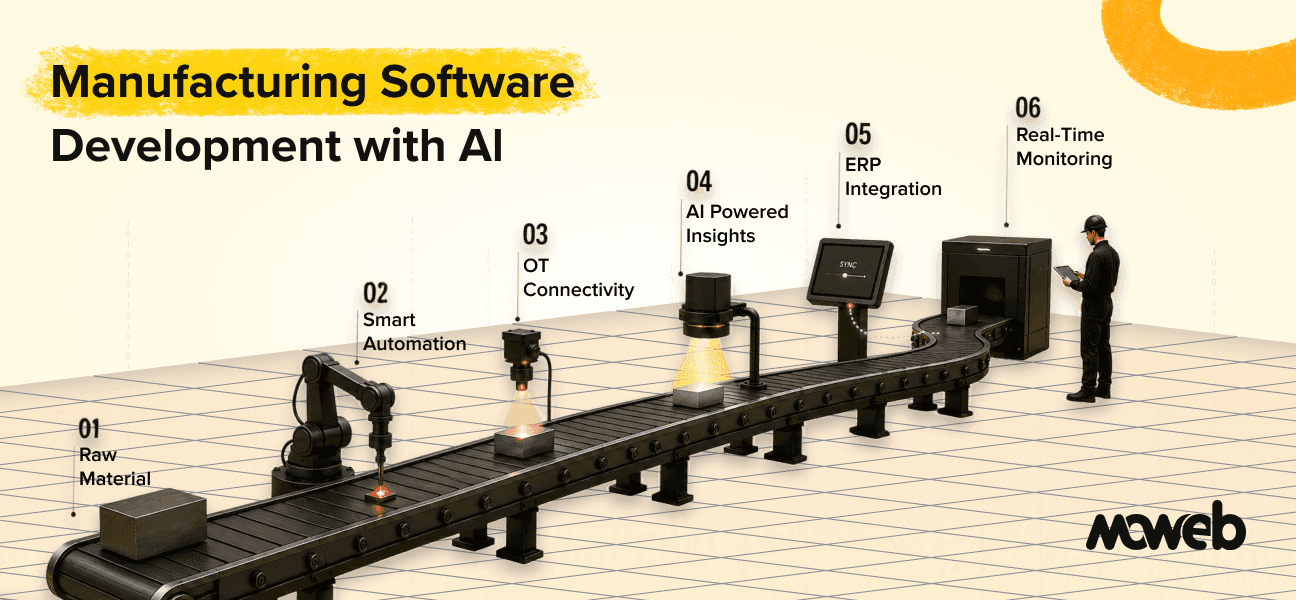
A practical guide to AI-enabled manufacturing software development in 2026. Covers ERP integration, IT/OT convergence, MES architecture, digital twin development, AI quality inspection, and a phased smart factory roadmap for manufacturers.
What is AI-enabled manufacturing software development? AI-enabled manufacturing software development is the design and build of software systems that connect factory floor operational technology (OT) – PLCs, SCADA, MES, CNC machines, IIoT sensors – with enterprise information technology (IT) – ERP, supply chain management, quality management systems – and apply AI capabilities to the data that flows across this connected environment. The AI layer enables: predictive maintenance (detecting equipment failure patterns before breakdown), AI quality inspection (computer vision detecting defects at production line speeds), autonomous production scheduling (AI optimising production plans across machine availability, demand forecasts, and material constraints), and digital twin modelling (virtual replicas of production assets that run optimisation simulations before changes are made to physical systems). Once plant data reaches the planning layer, the decisions it feeds are the subject of AI across the supply chain.
What is the IT/OT convergence challenge in manufacturing AI? IT/OT convergence is the integration of information technology systems (ERP, databases, cloud platforms, business applications) with operational technology systems (PLCs, SCADA, DCS, industrial robots, CNC machines) that control physical manufacturing processes. These two technology domains were historically designed in isolation: OT systems prioritised reliability and real-time determinism over connectivity, while IT systems prioritised data accessibility and integration. AI manufacturing applications require data from both domains simultaneously – a predictive maintenance model needs machine sensor data from OT and maintenance history from IT; an autonomous production scheduler needs machine availability from OT and customer orders from ERP. Bridging this gap is the foundational software engineering challenge in manufacturing AI, and the primary reason most manufacturers have not yet captured the AI value their technology investments should enable.
Manufacturing has always been a data-rich environment. Every machine cycle, every sensor reading, every quality measurement generates data. For decades, that data existed in isolation: OT systems collected it for real-time equipment control, operators used it for immediate decisions, and it was discarded or archived without ever reaching the business systems that could use it to improve production planning, supply chain management, or customer delivery performance.
The smart factory is the architectural answer to this data isolation problem – and AI is what makes the data valuable once the architecture connects it.
The commercial evidence is compelling.
But the gap between the manufacturers capturing this value and those that are not is not explained by access to AI technology. It is explained by the IT/OT architecture that AI depends on. A predictive maintenance model that cannot access real-time sensor data from the machines it is supposed to monitor cannot predict anything. An autonomous scheduler that cannot read machine availability from the factory floor cannot optimise a production plan. The AI is only as capable as the connected data infrastructure beneath it.
This guide covers the foundational IT/OT integration architecture, the software systems that form the manufacturing intelligence stack, the five AI applications with production evidence in manufacturing, and the phased development roadmap that takes manufacturers from data isolation to smart factory capability.
The Manufacturing Software Stack: Understanding the Layers
Before AI can be applied to manufacturing operations, the software stack that connects operational data to business systems must be understood. Manufacturing software has a distinct layered architecture that differs from enterprise software in most other industries.
Layer 1: Operational Technology (OT) – The Factory Floor. At the base of the manufacturing software stack are the operational technology systems that directly control production equipment: PLCs (Programmable Logic Controllers), SCADA (Supervisory Control and Data Acquisition) systems, DCS (Distributed Control Systems), CNC machine controllers, industrial robots, and IIoT sensors. These systems operate in real time, with cycle times measured in milliseconds, and were designed for determinism and reliability rather than data accessibility or network connectivity. Legacy OT systems frequently use proprietary communication protocols (Modbus, Profibus, DeviceNet) that were not designed for integration with modern IT systems.
Layer 2: Manufacturing Execution Systems (MES). MES sits between the OT layer and the enterprise layer, managing production execution in real time: work order management, production scheduling within the factory, quality data collection, material tracking, labour management, and machine performance monitoring. MES captures the production data that ERP cannot see – actual cycle times, actual yield rates, actual downtime events, actual quality measurements at each production step. It is the system that knows what is actually happening on the factory floor, as distinct from what the production plan says should be happening.
Layer 3: Enterprise Resource Planning (ERP). ERP manages the business processes that drive and are driven by manufacturing: customer orders, material requirements planning (MRP), procurement, inventory management, financial controlling, and customer delivery management. ERP is where demand signals enter the manufacturing system and where production costs and performance are reported to finance and leadership. Modern cloud ERPs (SAP S/4HANA, Oracle Cloud Manufacturing, Microsoft Dynamics 365 Finance and Operations) have significantly improved their manufacturing integration capabilities, but even the most modern ERP is blind to real-time factory floor conditions without explicit integration to MES and OT data.
Layer 4: AI and Analytics Layer. The AI layer sits above MES and ERP, consuming data from both operational and enterprise systems to generate predictions, recommendations, and in agentic architectures, autonomous actions. This layer includes: predictive models (maintenance failure prediction, quality defect prediction, demand forecasting), optimisation engines (production scheduling optimisation, energy optimisation, supply chain routing), computer vision systems (visual quality inspection, safety monitoring), and digital twins (virtual replicas of production assets and processes). The AI layer can only deliver value when the data connectivity between OT, MES, and ERP layers is reliable, consistent, and real-time.
The IT/OT Convergence Challenge: Why It Is the Primary Blocker
The foundational software engineering challenge in manufacturing AI is IT/OT convergence: establishing reliable, real-time data flow between the factory floor OT systems and the enterprise IT systems that AI applications need to span.
The challenge is not primarily a technology problem – the tools for OT connectivity (OPC UA, MQTT, industrial IoT gateways) are mature. It is an architectural and operational problem with several distinct dimensions.
Protocol heterogeneity on the factory floor. A typical mid-market manufacturing plant has 5-15 different OT systems from different vendors, using different communication protocols, with different data models for the same physical entities. An injection moulding machine from a German manufacturer, a robotic assembly cell from a Japanese manufacturer, and a vision inspection system from a US manufacturer all produce data about production quality – but in completely different formats, with different field names, different units, and different sampling rates. Normalising this data into a consistent schema is a significant data engineering project that must be completed before any AI application can consume it reliably.
OT security and network architecture constraints. Factory floor OT systems were historically isolated from corporate IT networks for security and reliability reasons – a legitimate concern given that a compromised PLC can cause physical damage or safety incidents. Enabling data flow from OT to IT requires establishing secure, unidirectional data channels (typically using industrial DMZ architecture) that allow sensor data to flow upward to IT without allowing IT system access to flow downward into OT control systems. The security architecture must be designed by teams with OT security experience, not general IT security experience.
Legacy OT system connectivity. Many brownfield manufacturing plants have OT systems that are 10-25 years old, using communication protocols with no native network connectivity. Connecting these systems typically requires either hardware retrofit (adding a communication module to the existing controller) or adding an OPC UA gateway that reads the proprietary protocol and translates it to a modern standard. The feasibility and cost of this retrofit varies significantly by equipment type and manufacturer.
Real-time data latency requirements. AI applications in manufacturing have heterogeneous latency requirements. Visual quality inspection at a production line running at 120 parts per minute requires inference in under 30 milliseconds – a hard latency constraint that mandates edge AI rather than cloud AI. Predictive maintenance models can tolerate data that is seconds to minutes old. Production scheduling optimisation runs on data that may be hours old. The AI architecture must match the latency requirement of each application to the appropriate data delivery mechanism.
The industrial standard that has most significantly reduced OT connectivity complexity is OPC UA (Unified Architecture), an open platform-independent protocol that provides a unified data model and security framework for industrial device communication. Major PLC manufacturers (Siemens, Rockwell Automation, Beckhoff, Schneider Electric) all support OPC UA on current-generation equipment. For legacy equipment without OPC UA support, gateway devices from vendors such as Kepware, Inductive Automation (Ignition), and Cogent DataHub translate proprietary OT protocols to OPC UA, providing a normalised connectivity layer that modern AI systems can consume.
Five AI Applications with Manufacturing Production Evidence
Application 1: Predictive Maintenance and Equipment Health Monitoring
Predictive maintenance is the highest-adoption AI application in manufacturing, driven by a straightforward commercial case: unplanned downtime is expensive and predictable from sensor data.
AI predictive maintenance systems collect vibration, temperature, current draw, pressure, and cycle count data from machine sensors continuously. ML models trained on historical failure data identify the sensor patterns that precede specific failure types – bearing wear, hydraulic seal degradation, motor insulation breakdown – typically detectable days to weeks before the failure event occurs. When sensors match a pre-failure pattern, a maintenance work order is automatically generated, parts are pre-ordered, and the maintenance event is scheduled during a planned downtime window.
The quantified commercial impact is consistent across published deployments: AI predictive maintenance reduces maintenance costs, reduces unplanned downtime, and extends asset life through optimised maintenance intervals. For a manufacturing plant with $2 million per year in maintenance spend and $5 million in unplanned downtime costs, these reductions represent $1.5-2.5 million in direct annual savings.
The data architecture requirement: sensor data streaming from OT to an edge processing layer (for anomaly detection at low latency), then to a cloud data platform for historical pattern analysis and model training. The edge processing layer is critical – cloud-only architectures introduce latency that misses short-duration precursor signals for fast-failure modes.
Application 2: AI Visual Quality Inspection
Visual quality inspection at production line speeds is one of manufacturing AI’s clearest demonstrations of capability that human inspection cannot match. A camera system capturing 30 frames per second at a production line running 200 parts per minute produces 1,800 inspection opportunities per hour – far more than any human inspector can evaluate at the required consistency.
AI computer vision systems trained on labelled defect images achieve detection accuracy for defined defect types under consistent lighting conditions – significantly above the human inspection baseline under optimal conditions and substantially lower under fatigue conditions at the end of a shift. The edge deployment ensures the sub-30-millisecond inference latency required for production line speeds, without dependence on cloud connectivity that introduces variable latency. Defect images, inspection results, and production metadata are streamed to the quality management system and MES for integration with the production record.
For the full computer vision architecture for manufacturing applications, our guide to vision AI and multimodal AI for enterprise covers the edge deployment and model training architecture in detail.
Application 3: AI-Powered Production Scheduling and Planning
Production scheduling is one of the most computationally complex problems in manufacturing operations. A typical mid-market manufacturer scheduling 500 production orders across 50 work centres, with 200 distinct routings, multiple shared resources, sequence-dependent setup times, and customer delivery priorities, must solve a combinatorial optimisation problem that classical rule-based scheduling algorithms cannot solve optimally at scale.
AI scheduling systems combine constraint satisfaction algorithms, machine learning for cycle time and yield prediction, and reinforcement learning for schedule optimisation to generate production plans that simultaneously satisfy customer delivery commitments, maximise machine utilisation, minimise changeover time, and manage shared resource constraints.
The specific commercial value: AI scheduling consistently reduces total production lead time and improves on-time delivery performance compared to manual or simple rule-based scheduling. In a manufacturer with $50 million in annual revenue, a 20-percentage-point improvement in on-time delivery has a direct impact on customer retention and new business win rate that dwarfs the technology investment.
The integration requirement: AI scheduling must read machine availability (from MES and OT), material availability (from ERP inventory), customer orders and priorities (from ERP sales order management), and workforce availability (from HR and shift management systems). It must also write the resulting schedule back to MES for execution sequencing and to ERP for delivery promise management. This bidirectional integration across OT, MES, and ERP is what makes AI scheduling complex to implement but also what makes it uniquely valuable – it is the first system that sees the full production picture simultaneously.
Application 4: Digital Twin Development
A digital twin is a virtual replica of a physical asset, production line, or entire factory that is continuously synchronised with real-world sensor data. At its most basic, a digital twin is a real-time monitoring dashboard for a specific asset. At its most sophisticated, it is a simulation environment that runs optimisation models against a live replica of the factory, enabling what-if analysis before changes are made to the physical system. Digital twins enable: production optimisation simulations (testing schedule changes, process parameter adjustments, and layout changes against a virtual factory before implementing them physically), predictive quality modelling (simulating how changes to process parameters will affect product quality characteristics), energy optimisation (modelling energy consumption under different production scenarios to identify efficiency improvements), and new product introduction acceleration (simulating production of new product variants to identify tooling and process requirements before physical trials).
The software architecture for a manufacturing digital twin has three layers: a real-time data ingestion layer that streams sensor data from OT systems (PLCs, SCADA) and operational data from MES into the twin, a physics-based or data-driven simulation model layer that represents the behaviour of physical assets and processes, and an analytics and optimisation layer that runs predictive models and optimisation algorithms against the simulation state. Digital twins are the simulation layer that makes this continuous validation possible.
The OT connectivity architecture described earlier in this guide is the prerequisite for digital twin development. A digital twin without reliable, real-time data from physical assets is a static model – useful for training but not for operational decision support. For the data pipeline and streaming architecture that digital twin real-time synchronisation depends on, see our data engineering work. Energy is a significant and increasingly scrutinised cost line for manufacturers, and the combination of rising energy prices, carbon reporting obligations (CSRD in Europe, SEC climate disclosure rules in the US), and customer sustainability requirements is making energy management AI an increasingly urgent priority.The 2026 smart factory outlook identifies rising power costs as one of three macroeconomic drivers making automation a necessity alongside a labour gap of 425,000 workers and a sluggish business cycle (IIoT World, March 2026). Energy optimisation AI is therefore both a cost management tool and a resilience investment.
AI energy management systems integrate with energy monitoring hardware, building management systems, production scheduling systems, and utility data feeds to generate real-time energy consumption visibility, identify optimisation opportunities, and in some architectures execute optimisation actions autonomously. The specific value drivers: shift production of energy-intensive processes to off-peak tariff periods, optimise compressed air and HVAC system operation, identify energy waste from equipment running idle, and provide the granular consumption data that sustainability reporting requires.
For manufacturers with CSRD or SEC climate disclosure obligations, AI energy management also provides the operational data foundation that sustainability reporting requires. Manual energy data collection from facility meters is insufficient for the scope-level granularity that emerging reporting standards require – AI-connected energy monitoring provides the asset-level and production-order-level consumption attribution that credible reporting depends on.
The ERP Integration Architecture for Manufacturing AI
ERP integration is the component of manufacturing AI architecture that most frequently creates project delays, because ERP integration complexity is consistently underestimated in project scoping and the consequences of integration failure are severe – a production scheduler that cannot read customer orders from ERP or cannot write schedule commitments back to ERP is not deployable in production.
The specific integration requirements for manufacturing AI ERP connectivity:
Real-time inventory and materials availability: AI production scheduling and predictive maintenance systems require current inventory levels, not yesterday’s ERP snapshot. This typically requires direct API connectivity to ERP inventory management modules with sub-hour refresh cycles, or event-driven integration that pushes inventory updates to the AI system as transactions occur in ERP.
Production order and demand signal integration: AI scheduling must read the full demand picture: open customer orders with delivery dates and priorities, planned production orders with material and capacity requirements, and forecast demand signals from sales planning. For manufacturers using SAP S/4HANA, this integration uses the SAP Production Planning module APIs or OData services. For manufacturers on Oracle, Microsoft Dynamics, or cloud ERP platforms, equivalent integration interfaces are available.
Bidirectional schedule commitment: The schedule generated by AI must be written back to ERP for delivery promise management and MRP calculation. This bidirectional integration – reading demand from ERP, writing schedule commitments back – is the technical requirement that most AI scheduling pilots omit (because it is complex to implement) and most production AI scheduling deployments require (because delivery management without ERP integration creates operational conflicts).
Quality data integration: AI quality inspection results must be integrated with the quality management module in ERP (or a standalone QMS) for supplier quality tracking, customer quality reporting, and regulatory compliance documentation. This integration connects the real-time output of the vision inspection system with the business process that manages quality disposition, customer communication, and corrective action.
Smart Factory Development Roadmap: From Data Isolation to AI Operations
The phased approach to smart factory development sequences investment from data connectivity (which has immediate value independent of AI) through operational AI (which generates the fastest ROI) to strategic AI (which requires the operational foundation).
Phase 1 (Weeks 1-12): OT connectivity and data foundation. Establish the IT/OT connectivity infrastructure before any AI capability is built. This means: OPC UA connectivity from key production assets to an industrial data platform (Ignition, PTC ThingWorx, Azure IoT Hub, AWS IoT Core), normalised data schema for production events, downtime events, quality events, and energy consumption, and the MES integration that connects factory floor data to production order records. This phase delivers immediate value independent of AI: real-time production visibility, automated downtime tracking, and the data foundation for every subsequent AI application. Before Phase 1 begins, an AI readiness assessment evaluates OT connectivity maturity, data quality from existing MES, and ERP integration readiness to identify the specific gaps that Phase 1 must address. Readiness assessment is part of our AI strategy and consulting work. The Purdue Model industrial DMZ security architecture should be established as part of Phase 1 not retrofitted after OT/IT connectivity is live.
Phase 2 (Weeks 12-24): Predictive maintenance and quality inspection. With OT connectivity established and historical sensor data accumulating, Phase 2 deploys the two AI applications with the fastest time to measurable ROI. Predictive maintenance model training on 6-12 months of historical sensor and maintenance event data, deployed as production alert generation. Visual quality inspection deployment at the highest-defect-rate production stage, with integration to the quality management system. Both applications can be validated against measurable baselines (maintenance cost per asset, defect escape rate) within 90 days of deployment.
Phase 3 (Months 6-12): AI scheduling and ERP integration. With the data foundation and first AI applications validated, Phase 3 deploys AI production scheduling with full ERP integration. This is the most technically complex phase – bidirectional ERP integration requires engagement with ERP administrators, change management for production planners whose role changes significantly, and careful parallel-run validation before full cutover. The commercial payoff – lead time reduction, 10-20 percentage point on-time delivery improvement – justifies the investment.
Phase 4 (Months 12+): Digital twin and strategic AI. Digital twin development and energy management AI build on the full data infrastructure established in Phases 1-3. The digital twin specifically requires the complete sensor data connectivity, MES production record integration, and ERP demand data that earlier phases have established. Phase 4 represents the transition from operational AI (using AI to optimise known processes) to strategic AI (using AI to model and improve the production system itself).
Frequently Asked Questions About Manufacturing Software Development with AI
What is IT/OT convergence and why does it matter for manufacturing AI? IT/OT convergence is the integration of information technology systems (ERP, databases, business applications) with operational technology systems (PLCs, SCADA, industrial robots) that control physical manufacturing processes. AI manufacturing applications require data from both domains simultaneously – predictive maintenance needs machine sensor data from OT and maintenance history from IT; AI scheduling needs machine availability from OT and customer orders from ERP. Without IT/OT convergence, each AI application must build its own bespoke data connections, making the overall programme slow, expensive, and fragile.
What is a Manufacturing Execution System (MES) and how does it connect to AI? MES sits between the factory floor OT layer and the enterprise ERP layer, managing production execution in real time: work order management, production scheduling within the factory, quality data collection, material tracking, and machine performance monitoring. For manufacturing AI, MES is the primary source of production event data – actual cycle times, yield rates, downtime events, quality measurements – and the target for AI scheduling outputs and quality inspection results. AI applications that bypass MES and attempt to connect directly to OT and ERP typically encounter data quality and integration architecture problems that MES solves.
How accurate is AI visual quality inspection compared to human inspection? AI computer vision systems trained on labelled defect images achieve detection accuracy for defined defect types under consistent lighting conditions. Human visual inspection baselines typically run under optimal conditions and substantially lower at the end of shifts due to fatigue. AI inspection also enables 100% inspection of every part rather than statistical sampling, and generates per-unit digital quality records that manual inspection cannot produce. The accuracy advantage is most pronounced for high-speed lines (above 120 parts per minute) where human inspection is physically unable to examine every part.
What is a digital twin in manufacturing? A digital twin is a virtual replica of a physical manufacturing asset, production line, or factory that is continuously synchronised with real-world sensor data. It enables: what-if scenario simulation (testing schedule changes or process adjustments against a virtual factory before implementing them physically), predictive quality modelling, energy optimisation, and new product introduction acceleration. The prerequisite is reliable OT connectivity – a digital twin without real-time sensor data is a static model.
What ERP integration does manufacturing AI require? Manufacturing AI requires ERP integration across four specific data flows: real-time inventory and material availability for scheduling and procurement optimisation, production order and demand signal integration for AI scheduling input, bidirectional schedule commitment writing for delivery promise management, and quality data integration for compliance reporting. The most commonly underestimated requirement is bidirectional schedule commitment integration – AI scheduling that cannot write commitments back to ERP creates operational conflicts between the AI-generated plan and ERP delivery management.
What is OPC UA and why is it the manufacturing AI connectivity standard? OPC UA (Unified Architecture) is an open, platform-independent protocol that provides a standardised data model and security framework for industrial device communication. It is supported by all major PLC manufacturers (Siemens, Rockwell, Beckhoff, Schneider Electric) on current-generation equipment, making it the connectivity standard for new smart factory deployments. For legacy equipment without OPC UA, gateway devices (Kepware, Ignition, Cogent DataHub) translate proprietary OT protocols to OPC UA. OPC UA is the connectivity layer that makes it possible to build a normalised data stream from heterogeneous factory floor equipment without bespoke per-device integration.
What is the ROI of manufacturing AI and how quickly is it achieved? AI production scheduling generates lead time reduction and 10-20 percentage point on-time delivery improvement for manufacturers with adequate ERP and MES integration. They are doing so because they made the right architectural decision first: connecting the factory floor data to the enterprise systems that need it, before investing in the AI applications that consume it. The smart factory programme that starts with data connectivity, not with AI use cases, is the programme that compounds.
The IT/OT convergence investment – OPC UA connectivity, industrial data platforms, MES integration – is the foundational smart factory decision. It generates immediate operational value (real-time production visibility, automated performance tracking) before a single AI application is deployed. And it is the prerequisite that determines whether every subsequent AI investment delivers its projected ROI or fails to connect to the data it needs.
The five AI applications with production evidence in this guide – predictive maintenance, visual quality inspection, AI scheduling, digital twin, and energy management – are all achievable with the right data foundation and the right development partner. The development roadmap sequences them from fastest ROI to most strategic, building the infrastructure progressively rather than attempting the full smart factory in a single programme.
Moweb’s enterprise software development, AI & ML development services, and Data Engineering and Foundations practices work with manufacturers to design and build smart factory architectures – from OT connectivity and MES development through to AI predictive maintenance, visual quality inspection, production scheduling AI, and digital twin implementation. Talk to us about your smart factory programme.
Found this post insightful? Don’t forget to share it with your network!