
AI in Supply Chain Software: An Enterprise Guide
How enterprises use AI in supply chain software: demand forecasting, predictive logistics, agentic automation, use cases, pitfalls, and a build roadmap.
Why AI moved to the center of the supply chain conversation
This piece is about the software layer: what to build or buy, and how the pieces fit. For the operational detail underneath it, including demand forecasting, inventory, routing and supplier risk, the longer practical guide to AI in supply chain management is the fuller treatment.
For most of the last decade, supply chain software was a system of record: it told you what had already happened. Orders were logged, inventory was counted, shipments were tracked after the fact. The people running the network absorbed the uncertainty in their heads and in spreadsheets, reacting to disruptions once they were already visible. Artificial intelligence changes the job of that software from recording the past to anticipating the future and, increasingly, acting on it. That shift is why AI in the supply chain has moved from a pilot-project curiosity to a board-level priority.
The market signal is hard to ignore. Gartner forecasts that spending on supply chain management software with agentic AI capabilities will grow from less than $2 billion in 2025 to $53 billion by 2030, and that the share of enterprises using such software with agentic AI features will climb from 5% to 60% over the same period (Gartner, April 2026). In Gartner's words, AI assistant features are becoming "a mandatory requirement for SCM software selection." This guide is written for the operations, technology, and product leaders deciding how to build AI into their supply chain systems without betting the network on hype.
Where AI actually creates value in a supply chain
AI is not a single capability you switch on. It is a set of techniques that pay off in specific places where prediction, pattern recognition, or autonomous action beats a static rule.
Demand forecasting and planning
The oldest and still highest-value use of AI in the supply chain is forecasting. Machine-learning models learn from sales history, seasonality, promotions, weather, and external signals to predict demand far more granularly than a moving average ever could. Better forecasts flow straight to the bottom line: less safety stock, fewer stockouts, and fewer emergency freight bills. The value compounds because every downstream plan — procurement, production, labor — inherits the quality of the forecast.
Inventory and network optimization
Given a forecast, AI helps decide how much to hold and where. Optimization models balance service levels against carrying cost across a network of warehouses and lanes, and they re-solve as conditions change. This is where AI quietly removes the working capital that spreadsheets leave trapped in the wrong locations.
Predictive logistics and maintenance
In transportation and fulfilment, models predict delivery times, flag shipments likely to miss a window, and forecast equipment failures before they cause a stoppage. Predictive maintenance in particular turns unplanned downtime into scheduled work, which is the difference between a quiet Tuesday and a missed shipment.
Supplier risk and visibility
AI reads the weak signals that precede disruption — a supplier's deteriorating on-time performance, a port congestion pattern, a news event near a sourcing region — and surfaces them while there is still time to act. Visibility is only useful if it arrives early, and early is precisely what pattern-detection models are good at.
The shift from predictive to agentic
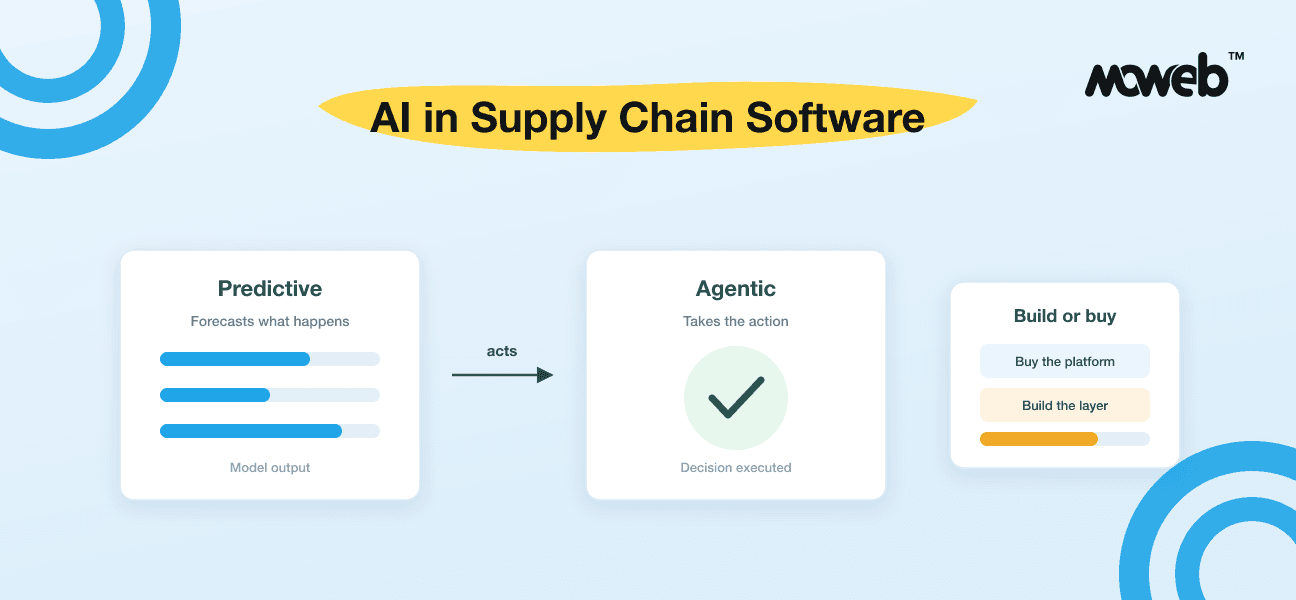
Most of the value above comes from predictive AI: the software tells a human what is likely to happen and what to do about it. The newer frontier is agentic AI, where software agents do not just recommend but execute discrete tasks within guardrails you set. As Gartner's analysts put it, simple agents can automate routine workflows and free people to handle the complex exceptions.
In a supply chain, an agent might reorder a component when stock crosses a dynamically calculated threshold, re-route a delayed shipment, or open and chase a supplier query without a planner touching the keyboard. The important design principle is that agents operate inside boundaries: value limits, approval thresholds, and clear escalation to a human when confidence is low or the stakes are high. For a deeper look at how these systems are structured, see our guide to AI agents and intelligent automation. Done well, agentic automation shrinks the queue of low-value decisions; done carelessly, it turns a small data error into an automated purchasing mistake at scale.
The pitfalls that stall AI supply chain projects
Teams rarely fail because the algorithms are not clever enough. They fail on the conditions around the model.
Data readiness comes first
An AI supply chain runs on data that is complete, timely, and consistent across systems. Gartner explicitly names supply chain data management and network-centricity as things that "need to evolve to enable deployment of AI-driven supply chain at scale." If your item masters conflict, your lead times are guesses, and your ERP and warehouse systems disagree about on-hand stock, no model will save you. A data foundation pass is usually the highest-leverage early work.
Integration with systems of record
AI does not replace your ERP, WMS, or TMS — it sits alongside them and must read from and write to them cleanly. The engineering effort is concentrated in these integrations, not in the model itself. This is the same lesson enterprises learned in manufacturing software modernization, where connecting operational systems was the hard part.
Trust, explainability, and adoption
Planners will not follow a recommendation they cannot understand, and they should not. Systems that show why a forecast moved or why an agent acted earn adoption; black boxes get overridden until they are abandoned. Explainability is an adoption requirement, not a nicety.
Change management and skills
Gartner flags "AI-readiness of the workforce" as a gating factor for a reason. The roles around the supply chain change when software starts making routine calls; planning that transition is part of the project, not an afterthought.
A realistic build roadmap
A production deployment tends to move through four stages, in this order.
Pick one decision that hurts
Choose a single, high-frequency decision where better prediction or faster action has obvious value — say, replenishment for a fast-moving category. A narrow first build is measurable and easier to trust.
Fix the data feeding that decision
Consolidate and clean the specific data the use case needs before modeling. This is unglamorous and decisive.
Predict first, then automate
Stand up the predictive model and let humans act on it. Only once its recommendations are trusted do you let agents execute the routine cases automatically, inside firm guardrails.
Measure, then expand
Track the metric that justified the project — service level, working capital, freight cost — and use the result to extend the pattern to adjacent decisions. Expansion should be earned by evidence, not assumed.
This sequence keeps the risky, high-value work — data and prediction — ahead of the visible work of automation and dashboards.
Build versus buy
Off-the-shelf planning suites now ship AI features, and for standard flows they are a reasonable start. Enterprises hit their limits where the network is unusual, where the AI must integrate deeply with proprietary systems, or where agentic actions need to respect company-specific rules and controls. A custom or hybrid build costs more up front and repays it in fit, control, and the ability to extend into autonomous workflows on your terms. The right answer depends on how distinctive your network is and how much of your advantage lives in how you run it — which is the conversation worth having before signing a platform contract.
Frequently asked questions
What is the difference between predictive and agentic AI in the supply chain?
Predictive AI forecasts what will happen and recommends an action for a human to take. Agentic AI goes a step further and executes routine actions autonomously within guardrails you define, escalating to a person when confidence is low or the stakes are high. Most enterprises should deploy predictive capability first and add agentic automation once the recommendations are trusted.
How much data do we need before starting?
Less than most teams assume, but it must be the right data. A single, well-scoped use case needs clean, consistent history for that specific decision — not a perfect enterprise-wide data lake. Data readiness for the chosen decision is the real prerequisite, which is why scoping narrowly matters.
Will AI replace supply chain planners?
It changes their work rather than removing it. AI absorbs the routine, high-volume decisions and surfaces the exceptions, so planners spend their time on judgment calls, supplier relationships, and the disruptions software cannot resolve alone. Workforce readiness is one of the named factors in whether these deployments succeed.
How long does an AI supply chain project take?
A focused first use case can reach a credible pilot in weeks to a few months, driven far more by the state of your source data and system integrations than by the AI models themselves.
Building it with Moweb
AI rewards supply chain teams who treat it as a data and integration problem first and a model problem second. If you are scoping demand forecasting, network optimization, or agentic automation and want it grounded in your real systems and controls, Moweb's enterprise AI practice and supply chain industry experience help enterprises design and ship these systems. Tell us what you are building and a senior engineer will help you pressure-test the approach before you invest. For an outside view of how autonomous agents are being applied across logistics, IBM's overview of AI agents in the supply chain is a useful primer.