
AI for Field Service Software and Scheduling
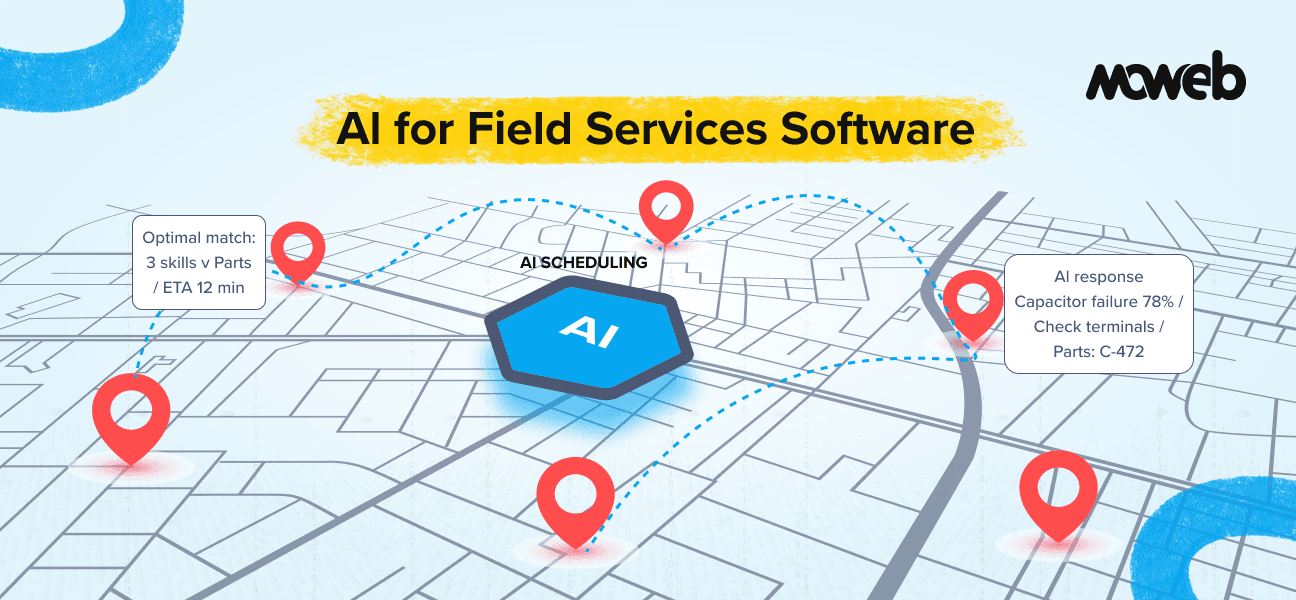
A practical guide to AI in field service management software for 2026. Covers AI-powered scheduling and dispatch, predictive maintenance, job management automation, IoT integration, and implementation roadmap for field service enterprises.
What is AI used for in field service management software?
What is the difference between preventive and predictive maintenance in field service AI? Preventive maintenance follows fixed schedules regardless of equipment condition – quarterly service calls whether needed or not. Predictive maintenance uses IoT sensors and machine learning to monitor equipment condition in real time and schedule maintenance only when sensor data signals a developing problem. Predictive maintenance reduces maintenance costs, cuts unplanned downtime, and eliminates unnecessary scheduled maintenance visits. The shift from preventive to predictive is the highest-leverage operational change in field service management. Stocking levels for the parts those visits consume are set upstream, which is treated in a practical guide to AI in supply chain management.
Field service organisations run on two things: the right technician arriving at the right job at the right time, and equipment staying operational long enough for the emergency call never to happen. Both of these requirements are fundamentally information problems – and AI is better at information problems than any scheduling board, paper job ticket, or reactive maintenance programme has ever been. The shift is from field service as a reactive cost centre to field service as a proactive, data-driven function that prevents problems rather than responding to them – and earns recurring revenue from selling uptime rather than billable hours for break-fix repairs.
This guide covers the four AI capabilities delivering measurable ROI in field service operations, the IoT infrastructure that makes predictive maintenance viable, the job management automation that eliminates the administrative burden consuming technician time, and a phased implementation roadmap for field service organisations at different stages of AI maturity.
The Field Service Management Problem AI Solves
Traditional field service management follows a predictable cycle: a customer reports a problem, a dispatcher manually assigns a technician based on availability and rough location, the technician travels to the site without necessarily having the right parts or documentation, diagnoses the problem, and either fixes it or schedules a return visit with the right parts. The cycle repeats.
The operational inefficiencies in this model are specific and quantifiable:
Scheduling takes too long and optimises too few variables. Manual dispatchers can hold five to ten variables in mind simultaneously: technician availability, rough location, job type, and maybe skill level. AI scheduling systems evaluate hundreds of variables simultaneously: precise GPS location, traffic conditions, technician skill certifications for the specific job type, parts currently in the van, service level agreement priority, customer preference history, and predicted job duration based on similar past jobs. The result is scheduling decisions that are objectively better than any human dispatcher can produce at scale.
Rescheduling is a significant time sink. Booking, cancelling, or rescheduling a service appointment takes an average of 11 to 17 minutes per event when handled manually. Agentic scheduling systems handle inbound and outbound scheduling autonomously, redistribute appointments when technicians call in sick, and conduct proactive outreach for upcoming maintenance windows – all without dispatcher involvement. For organisations managing thousands of appointments per week, the time recovered is substantial.
Administrative burden consumes technician time. Salesforce research found that field workers spend an average of 7+ hours per week on administrative tasks: writing job reports, completing paperwork, and manually entering data from job sites. This is time spent not generating revenue. AI job management automation reduces this burden directly.
Reactive maintenance is expensive. The fundamental problem with fix-it-when-it-breaks maintenance is that equipment failures are unpredictable, emergency dispatch is expensive, customer disruption is significant, and the failure event itself often causes secondary damage that a prevention event would have avoided. The same use case selection principles that apply to finance and operations AI apply to field service. The highest-ROI starting points share the same characteristics: high volume, high repetition, clear baseline metrics, and data already in digital form. Choosing which use case to start with is the first piece of work in AI strategy and consulting.
Capability 1: AI-Powered Scheduling and Intelligent Dispatch
AI scheduling is the field service AI capability with the fastest time to measurable ROI and the broadest applicability across service types. Every field service organisation with more than five technicians has a scheduling optimisation problem that AI solves better than manual dispatch.
The core capability: AI scheduling systems ingest data from multiple sources simultaneously and compute the optimal technician assignment for each job in real time. The variables considered go substantially beyond what a human dispatcher can manage:
Technician factors: specific skill certifications for the job type, current location (GPS), current job status (in progress, travelling, available), remaining hours in shift, performance history on similar job types, customer relationship history (has this technician served this customer before?), and parts currently loaded in the van.
Job factors: job type and complexity, service level agreement tier and response time requirement, customer location and access requirements, required parts and tools, and estimated duration based on historical data for similar jobs at similar assets.
External factors: real-time traffic conditions and route options, weather conditions affecting travel or job execution, and other pending jobs in the same geographic area that could be efficiently combined.
The output is an assignment that minimises total travel time, maximises first-time fix rate (by matching technicians to jobs they have the skills and parts to complete in one visit), and meets SLA requirements across the full job queue simultaneously. AI-powered scheduling has increased first-time fix rates for leading companies (FieldServiceSoftware.io, 2025). CPI Security, using Salesforce’s AI scheduling, reduced ‘where’s my technician’ customer calls after implementing AI appointment window narrowing. AAA Roadside Assistance reduced customer response time by 5 minutes and reduced employee turnover after deploying AI-assisted FSM.
Agentic scheduling for routine appointment management: Beyond assisting human dispatchers, AI agents now handle routine scheduling workflows autonomously: processing inbound appointment requests, sending confirmations and reminders, proactively reaching out to customers whose equipment is due for service, redistributing the day’s schedule when a technician calls in sick, and escalating unusual situations to human dispatchers. This is the shift from AI-assisted scheduling to AI-autonomous scheduling for the routine – freeing human dispatchers for the complex and exception-handling cases where human judgment adds real value. The agentic scheduling systems described here are enterprise AI agents applied to field service workflows. The same architecture and build practices apply here.
Capability 2: Predictive Maintenance and IoT Integration
Predictive maintenance is the capability with the highest long-term ROI in field service AI and the one requiring the most infrastructure investment to implement correctly.
The mechanism is straightforward. IoT sensors attached to equipment continuously monitor operational parameters: temperature, vibration, pressure, electrical current, fluid flow, and usage hours. This sensor data feeds into machine learning models that have been trained on historical failure data for the same equipment type. The models identify patterns in the sensor data that precede failures – often detectable weeks or months before the failure actually occurs. When sensor readings match a pre-failure pattern, a work order is automatically generated, parts are ordered, and the job is scheduled during a planned maintenance window rather than as an emergency response.
The IoT data architecture: Building reliable predictive maintenance requires a data pipeline from sensors through to work order generation. The key components are sensor hardware (industrial IoT sensors calibrated for the specific equipment type and failure modes being monitored), edge processing (local computation that filters and processes sensor data before transmission, reducing bandwidth requirements and enabling offline operation), data ingestion pipeline (cloud-based ingestion, storage, and real-time processing of sensor streams), and ML model serving (the prediction layer that evaluates incoming sensor data against failure pattern models and generates alerts when failure probability exceeds the threshold).
For field service organisations not yet ready for the full IoT infrastructure investment, a practical starting point is service history analysis: mining historical work order data to identify which equipment models, ages, and usage patterns have the highest breakdown frequency, then using that pattern analysis to create data-driven preventive maintenance schedules that improve on fixed-interval scheduling without requiring live sensor data. This delivers of the predictive maintenance benefit at a fraction of the infrastructure cost.
For the data engineering architecture that predictive maintenance depends on, our guide to data engineering for AI: building the foundations covers the pipeline design and data quality requirements in detail.
Capability 3: Job Management Automation
Job management automation addresses the administrative burden that sits between a technician completing a job and the organisation receiving the financial benefit of that job: the paperwork, reporting, data entry, and documentation that consumes 7+ hours of technician time per week.
The specific workflows that AI automates in job management:
Automated work order generation. When a predictive maintenance alert triggers or a customer reports an issue, AI systems create a complete work order automatically: pulling asset history, service level agreement terms, required skill certifications, typical parts for this job type, and estimated duration from the FSM database. The dispatcher receives a pre-populated work order rather than starting from a blank form.
Real-time job status and documentation. During job execution, AI-assisted mobile applications guide technicians through required steps, prompt for photo documentation at key stages, extract asset data (serial numbers, model numbers, readings) directly from photographs, and update the work order status automatically as steps are completed. The technician focuses on the work; the documentation happens in parallel.
Automated reporting and job closeout. After job completion, AI generates the job closeout report from the photos, timestamps, and structured data captured during execution. Salesforce research found that this automation eliminates the ~7 hours per week that field workers spend on administrative tasks. For a team of 50 technicians, 7 hours per week per technician is 350 hours of technician time per week recovered for revenue-generating work.
Parts and inventory management. AI systems analyse job requirements, technician van inventory, and parts usage patterns to optimise what each technician carries and automate parts replenishment orders. The most expensive field service outcome is a technician who arrives at a job site without the right part, requiring a return visit, extending customer downtime, and generating a second dispatch cost. AI parts optimisation directly reduces this outcome.
Automated invoicing and payment. AI-generated job closeout packages include all required evidence for invoicing: completion photos, customer sign-off, parts used, and time on site. This accelerates the invoice-to-payment cycle and reduces disputes because the evidence package is comprehensive.
For the measurement framework that quantifies the ROI of each field service AI capability, see our guide to AI ROI measurement.
Capability 4: Field Technician AI Enablement
The fourth AI capability category addresses a persistent field service challenge: experienced technician knowledge is hard to scale and retain. When a senior technician with 15 years of equipment knowledge retires, that institutional knowledge does not transfer automatically to junior technicians. When a technician encounters an unfamiliar equipment model, they spend time searching for documentation or calling back to base.
AI knowledge assistants for field technicians address this directly. A technician photographs the equipment nameplate and asks, “What is the most common failure mode for this equipment at this age, and what is the diagnostic procedure?” and receives an answer grounded in the organisation’s service history, manufacturer documentation, and known patterns for that specific model and age combination.
This is multimodal AI applied to field operations – the same capability described in our guide to vision AI and multimodal AI for enterprise. The technician’s photograph is the visual input; the equipment history and documentation knowledge base is the retrieved knowledge; the natural language response is the actionable output. Augmented reality combined with AI diagnostics is the next development: technicians point a mobile device at equipment and receive AI-generated diagnostic guidance overlaid on the live camera view. This is already deployed in heavy industrial settings and is expected to reach commercial HVAC, electrical systems, and building management by 2027-2028 (FieldCamp 2026).
The operational impact: reduced time to diagnosis, lower escalation rate to senior technicians for routine consultation, improved first-time fix rate because the technician arrives informed about likely failure modes and recommended procedures, and reduced training time for new technicians who have access to institutional knowledge that previously required years of experience to accumulate.
The FSM Platform Landscape: Build vs Extend vs Custom
Field service AI capability in 2026 is available through three distinct delivery approaches, each appropriate for different organisational contexts.
Major FSM platform extensions (Salesforce Field Service, Microsoft Dynamics 365 Field Service, ServiceMax, IFS Cloud FSM, ServiceTitan): these enterprise platforms have embedded AI scheduling, predictive maintenance connectors, and AI automation capabilities that activate with configuration rather than custom development. For organisations already on these platforms, the right first move is typically activating and configuring the AI capabilities already in the platform before investing in custom development.
The limitation of platform-based AI is that it operates within the constraints of the platform’s data model, integration architecture, and feature roadmap. Organisations with unique scheduling requirements, non-standard asset types, or integration requirements that the platform does not natively support may find platform AI insufficient for their specific needs.
Platform AI with custom extensions: the most common architecture for mid-market and enterprise field service organisations in 2026. The major FSM platform provides the core workflow – scheduling, dispatch, work order management, customer communication – while custom AI extensions address the organisation’s specific requirements: a predictive model trained on the organisation’s own asset failure history, a technician knowledge assistant grounded in the organisation’s specific documentation library, or a custom routing optimisation that accounts for operational constraints the standard platform does not model.
Custom FSM development with AI architecture: appropriate for organisations with highly specialised field operations (specialised industrial inspection, defence or government field services, or operations with unique compliance requirements) where commercial FSM platforms do not adequately address operational needs. Custom FSM development with AI-first architecture provides maximum flexibility but requires significantly higher investment and longer implementation timelines.
Implementation Roadmap for Field Service AI
The phased implementation approach matches AI investment to operational maturity and builds each capability on the data foundation established by the previous one.
Phase 1 (Weeks 1-8): Data foundation and quick wins. The prerequisite for every AI capability in field service is clean, accessible job history data. Phase 1 establishes the data foundation: consolidating job history into a queryable format, cleaning technician skill and certification data, establishing asset inventory with model and age information, and implementing mobile job management to begin capturing structured job data digitally if not already done. A structured AI readiness assessment covering data quality and infrastructure readiness before Phase 1 begins prevents the mid-project data quality surprises that extend timelines. Readiness assessment is part of our AI strategy and consulting work.
Quick wins available immediately without AI investment: service history analysis to identify high-frequency failure patterns and adjust preventive maintenance intervals accordingly, and scheduling rule optimisation to reduce obvious inefficiencies in the current dispatch process. These generate ROI that funds subsequent phases.
Phase 2 (Weeks 8-16): AI scheduling deployment. With clean data in place, Phase 2 deploys AI scheduling. Whether through platform activation (for organisations on Salesforce or Dynamics 365) or custom scheduling AI (for organisations on smaller platforms or custom systems), the core AI scheduling capability – multi-variable optimisation across technician, job, and route factors – is the highest-ROI near-term investment. Establish baseline metrics (jobs per day per technician, first-time fix rate, travel time as a percentage of total time) before deployment and measure against them monthly.
Phase 3 (Months 4-9): Predictive maintenance pilot. Phase 3 introduces IoT-based predictive maintenance on a defined asset class – typically the equipment type with the highest breakdown frequency and highest breakdown cost. Sensor deployment, data pipeline establishment, and initial model training on historical failure data. The pilot scope should be small enough to manage carefully and large enough to generate statistically meaningful results.
Phase 4 (Months 9+): Job automation and technician enablement. With scheduling optimised and predictive maintenance operational, Phase 4 adds the job management automation and technician enablement layers that close the loop on administrative efficiency and knowledge transfer. Each subsequent capability builds on the data and integration infrastructure established in earlier phases.
Frequently Asked Questions About AI in Field Service Software
What is field service management (FSM) software? Field service management software is a platform that manages the full lifecycle of field service operations: customer appointment scheduling, technician dispatch and routing, work order management, parts and inventory tracking, job documentation and reporting, customer communication, and invoicing. AI-enhanced FSM platforms add intelligent scheduling that optimises across many variables simultaneously, predictive maintenance that prevents equipment failures before they occur, and automation that reduces administrative work.
How does AI scheduling differ from traditional dispatch software? Traditional dispatch software presents a dispatcher with a schedule board and technician map and lets the dispatcher make assignment decisions. AI scheduling systems compute the optimal assignment automatically by evaluating technician skills, location, parts inventory, job requirements, SLA priority, traffic conditions, and route efficiency simultaneously.
What IoT sensors are used for predictive maintenance in field service? Common IoT sensor types for field service predictive maintenance include: temperature sensors (detecting overheating, indicating bearing failure or electrical faults), vibration sensors (detecting abnormal vibration patterns preceding mechanical failure), pressure sensors (for hydraulic and pneumatic systems), electrical current sensors (detecting motor anomalies), and usage counters (tracking operational hours against manufacturer maintenance schedules). The appropriate sensor type depends on the equipment being monitored and the failure modes being predicted. Starting with the equipment type responsible for the highest emergency dispatch volume typically generates the fastest payback on sensor investment.
What is a first-time fix rate, and how does AI improve it? First-time fix rate (FTFR) is the percentage of field service jobs completed successfully in a single visit without requiring a return trip. It is one of the most important field service KPIs because each return visit doubles the cost of that job and negatively impacts customer satisfaction. AI improves FTFR by matching the right technician to the job (ensuring skill match), optimising parts loadout on technician vans (ensuring the required parts are available), and providing technicians with diagnostic guidance and equipment history at the point of work (reducing misdiagnosis that leads to wrong-part orders).
How long does it take to implement AI scheduling in field service software? For organisations already on a major FSM platform (Salesforce, Dynamics 365, ServiceMax): AI scheduling activation and configuration typically takes 4-8 weeks, including data cleaning, configuration, testing, and dispatcher training. For organisations requiring custom AI scheduling development: 10-16 weeks from project start to production deployment. The primary timeline driver is data quality – organisations with clean, well-structured technician and job history data consistently achieve faster implementations than those requiring significant data remediation before AI can operate reliably.
What is the ROI of AI field service management software? For a field service organisation with 20 technicians, recovering even 4 hours of administrative time per technician per week at a fully-loaded cost of $60 per hour generates $240,000 in annual value from the job automation capability alone.
Conclusion: Field Service Is Transitioning From Cost Centre to Revenue Driver
The field service organisations that are winning in 2026 are not simply operating more efficiently than their competitors. They are fundamentally repositioning their service function: from a reactive cost centre that fixes things when they break to a proactive service model that sells uptime, prevents failures before customers notice them, and generates recurring revenue from service contracts backed by AI-driven outcome guarantees.
This transition is enabled by exactly the AI capabilities covered in this guide – intelligent scheduling that maximises technician productivity, predictive maintenance that shifts the service model from reactive to proactive, job automation that eliminates administrative burden, and technician enablement that scales institutional knowledge across the workforce. Field service is a competitive market. The organisations that invest in AI-enabled operations in 2026 will have a structural advantage in technician productivity, customer satisfaction, and margin that is difficult for competitors to replicate quickly.
Moweb’s enterprise software development and AI & ML development practices build custom field service management platforms and AI extensions to existing FSM systems – including predictive maintenance architectures, AI scheduling optimisation, IoT data pipelines, and technician knowledge assistant implementations. Talk to us about your field service AI programme.
Found this post insightful? Don’t forget to share it with your network!