
How to Build an AI-Ready Data Strategy
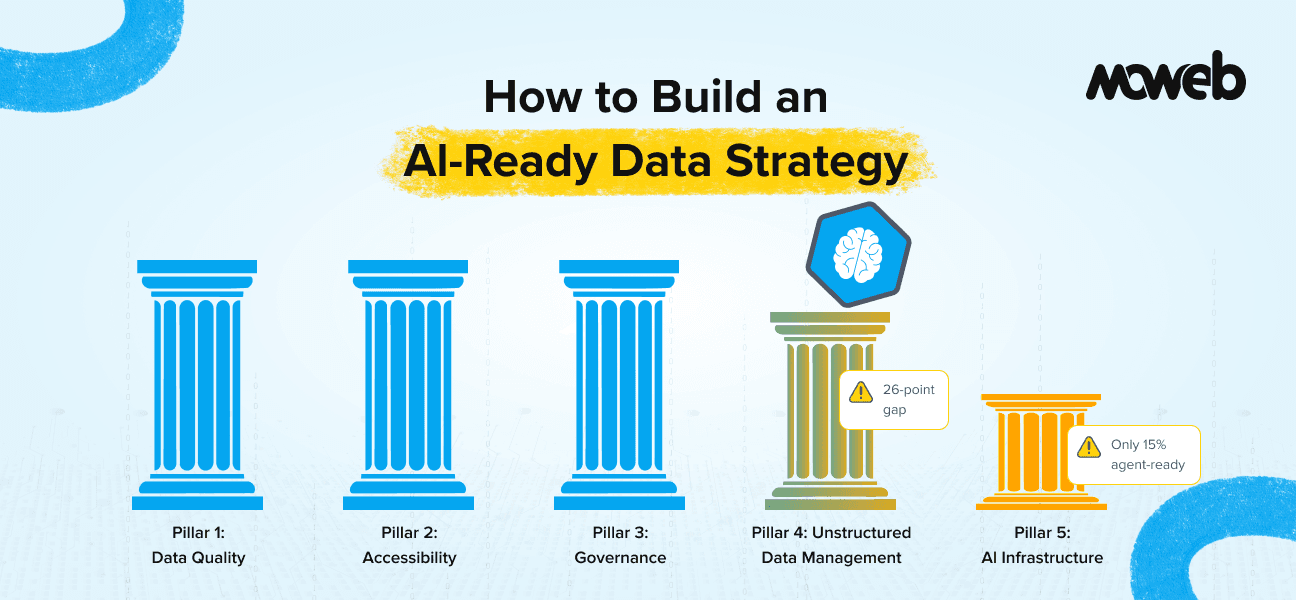
A practical framework for building an AI-ready data strategy in 2026. Covers data quality, governance, accessibility, unstructured data, the five pillars of AI readiness, and how CDOs can close the gap between AI ambition and data reality.
What is an AI-ready data strategy? An AI-ready data strategy is an organisation’s plan for ensuring its data assets can support AI deployments reliably, at scale, and in compliance with applicable governance and regulatory requirements. It covers five dimensions: data quality (accuracy, completeness, consistency, and freshness of data across all sources), data accessibility (the ability to retrieve the right data at the right time through appropriate APIs and access controls), data governance (documented ownership, lineage, and compliance across all data used in AI systems), unstructured data management (the policies and infrastructure for making documents, images, and other non-tabular data available to AI retrieval systems), and AI-specific infrastructure (the feature stores, vector databases, and real-time pipelines that AI applications depend on beyond standard BI infrastructure). The data readiness gap is not a technology problem. It is a strategy, governance, and prioritisation problem that no model upgrade can fix.
The most revealing statistic in enterprise AI in 2026 is not about models, agents, or investment levels.
A second and larger Cloudera survey, The Data Readiness Index, surveying 1,270 global IT leaders, published in April 2026, adds a striking paradox to the picture. Cloudera describes this as the ‘AI readiness illusion,’ the widespread belief that organisations are prepared to scale AI even as critical data challenges remain unresolved. The strategy alignment is there. The data reality is not.
The consequence is visible in productivity data. The productivity that AI is supposed to unlock is currently being consumed by the foundational data work that AI requires – a circular problem that does not resolve itself without a deliberate strategy change.
Two further 2026 data points sharpen the urgency. As AI moves from simple copilot assistance to agentic workflows and as Cloudera’s research notes, production-grade AI agents now routinely orchestrate data from 15 or more systems in a single workflow, the data readiness bar is rising faster than most organisations are building toward it.
This guide provides the framework for making that change: the five pillars of AI data readiness, how to assess where your organisation currently sits, the sequencing that gets you from the current state to an AI-ready data foundation, and the governance design that makes AI data strategy sustainable rather than a one-time clean-up exercise. For the structured assessment framework that identifies specific data readiness gaps before AI deployment begins, see our AI readiness assessment checklist for mid-sized enterprises.
Why AI Data Readiness Is Different From BI Data Readiness
Enterprise organisations that have invested seriously in business intelligence infrastructure frequently discover that their BI-ready data estate is not AI-ready. The requirements differ in ways that are not obvious until an AI programme surfaces them.
AI requires real-time or near-real-time data; BI tolerates nightly batch updates. A fraud detection model cannot use yesterday’s transaction features to detect today’s fraud. A customer service AI that references week-old account data provides inaccurate responses. The freshness requirements of AI systems are materially more demanding than BI dashboards, which typically tolerate 24-hour data latency without operational impact.
AI requires complete context across multiple data sources; BI often works from aggregated summaries. A BI dashboard that shows regional sales performance by month aggregates from multiple sources in a scheduled process. An AI agent answering a customer query about their account status needs real-time access to transaction records, account status, open service tickets, recent communications, and product entitlements – all in the same interaction. Production-grade AI agents now routinely orchestrate data from 15 or more systems in a single workflow (Cloudera Data Readiness Index, April 2026). The cross-source, real-time context assembly requirement of AI systems is significantly more demanding than BI aggregation pipelines.
AI requires structured metadata and data lineage that BI rarely captures. For AI governance and compliance – particularly under the EU AI Act and emerging US state AI legislation – the ability to trace which data was used in which AI output is a legal requirement for regulated AI systems. BI systems typically do not capture this level of lineage because BI dashboards are not legal evidence. AI decisions can be. For the full AI governance framework that data governance for AI sits within, see our guide to AI governance for LLMs and enterprise agents.
AI requires access to unstructured data that BI largely ignores. A BI infrastructure that is strong on structured transactional data and weak on unstructured content access is systematically excluding the AI use cases most likely to generate competitive differentiation.
AI requires governance designed for machine consumers, not human ones. BI governance controls who can see which dashboards. AI governance must control which data an AI system can access during a query, on behalf of which user, for which purpose, at what level of granularity, and log every access for compliance purposes. The governance requirements are structurally different even when the underlying data is the same.
Understanding these differences is the starting point for an AI data strategy. The investment in BI data infrastructure is not wasted – it is the foundation. But it is not sufficient, and treating it as sufficient is one of the most consistent ways AI programmes stall mid-implementation.
The Five Pillars of AI Data Readiness
An AI-ready data strategy addresses five distinct capability dimensions. Each pillar has independent value, but the pillars are also interdependent: weakness in one consistently constrains performance in the others.
Pillar 1: Data Quality and Trustworthiness
Data quality for AI has requirements beyond standard BI data quality. The specific quality dimensions that matter for AI:
Accuracy: data values must correctly represent the real-world entities they describe. Inaccurate training data produces systematically biased or incorrect model outputs. Inaccurate retrieval data produces AI responses that are confidently wrong.
Completeness: missing data is not just a gap in reports – for AI systems, missing fields frequently mean the record cannot be used for training or retrieval, reducing the effective training data volume and skewing the model toward the characteristics of the non-missing population.
Consistency: the same entity described differently across different systems creates a data matching problem that must be resolved before AI can reason across those systems. A customer who is “John Smith” in the CRM and “J. Smith” in the billing system, and “JDS” in the support ticketing system, is three different entities to an AI system that does not have the context to know they are the same person.
Freshness: data that is accurate at the time of capture but has not been updated to reflect current reality is misleading to AI systems in ways that stale BI data is not. A product catalogue with 15% of entries marked as available when they are actually discontinued generates AI shopping assistant recommendations that disappoint customers and erode trust in the AI system.
AI-specific quality dimensions: beyond standard BI quality, AI requires class balance (training datasets must represent the full distribution of real cases, not just the common cases), temporal integrity (training data must not contain information that would not have been available at prediction time), and adversarial robustness (data quality frameworks must address the possibility of corrupted or manipulated input data in AI inference contexts).
Automated data quality monitoring – using tools like Great Expectations, dbt tests, Monte Carlo, or Soda Core – is the operational foundation. Manual data quality management does not scale to the volume and freshness requirements of AI data estates.
Pillar 2: Data Accessibility and Integration
AI systems need data at the moment they need it, from whatever source holds it, in a format they can process. The accessibility pillar is about making this possible without requiring bespoke integration work for every new AI use case.
The key accessibility requirements:
Unified access layer: a single interface (API or query endpoint) that allows AI systems to retrieve data from multiple underlying sources without knowing the specifics of each source system.
Semantic consistency: data from different sources must use consistent definitions for the same concepts. “Revenue,” which means gross revenue in one system and net revenue in another, creates AI reasoning errors that are difficult to diagnose because the inconsistency is in the data semantics, not the data values. A semantic layer or data catalogue that establishes authoritative definitions for key business concepts is the foundation of semantic consistency.
Permission-preserving access: when an AI system retrieves data on behalf of a user, it must retrieve only the data that the user is permitted to see. The access control layer must propagate user permissions through to the data retrieval layer, not rely on application-level filtering after broad data access.
Low-latency retrieval for real-time AI use cases: AI systems operating in real time (customer service, fraud detection, personalisation) need data retrieval in milliseconds, not seconds. The access infrastructure must support low-latency retrieval for time-sensitive use cases alongside higher-latency retrieval for batch and analytical use cases.
The accessibility gap is the most widely reported blocker in 2026. This is an access architecture problem, not a data existence problem. The data exists. The unified, permission-aware access layer does not.
Pillar 3: Data Governance and Lineage
Data governance for AI is more demanding than data governance for BI because AI systems make decisions (or influence decisions) that can be audited, challenged, and regulated. The governance design must support three specific requirements:
Data lineage end-to-end: for every AI output – a prediction, a generated response, a retrieved document – it must be possible to trace the data that produced it. Which sources contributed, which transformations were applied, which version of the data was used, and at what point in time? This lineage chain is the audit trail that regulators, compliance teams, and legal teams need to trust and defend AI-generated outputs.
Consent and legal basis documentation: AI training data must be processed under a documented legal basis. The GDPR, UK GDPR, CCPA, and equivalent frameworks impose specific requirements on AI training data that must be systematically documented and maintained. The documentation requirement is ongoing – if data processing purposes change, the legal basis must be reassessed.
Data retention and deletion: AI training datasets retained beyond their governance-defined retention period create compliance exposure. Data subject deletion requests require the ability to remove data from training datasets – technically complex but legally required in many jurisdictions. The governance gap is the primary explanation for this low figure. The gap between perceived and actual governance coverage is itself a governance risk: organisations that believe they are governed but are not have less incentive to invest in closing the gap. Databricks’ 2026 State of AI Agents research reinforces the stakes: organisations using unified governance tooling were deploying far more AI projects to production than average, confirming that governance is not a compliance overhead but a production enabler.
Pillar 4: Unstructured Data Management
The most significant gap between current enterprise data estates and AI-ready data estates is in unstructured data. The gap exists because unstructured data management requires capabilities that traditional data infrastructure does not provide.
Unstructured data – documents, emails, images, audio transcripts, log files, presentation decks – is where much of an enterprise’s most valuable knowledge lives. It is also where AI knowledge management use cases derive their value: RAG-based knowledge assistants that answer employee questions from policy documents, contract intelligence that extracts terms from lease portfolios, and multimodal AI that analyses images alongside text descriptions.
Making unstructured data AI-ready requires:
Content inventory and ingestion pipeline: knowing what unstructured content exists, where it lives, and establishing automated pipelines that ingest, process, and index new content as it is created. Content that the organisation owns but has not inventoried and indexed is invisible to AI systems.
Chunking and embedding: for retrieval-augmented generation, unstructured content must be chunked into semantically meaningful segments, converted to vector embeddings, and stored in a vector database for semantic retrieval. This is a data engineering process that requires ongoing maintenance as content is updated.
Permission-preserving indexing: the access permissions that apply to a document in SharePoint or Confluence must be preserved in the vector index. A document restricted to the Finance team in SharePoint must also be restricted to Finance users in the vector retrieval system. Access control propagation from source to index is one of the most commonly overlooked requirements in RAG system design.
Freshness management: when a policy document is updated, the old version must be removed from the index and the new version indexed. Stale content in the knowledge base produces incorrect AI responses. Automated update detection and re-indexing are the operational requirements.
For the technical architecture of unstructured data pipelines for AI, our guide to RAG development for enterprise knowledge systems covers the full implementation in detail.
Pillar 5: AI-Specific Infrastructure
The fifth pillar covers the infrastructure components that AI systems require beyond standard data warehousing and BI infrastructure:
Feature stores: for machine learning applications, feature stores centralise the computation and serving of engineered features, ensuring consistency between training and production serving. Without a feature store, the training-serving skew described in our guide to data engineering for AI is a persistent production risk.
Real-time data pipelines: streaming infrastructure (Apache Kafka, AWS Kinesis, Azure Event Hub) for AI applications that require real-time data.
Vector databases: the retrieval infrastructure for semantic search and RAG applications. Production vector database choices (Qdrant, Weaviate, Pinecone, pgvector) require careful capacity planning, indexing strategy design, and ongoing management that differs from relational database administration.
AI observability and monitoring: the infrastructure that tracks AI model performance, data drift, and output quality in production. AI systems degrade when input data distributions shift or when model outputs move outside acceptable quality ranges. Observability infrastructure detects this before it affects users.
The infrastructure gap is particularly acute for agentic AI. Standard BI infrastructure was not designed for this. AI-specific infrastructure is the pillar that converts a data strategy into an agentic AI enablement platform. For the training-serving skew problem specifically, our guide to data engineering for AI covers the feature store design and pipeline architecture in detail.
The AI Data Strategy Assessment: Where Is Your Organisation Now?
Before investing in AI data strategy improvements, a structured assessment identifies the specific gaps that are most constraining current AI performance and most impeding planned AI deployments.
The assessment covers five diagnostic questions, each with observable evidence:
1. Can your AI systems access the data they need, when they need it? Evidence of gaps: AI system queries time out or return incomplete results; AI outputs regularly reference outdated information; different AI systems serving the same user return inconsistent information about the same entity.
2. Is your data quality sufficient for AI systems to rely on it? Evidence of gaps: AI systems frequently produce outputs that human reviewers must correct; training data quality reviews surface systematic errors that affect model performance; users report that AI responses “don’t seem to know” about recent changes.
3. Can you trace what data was used in any AI output? Evidence of gaps: Compliance teams cannot answer basic audit questions about AI data provenance; AI system incidents cannot be diagnosed because the data inputs are not logged; data subject deletion requests cannot be implemented because training data records are not tracked.
4. Is your unstructured data accessible to AI systems? Evidence of gaps: AI knowledge assistants cannot find information that exists in organisational documents; different AI implementations independently build the same document ingestion pipelines; employees report that the AI assistant “doesn’t know” about documented policies or procedures.
5. Do your AI systems have the infrastructure they need – feature stores, real-time pipelines, vector databases? Evidence of gaps: AI systems that require real-time data are making decisions on hours-old information; ML models in production show lower performance than in training (training-serving skew); RAG systems return irrelevant results because the vector index was not designed for the retrieval task.
The Atlan AI Readiness Framework (2026) adds useful maturity benchmarks to these diagnostic questions: typical enterprise timelines are 18–24 months from data readiness Level 1 to Level 3 (governance and access consistently applied), and 6–9 months from Level 2 to Level 3 for organisations with governance foundations already in place. These timelines help set realistic expectations for board-level AI data strategy presentations.
The AI Data Strategy Roadmap: From Gap to Foundation
Based on the assessment findings, the roadmap sequences investments to maximise near-term AI value while building toward the full AI-ready data foundation.
Phase 1 (Months 1-3): Governance and ownership foundation. No data quality programme, data accessibility investment, or unstructured data pipeline will work sustainably without clear data ownership and governance authority. Phase 1 establishes: a data governance council with cross-functional membership and real decision-making authority, documented data domain ownership (who is accountable for the quality and accessibility of customer data, product data, transaction data), and data quality baselines for the domains that the highest-priority AI use cases depend on.
This phase does not require technology investment – it requires organisational decision-making that many organisations have deferred. For the MLOps layer that monitors data quality and model performance in production AI deployments, see our guide to MLOps best practices for regulated industries.
Phase 2 (Months 3-9): Quality and accessibility for priority AI use cases. With governance established, Phase 2 invests in the specific data quality improvements and accessibility infrastructure that the organisation’s highest-priority AI use cases require. Not every data domain needs to be AI-ready simultaneously – the sequencing should match the AI deployment roadmap.
For the highest-priority use case, this means: establishing automated data quality monitoring on the relevant data domains, building or activating the API access layer the AI system needs, and implementing the data freshness pipeline that the use case’s latency requirements demand. For organisations where data sovereignty requirements constrain where data can be processed and which AI infrastructure can access it, see our guide to sovereign AI and on-premises model deployment.
Phase 3 (Months 6-18): Unstructured data and AI infrastructure. With structured data quality and accessibility established for priority use cases, Phase 3 addresses the unstructured data gap and builds the AI-specific infrastructure (feature stores, vector databases, real-time pipelines) that the broader AI programme requires.
The unstructured data work in particular is a sustained investment rather than a one-time project: content inventories require ongoing maintenance, chunking and embedding pipelines require monitoring and refresh cycles, and permission-preserving indexing requires synchronisation with source system access control changes.
Phase 4 (Ongoing): Data product development and democratisation. The mature AI data strategy produces data products – well-governed, well-documented, accessibility-tested data assets that any AI system in the organisation can use without bespoke integration work. The shift from managing raw data to managing data products is the organisational maturity milestone that makes AI deployment consistently faster and cheaper with each subsequent use case. Data products exposed via MCP endpoints, as described by multiple 2026 AI-ready data platform architectures, allow AI agents to discover governed datasets with full metadata, lineage, and access policies across the entire estate. This is the architecture that makes AI data strategy and agentic AI deployments mutually reinforcing rather than independently competing infrastructure investments.
The AI data strategy is the mechanism that closes this gap. A CDO who can demonstrate that the data investments they are making are directly enabling specific AI business outcomes – increased revenue, reduced cost, improved risk management – is functioning as a business strategist. A CDO who is managing data quality KPIs without connecting them to AI system performance and business outcomes is still functioning as a custodian.
The practical implication: every data quality initiative, every governance investment, every infrastructure upgrade in the AI data strategy should have a named AI use case and a projected business outcome that it enables. “Improving customer data quality” is a custodian priority. “Improving customer data quality to enable the AI customer service agent to resolve 60% of interactions without escalation, reducing cost per interaction by $4.20” is a business strategy priority. This expanded scope is both an opportunity and a risk. CDOs who lead AI strategy with a credible data foundation to back it up will consolidate the function’s influence. CDOs who own AI strategy accountability without addressing the data readiness gap will be accountable for the AI programme failures that inadequate data foundations cause. A CDO without sufficient authority, budgetary control, or cross-functional alignment to enforce governance decisions cannot build an AI-ready data foundation, regardless of how good the strategy document is. The AI CoE is the organisational structure within which the CDO’s AI data strategy leadership operates. See our guide on how to build an AI Center of Excellence for the governance and operating model design.
Frequently Asked Questions About AI-Ready Data Strategy
What does “AI-ready data” actually mean? AI-ready data satisfies five conditions: it is accurate and complete enough for AI systems to reason from reliably; it is accessible in real time or near-real time through appropriate APIs; it has documented lineage that enables audit and compliance; it covers unstructured as well as structured content; and it is managed under a governance framework that controls AI system access at the user-permission level. Because the most common AI project failure mode is discovering mid-implementation that the data required for the AI system does not meet the quality, accessibility, or freshness requirements the system needs to perform reliably. This discovery typically happens 8-14 weeks into a project, after significant investment, when the team begins connecting the AI system to real production data. The data problems were present before the project started, but were not surfaced by a structured data readiness assessment.
What is the difference between a data strategy and an AI data strategy? A data strategy addresses how the organisation manages, governs, and makes available its data assets for reporting, analytics, and decision support. An AI data strategy addresses these same dimensions but with the additional requirements that AI systems impose: real-time accessibility, cross-source context assembly, unstructured data management, permission-preserving retrieval, training data governance, and AI-specific infrastructure. Most organisations have elements of both, but have not explicitly designed their data strategy for AI consumption requirements.
How does data governance need to change for AI? AI governance requires data governance to extend in two directions. Upstream: documenting the legal basis and consent framework under which every data source used in AI training was collected and can be processed. Downstream: maintaining lineage from AI training data through to AI outputs, supporting data subject rights requests that affect training datasets, and providing the audit trail that regulators may require for regulated AI decisions. The governance framework must be designed for machine consumers of data (AI systems) as well as human consumers.
What is a data product, and why does it matter for AI strategy? A data product is a well-governed, well-documented, accessibility-tested data asset that any consuming system can use reliably without bespoke integration work. Examples: a unified customer profile that consolidates customer attributes, transaction history, and support interactions from multiple source systems into a single accessible record; a product catalogue with consistent attributes, current availability, and embedded metadata; a contract data product that consolidates extracted contract terms from the document intelligence pipeline. Data products make each subsequent AI use case faster and cheaper to deploy because the data it needs is already packaged for consumption. In 2026, the leading-edge implementation exposes data products via MCP endpoints, allowing AI agents to discover governed datasets with full metadata and lineage across the full estate, converging data product strategy with agentic AI readiness.
How should we prioritise which data domains to make AI-ready first? Prioritise based on two criteria: which AI use cases are highest-priority for the business (the AI deployment roadmap), and which data domains those use cases depend on most critically. The intersection of a high-priority AI use case and a critical data dependency identifies the first data domain to invest in. Within that domain, address the specific quality, accessibility, and governance gaps that the AI use case surfaces. Build from the highest-priority use case outward rather than trying to make the entire data estate AI-ready uniformly.
What is the ‘AI readiness illusion’ and why does it matter? The illusion matters because it changes the nature of the intervention required. Organisations that believe they are data-ready have less urgency to invest in closing the gap. A structured data readiness assessment measuring the five pillars against production AI requirements rather than BI requirements typically surfaces the gap between perceived readiness and the data reality an AI system will actually encounter. They made a strategy sequencing mistake: investing in AI systems before establishing the data foundation that those systems depend on. They established governance before deploying tools. They invested in data quality for specific AI use cases before building those systems. They built the unstructured data pipeline before deploying the knowledge assistant that depends on it.
The compounding benefit of this sequencing is significant. An organisation with an AI-ready data foundation deploys its second AI use case faster than its first, its third faster than its second. Databricks’ 2026 State of AI Agents research confirms this in production: organisations using unified governance tooling are deploying far more AI projects to production than average. Governance is not a compliance overhead in this finding; it is the operational mechanism that converts data investment into production AI throughput. Each deployment builds on the governance framework, the data quality investment, and the infrastructure established by its predecessors.
Data readiness is not a project that can be completed. It is an operational capability that compounds. Building it systematically, starting with the highest-priority use cases and expanding from there, is the strategy decision that distinguishes AI programmes that scale from those that stall.
Moweb’s Data Engineering and Foundations practice designs and builds AI-ready data architectures for enterprise clients – covering data quality frameworks, unified access layers, unstructured data pipelines, governance design, and the AI-specific infrastructure that production AI systems require. Talk to us about your AI data strategy.
Found this post insightful? Don’t forget to share it with your network!