
How to Evaluate Indian AI Development Firms
A structured comparison framework for US and UK enterprises evaluating Indian AI development companies in 2026. Covers cost, quality signals, delivery models, compliance credentials, production track record, and the eight questions every buyer must ask.
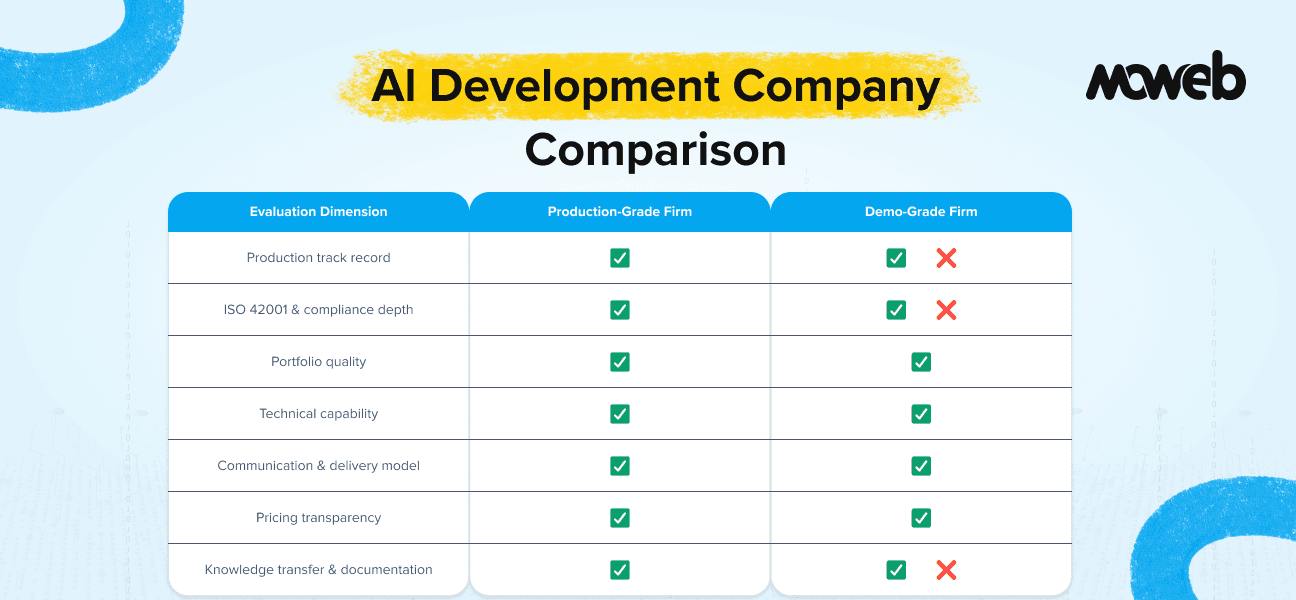
What should US and UK enterprises look for when evaluating Indian AI development companies? When evaluating Indian AI development companies, US and UK enterprises should assess seven dimensions in sequence: production deployment track record (not demo capability or claimed years of experience), compliance and security credentials relevant to their industry (ISO 27001:2022, CMMI Level 3, SOC 2 where applicable), data handling practices and sovereignty commitments, integration depth with enterprise systems (ERP, CRM, legacy infrastructure), communication and time-zone operating model, total cost of ownership across the full engagement lifecycle, and knowledge transfer approach. The most common evaluation mistake is focusing on cost and surface-level portfolio review while underweighting the dimensions that determine whether a system actually reaches production and stays reliable over 12 months.
Is it worth working with an Indian AI development company vs a US-based firm? For most mid-market enterprise AI engagements in 2026, the answer is yes with the right evaluation framework. The quality and process maturity of leading Indian firms (ISO 27001:2022 certified, CMMI Level 3 appraised) is equivalent to US market standards. The critical distinction is between firms with genuine production experience and firms with strong portfolios of demos that never reached production.
A US-based VP of Engineering recently described their AI vendor evaluation process: “We looked at 11 firms. Most had impressive websites, credible case studies, and articulate leadership. Eight of them could not answer our basic question: show us a production AI system you built 12 months ago and tell us what it looks like now.”
That question – not “what can you build?” but “what have you built that is still running?” – is the right question in 2026. It is also the question that most vendor evaluation frameworks fail to ask clearly enough.
The Indian AI development market is the largest source of enterprise AI engineering talent outside the United States. Leading Indian AI firms have ISO 27001:2022 certification, follow CMMI Level 3 appraised processes, and have delivered AI systems for enterprise clients across financial services, healthcare, manufacturing, and retail globally. The top Indian firms are not inferior alternatives to US firms. They are genuine engineering partners that, for the right engagement type, deliver better value than any other sourcing option.
But the Indian AI market also contains a significant number of firms that build impressive demos, present credible portfolios, and cannot navigate the gap between proof-of-concept and production deployment. For US and UK enterprise buyers, the challenge is distinguishing between these two groups with confidence – before signing a contract, not after a disappointing engagement.
This guide provides the evaluation framework: the seven dimensions that differentiate production-grade Indian AI firms from demo-grade vendors, the eight questions that surface the difference, the delivery models available and when each is appropriate, and a realistic cost framework that makes the TCO comparison honest.
Why Indian AI Development Firms Deserve Serious Evaluation
Before the evaluation framework, it is worth addressing the scepticism that some US and UK buyers bring to the Indian AI market, because the scepticism, where it exists, is usually based on outdated information.
The talent depth is real and growing. India’s engineering talent pool for AI is not just large – it is deep in the specific disciplines that enterprise AI requires. Production AI deployment, data engineering, MLOps, RAG system development, and AI agent architecture are areas where leading Indian firms have accumulated genuine production experience across multiple enterprise engagements. The firms at the top of the Indian AI market are not executing US clients’ architectural decisions. They are making them. This means the best talent is scarce and is being absorbed disproportionately by Global Capability Centres (GCCs) of major multinationals, which now account for of AI hiring in India and offer premium compensation. Boutique AI development firms compete for the same talent pool and must have genuine retention and development programmes to maintain delivery quality. This is one of the questions to ask in evaluation: not just ‘do you have AI engineers?’ but ‘what is your senior engineer retention rate and how do you develop and retain AI talent?’
The cost advantage is structural, not a signal of lower quality. The cost saving from Indian AI development versus US-headquartered firms reflects labour cost differentials and operational cost structures, not engineering quality differentials. Senior AI engineers at the largest Indian firms earn INR 58–60 LPA, approximately $70,000–72,000, with boutique firm rates structurally lower. This is not a marginal difference; it is a structural cost arbitrage that reflects cost of living, compensation benchmarks, and operational overhead, not a quality differential. The quality delivered by the best Indian firms is equivalent to the quality delivered by mid-tier US firms at a fraction of the price.
The compliance posture of leading firms matches enterprise requirements. SO 27001:2022 is the international information security management standard. CMMI Level 3 compliance signals audited, standardised delivery processes. SOC 2 Type II is available from a growing number of Indian firms serving US enterprise clients. Ask whether an Indian AI firm holds ISO 42001 or has a roadmap to it this is the differentiator that signals AI-specific governance maturity, not just information security maturity. Data Processing Agreements aligned to GDPR and CCPA are standard practice at serious Indian AI firms serving US and UK clients.
The time-zone challenge is manageable with the right operating model. The India-US time zone gap (9.5 to 12.5 hours, depending on US region) is real but not the operational barrier that uninformed commentary suggests. The firms that have built successful US enterprise client relationships have structured their operating model for it: a daily overlap window in the Indian morning/US evening, a structured communication rhythm that does not require real-time sync for most work, and a US-based point of contact for escalations. The firms that do not have this operating model built in are the ones where the time-zone gap becomes a problem.
For the specific expectations and evaluation criteria that experienced US buyers apply to all AI partners, see our guide to what American buyers expect from an enterprise AI partner.
The Seven Evaluation Dimensions
Dimension 1: Production Deployment Track Record
This is the most important dimension and the one most frequently glossed over in vendor evaluations. A firm’s production track record answers the question that matters most: can they take a system from concept to production, and does it stay running reliably after the engagement ends?
What to look for: Specific deployments described in technical detail – not just “we built an AI customer service system for a financial services client” but “we deployed a RAG-based knowledge assistant with 87% query resolution accuracy on a test set of 500 representative queries, integrated with their Salesforce instance via REST API, with a JWT-authenticated context retrieval layer and usage monitoring that has been running for 14 months since deployment.” What to be sceptical of: Portfolio entries described entirely in capability terms (“we built LLM applications”) without outcome metrics. Case studies that end at go-live without post-deployment performance data. An inability to connect you with a reference who worked with their engineering team day-to-day rather than their account management team.
The question to ask: “Tell me about a production AI deployment you completed more than 12 months ago. What were the evaluation metrics at launch? What are they now? What broke, and how did you fix it?”
Dimension 2: Compliance and Security Credentials
For US and UK enterprise clients, the compliance credentials of an Indian AI development partner are a deployment prerequisite, not a nice-to-have. The specific credentials to look for:
ISO 27001:2022: the current version of the international information security management standard. ISO 27001 certification requires an audited, maintained ISMS with specific controls. Ask for the certification document and the issuing body. Third-party certification from a recognised body (BSI, Bureau Veritas, SGS) is verifiable. Self-certification is not. It covers 38 controls across AI policy, risk assessment, data governance, lifecycle management, and transparency. For regulated industry clients (financial services, healthcare), this credential signals that the firm governs its AI delivery process, not just its information security. Ask whether the firm holds this certification or has a documented roadmap to it with a target date.
CMMI Level 3 compliance: signals that the firm follows standardised, documented delivery processes that have been assessed by a third party. Important note: CMMI Level 3 compliance means the firm follows CMMI Level 3 appraised processes. It does not mean the firm “holds” or is “certified to” CMMI – CMMI is a process model, not a certification. A firm that describes itself as “CMMI Level 3 certified” without qualification may be misrepresenting its credentials.
SOC 2 Type II: for US-facing enterprise clients, SOC 2 Type II verification means the firm’s security controls have been independently validated over an extended period. It is particularly relevant for healthcare and financial services engagements.
HIPAA BAA capability: for healthcare clients, the ability to sign a HIPAA Business Associate Agreement is a legal prerequisite, not a contractual preference. Ask for this in the first evaluation conversation, not after the statement of work is drafted.
Dimension 3: Data Handling and Sovereignty
Enterprise AI development engagements involve sensitive data: client data, proprietary process data, customer records, and financial data. The data handling practices of the development firm are a compliance and competitive risk question.
What to establish before signing:
Processing location – where is your data stored and processed during the engagement? For some US enterprises, ITAR restrictions, HIPAA interpretations, or financial data residency requirements may constrain offshore processing of specific data types. Know the answer before it constrains your architecture.
Training data exclusivity – contractual commitment that no client data will be used to train models that serve other clients. This should be in the contract, not in a verbal assurance.
Access governance – how are individual team members authorised to access client data? Is access logged? Is it limited to the minimum necessary? A firm where all team members have broad access to all client data is a governance risk regardless of certification status.
Data deletion procedures – documented process for deleting client data at engagement end, including from development environments and testing infrastructure.
Require written documentation of access control procedures before contract signature, not as a due diligence exercise after the engagement begins. For organisations where data sovereignty requirements constrain where AI infrastructure can process data, see our guide to sovereign AI and on-premises model deployment.
Dimension 4: Integration Depth and Technical Architecture
The gap between a demo-grade Indian AI firm and a production-grade one is most visible in their integration capability. Production enterprise AI systems connect to CRMs, ERPs, data warehouses, identity management systems, and legacy infrastructure that was not designed for AI integration. Firms that have navigated this complexity successfully will discuss it in technical terms. Firms that have not will respond in generalities.
Questions to ask:
“What legacy system integration challenges have you encountered in enterprise AI deployments, and how did you address them?”
“How do you handle IAM integration – specifically, how does the AI system inherit user-level permissions rather than operating with service account access?”
“What integration patterns do you use for AI agent tool connectivity – do you build custom integrations, use MCP servers, or use an integration platform approach?”
“What monitoring and observability infrastructure do you deploy alongside the AI system?”
Dimension 5: Communication and Operating Model
The time-zone gap between India and the US/UK is the most cited concern in enterprise evaluation of Indian AI firms. It is also one of the most manageable – with the right operating model.
What good looks like: A defined daily overlap window (typically the Indian morning, which covers US evening time for ET/PT) where synchronous communication happens. A structured communication rhythm: daily async status via a project management tool, weekly video calls for planning and issue review, escalation SLA of under 4 hours for critical issues. A US or UK-based point of contact (not just an account manager but someone with the authority to make decisions and access the team directly).
What to watch for: Firms whose only proposed communication channel is email. Firms without a defined US/UK presence (even a single point of contact in the local timezone makes a significant operational difference). Firms that describe their communication model entirely in terms of tools (Slack, Jira) without addressing the timezone operating model explicitly.
The question to ask: “How is your team structured for US client engagements? What does our overlap window look like? Who is our point of contact for urgent issues at 9 PM Eastern, and how quickly can they reach the delivery team?”
Dimension 6: Total Cost of Ownership
The proposal price comparison between Indian and US firms often underestimates the full cost difference and the full cost of either option. A genuine TCO comparison requires: Indian firm TCO components: engagement fee (typically $50–$150 per hour for senior engineers at leading Indian boutique AI firms noting that the best Indian talent increasingly commands premium rates as demand from GCCs intensifies), travel costs for on-site visits where required, time investment in communication overhead relative to a co-located team, potential rework cost if communication gaps produce misaligned deliverables, and the coordination cost of managing a remote team.
US firm TCO components: engagement fee ($150–300 per hour for specialist AI firms, $300–600 for global consultancies with AI engineering specialists at elite firms billing up to $900 per hour (Fortune, 2025)), lower communication overhead, higher senior talent cost, and typically faster escalation paths.
The hybrid model: the highest-performing enterprise AI programmes in 2026 consistently use a hybrid model, a US or UK-based senior architect or programme manager for strategic direction and client relationship, Indian engineering team for execution. This model captures total cost savings while maintaining the onshore oversight that regulated enterprise clients require for key decisions. Hidden costs add an average of to stated vendor pricing when integration, training, change management, and ongoing maintenance are factored in (AI Agent Square, 2026). Budget this overhead explicitly in any vendor comparison. For the specific cost benchmarks for AI consulting engagements, see our guide to enterprise AI consulting services: what to expect from an engagement.
Dimension 7: Knowledge Transfer Approach
The final evaluation dimension is one that enterprise buyers frequently underweight: what happens after the engagement ends? Does your team have the knowledge to operate, maintain, and extend the system, or does ongoing ownership require returning to the vendor?
What good looks like: technical architecture documentation sufficient for a new engineer to understand and modify the system, operational runbooks for the operations team, recorded or live training sessions covering system operation and extension, and a defined post-engagement support arrangement with specific SLAs rather than “we’re always available to help.”
What to watch for: firms whose knowledge transfer plan consists of “we’ll hand over the code.” Code without documentation and training is not knowledge transfer – it is a dependency relationship with a delay.
For the complete knowledge transfer framework within a consulting engagement, see our guide to enterprise AI consulting services: what to expect.
The Eight Reference Questions That Reveal Production Reality
The reference call is the highest-signal evaluation activity available and the one most commonly shortcut. These eight questions extract the information that portfolio reviews and sales conversations do not surface:
Question 1: “What were the quality or accuracy metrics at system launch? What are they now, 12 months later?” – Reveals whether production performance has been maintained or degraded.
Question 2: “What went wrong during the engagement that was not in the original proposal? How did the team respond?” – Reveals communication quality and problem-solving under pressure, not just under favourable conditions.
Question 3: “Is your team able to operate the system independently, or do you still rely on the vendor for routine maintenance?” – The definitive knowledge transfer quality check.
Question 4: “How did they handle the discovery that source data was messier than assumed in the proposal? Was the scope and timeline adjustment reasonable?” – Reveals how the firm manages the most common AI project complication.
Question 5: “Did the delivery team match what was presented in the sales process? Were the engineers you worked with day-to-day the ones you were told you were getting?” – A common complaint with offshore vendors is team substitution after contract signing.
Question 6: “How did communication work across the time zone? Were there periods where the time-zone gap caused meaningful problems? How were they resolved?” – Reveals whether the operating model claim matches the client experience.
Question 7: “Would you use this firm again for your next AI project? If not, why not?” – The most direct indicator of overall satisfaction beyond the sales-managed reference experience.
Question 8: “Can you connect us with someone from your engineering team who worked with their delivery team technically, not just commercially?” – A firm confident in its delivery quality will welcome this. A firm managing its reference narrative will resist it. Also ask: “What would you have required contractually that you did not require the first time?” This question surfaces IP ownership clarity, data deletion timelines, scope change provisions, and post-deployment SLA definitions that experienced buyers discover too late.
Delivery Models: Choosing the Right Engagement Structure
Indian AI development firms offer multiple engagement models, each appropriate for different project types and client risk tolerances.
Fixed-price project: a defined scope delivered for a fixed price, with milestones and acceptance criteria. Appropriate when requirements are stable, well-defined, and unlikely to change during delivery. Transfers scope risk to the vendor but requires the client to invest significantly upfront in defining requirements precisely. Most appropriate for well-understood AI use cases with clear success criteria – a document extraction system, a classification model, or a knowledge assistant with a defined corpus.
Time and materials with a dedicated team: a team of defined engineers allocated to the client’s AI programme, billed hourly or monthly. Appropriate when requirements are evolving, when the AI programme is expected to scale across multiple use cases, or when the client wants to build ongoing capability rather than deliver a single system. Provides more flexibility than fixed-price but requires more client investment in programme direction and quality oversight.
Staff augmentation: individual engineers or specialists added to the client’s existing team. Appropriate when the client has a strong internal AI programme management but needs specific technical skills (a senior RAG architect, a data engineer with MLOps experience) that they cannot source locally. The lowest delivery risk model because the client retains full programme direction, but requires more internal technical capacity than the other models.
Build-operate-transfer (BOT): the vendor builds the AI system and team, operates it for a defined transition period, and then transfers full ownership and operation to the client. Appropriate for clients who want to build an internal AI capability eventually but do not yet have the team or knowledge to do so. Highest cost initially, but avoids perpetual vendor dependency.
For US and UK enterprises engaging Indian AI firms for the first time, the fixed-price model for a first defined project – with clear scope, measurable acceptance criteria, and explicit knowledge transfer deliverables – is the lowest-risk starting engagement. It tests the firm’s delivery quality, communication model, and knowledge transfer approach at a defined cost before committing to a longer-term programme engagement. For the detailed operating model and contract considerations specific to US companies working with offshore AI teams, see our guide to AI consulting engagement models for US companies working with offshore teams.
How Moweb Compares to Other Indian AI Development Firms
We are one of the firms you may be evaluating. We think it is useful to say directly what we offer and what we do not, so you can assess us against the framework in this guide rather than against our marketing materials. ISO 27001:2022 certification (verifiable from our certification body). CMMI Level 3 appraised processes. Active ISO/IEC 42001 implementation roadmap with a target certification date. Production AI deployments across enterprise clients in financial services, healthcare, retail, and field services. Deep capabilities in Generative AI and LLM development, AI agents and intelligent automation, data engineering, and enterprise platform integration.
What we are honest about: We are not the cheapest option in the Indian market. We price for the quality, governance, and delivery discipline that production enterprise AI requires. We are not the right choice if the primary criterion is minimum cost with maximum deliverable scope. We are the right choice if the criterion is a system that reaches production, performs reliably over 12 months, and leaves your team able to maintain and extend it without returning to us for routine operations.
What we would say to you in a reference call: the specific deployments we are most proud of are the ones where clients can describe in technical terms what the system does, why the architecture decisions were made as they were, and what they have modified independently since delivery. Those reference conversations are the ones we are most confident about.
Moweb’s AI & ML development services, Generative AI & LLM development, and AI Agents & Intelligent Automation practices cover the full enterprise AI development capability. Start the evaluation conversation with us.
Frequently Asked Questions About Evaluating Indian AI Development Companies
What is the cost difference between Indian and US AI development firms in 2026? Indian AI development firms typically charge $50–150 per hour for senior engineers at leading boutique firms, compared to $150–300 per hour for US specialist AI firms and $300–600 for global consultancies. AI engineering specialists at elite global firms now bill up to $900 per hour (Fortune, 2025). For context: the median base salary for a US AI/ML engineer reached $195,000 in 2026, with top-tier total compensation exceeding $400,000, making the structural cost difference more extreme than the headline billing rates suggest. This represents a cost saving on comparable technical capability. The hybrid model (Indian execution, onshore strategic oversight) achieves blended cost savings while maintaining governance quality.
How do Indian AI development companies handle US data privacy requirements? Leading Indian AI firms serving US enterprise clients operate under Data Processing Agreements aligned to GDPR and CCPA, can sign HIPAA Business Associate Agreements for healthcare data, and maintain ISO 27001:2022 certified information security management systems that include controls for data processing in offshore contexts. The key requirements to establish contractually before engagement: processing location commitments, no training on client data, minimum necessary access with logging, and documented data deletion procedures at engagement end.
What is the time-zone challenge working with Indian AI firms, and how is it managed? The India-US time gap runs from 9.5 hours (ET) to 12.5 hours (PT). Leading Indian AI firms manage this through: a daily overlap window in the Indian morning covering US evening hours, structured async communication in project management tools for work that does not require real-time sync, weekly video calls for planning and alignment, and a US-based point of contact for escalations. Teams that have built their operating model for this gap report it as a manageable constraint rather than a material problem. Teams that have not reported it as their primary frustration.
What certifications should an Indian AI development firm have for enterprise US clients? At minimum: ISO 27001:2022 for information security management (verify the certification body, not just the claim). Ask whether the firm holds this certification or has a documented roadmap to it with a target date. CMMI Level 3 compliance for process maturity. For healthcare: HIPAA BAA capability. For financial services: demonstrated familiarity with SOC 2, PCI-DSS, and relevant sector-specific requirements. These should be independently verifiable from documentation rather than accepted on self-report.
How do I know if an Indian AI firm has genuine production AI experience versus demo experience? Ask for a specific production deployment they can describe in technical detail: the LLM or retrieval architecture, the evaluation metrics at launch and at 12 months post-deployment, what broke and how it was fixed, and what the system looks like today. Ask to speak with a reference who worked with their engineering team technically, not commercially. A firm with genuine production experience can answer all of these questions specifically. A demo-grade firm will speak in capability terms, share case studies that end at launch, and offer references that are exclusively account-level rather than engineering-level.
Should we choose a fixed-price or time-and-materials engagement with an Indian AI firm? For a first engagement with a new Indian AI firm: fixed-price with clearly defined scope, measurable acceptance criteria, and explicit knowledge transfer deliverables. This tests delivery quality, communication model, and knowledge transfer approach at a defined cost before committing to a longer programme. For ongoing programmes with a firm whose delivery quality has been validated, time-and-materials with a dedicated team provides the flexibility that evolving AI programmes require. The engagement model should match the scope clarity and risk tolerance, not default to whichever the vendor proposes.
What is the AI talent gap in India, and how does it affect vendor quality? In practice, the best Indian AI talent is being absorbed disproportionately by Global Capability Centres of major multinationals, which account for of AI hiring in India and offer premium compensation. This means boutique AI development firms must have genuine talent retention and development programmes to maintain delivery quality. Add to your evaluation checklist: senior engineer retention rate, how the firm develops AI talent internally, and whether the engineers presented in the sales process are the same ones who will deliver the project.
Conclusion: The Evaluation Framework Is the Differentiator
The difference between an Indian AI development firm that delivers transformational value and one that delivers an impressive demo and an expensive stall is not visible on their website, their case study library, or their first two sales meetings.
It is visible in the answers to the eight reference questions, the specificity with which they describe past production deployments, the documentation they provide when asked for compliance credentials, and the honesty with which they describe what went wrong in past engagements and how they addressed it.
The evaluation framework in this guide, the seven dimensions, the eight reference questions, and the delivery model selection criteria are designed to surface that difference before you sign, rather than after you are disappointed. Indian AI development firms at the top of the market are not merely cost-effective alternatives to US firms. The evaluation challenge is identifying them accurately among a market that contains a larger number of firms that look similar from the outside.
Indian AI development firms at the top of the market are among the best enterprise AI delivery partners available globally. The evaluation challenge is identifying them accurately among a market that contains a larger number of firms that look similar from the outside.
Moweb meets every criterion in this evaluation framework. We welcome the reference calls, the technical questions about past deployments, and the compliance documentation requests – because these are exactly the conversations that result in long-term client relationships built on what we actually delivered rather than what we claimed we could. Start the evaluation with us.
Found this post insightful? Don’t forget to share it with your network!