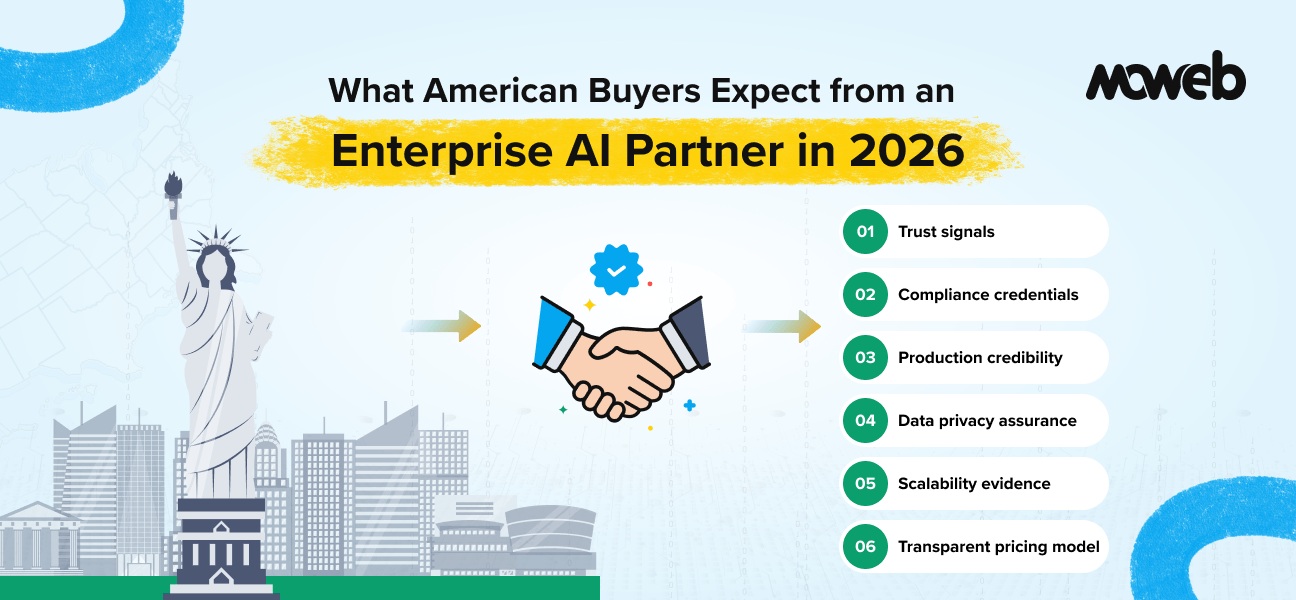
What do American enterprise buyers look for in an AI partner? American enterprise buyers evaluating AI partners in 2026 prioritise five things above all others: demonstrable production experience (not just demos or proofs of concept), honest scoping that acknowledges what will not work rather than only what will, clear data security and compliance credentials relevant to their industry, US market presence or genuine time-zone coverage, and a defined post-deployment support model. The US enterprise buyer has become significantly more sophisticated since 2023 – they have seen failed AI projects, heard vendor overpromising, and are evaluating partners with a level of scepticism that rewards transparency over enthusiasm.
What are the biggest mistakes offshore AI vendors make with US buyers? The most common mistakes offshore AI vendors make with US enterprise buyers are: leading with technology capabilities rather than business outcomes, providing vague scoping that avoids specific quality commitments, underestimating the importance of compliance language and certifications, treating the sales process as separate from the delivery process (so the person who sells is never the person who delivers), and failing to demonstrate understanding of the specific regulatory or operational context of the buyer’s industry.
The enterprise AI vendor demo that closes a deal in 2023 is the same demo that disqualifies a vendor in 2026. The US enterprise buyer has learned to distinguish a curated dataset from a production environment, and they are asking questions most AI vendors cannot answer. Three years of widespread AI project investment with mixed results have produced a buyer cohort that is significantly more experienced, more sceptical, and more precise in what it demands from AI implementation partners. According to Forrester’s The State of Business Buying, 2026, purchases involving generative AI now often double the size of buying groups as enterprises add cross-functional scrutiny and risk mitigation to procurement processes.
The CTO, who was excited about AI pilots in 2023, has now lived through at least one project that did not deliver on its promises. The CFO who approved the first AI budget without hard ROI requirements is now asking pointed questions about measurable outcomes before signing. The compliance team that was not involved in the first AI deployment is now at the table before any new project starts.
This is a healthy evolution. And it means that AI vendors – whether domestic or international – who approach the US market with the same playbook they used three years ago will struggle. The playbook has changed because the buyer has changed.
This guide is written for AI development teams, account managers, and founders who want to understand what US enterprise buyers actually expect from an AI partner in 2026, and how to position credibly for that conversation.
The US Enterprise AI Buyer in 2026: Who They Are and What Has Changed
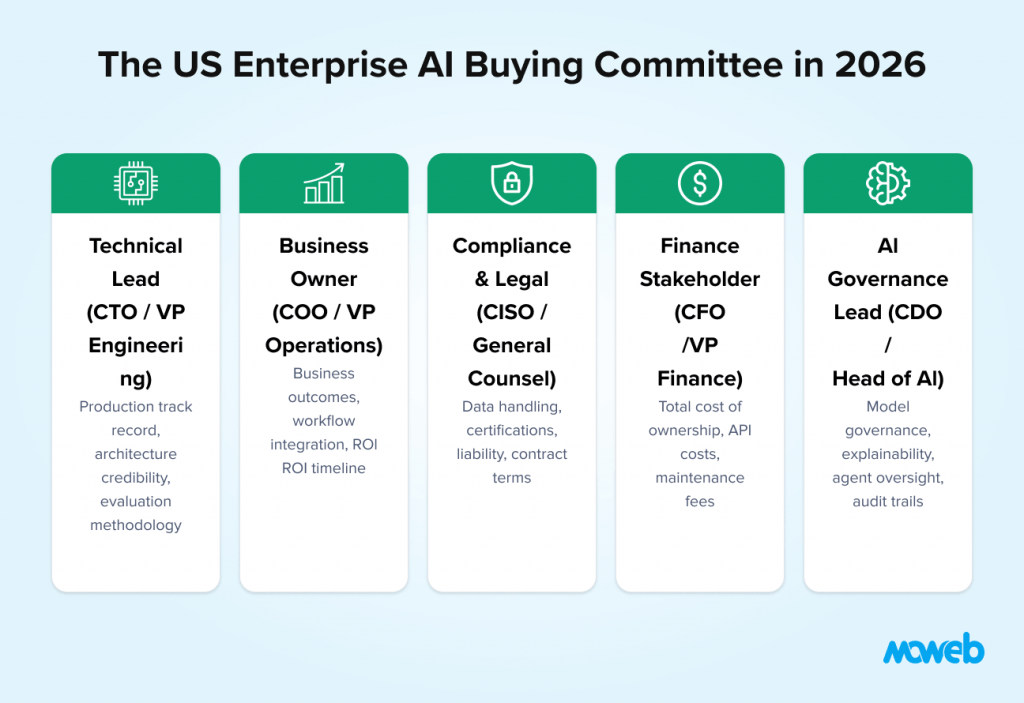
The decision-making structure for enterprise AI purchases in the US mid-market has evolved considerably. Three years ago, AI projects were often championed by a single enthusiastic technical leader and approved by a CEO who trusted their judgment. Today, the buying committee typically includes:
The technical lead (CTO, VP of Engineering, or Head of Data) who assesses architectural credibility, evaluates the vendor’s technical depth, and owns the delivery relationship. This person is asking specific questions about tooling, evaluation methodology, and production track record – not accepting “we use AI” as a capability claim.
The business owner (COO, VP of Operations, or a functional VP whose team will use the system) is primarily concerned with business outcomes, workflow integration, and change management. This person wants to understand what changes for their team, what happens if the system underperforms, and what the ROI model looks like in practical terms.
The compliance and legal stakeholder (General Counsel, CISO, or Chief Compliance Officer) who was often excluded from early AI projects and is now firmly in the process. This person is asking about data handling, vendor certifications, contract terms, liability, and regulatory alignment.
The finance stakeholder wants the total cost of ownership, not just the initial project cost. They are asking about ongoing API costs, maintenance fees, re-indexing costs, and the cost of the engineering overhead that the vendor is not including in their headline number.
The AI governance lead (Chief Data Officer, Head of AI, or AI Program Owner) is an increasingly distinct buying committee role in 2026. This person is asking about model governance, explainability requirements, audit trail capabilities, and, in organisations deploying AI agents, human-in-the-loop controls and agent escalation policies.
Understanding this buying committee is the first requirement for positioning credibly with US enterprise buyers. A proposal that only speaks to the technical lead will not survive the full committee review.
For the broader picture of where US mid-market AI adoption stands in 2026, see our analysis of how US mid-market companies are adopting AI in operations.
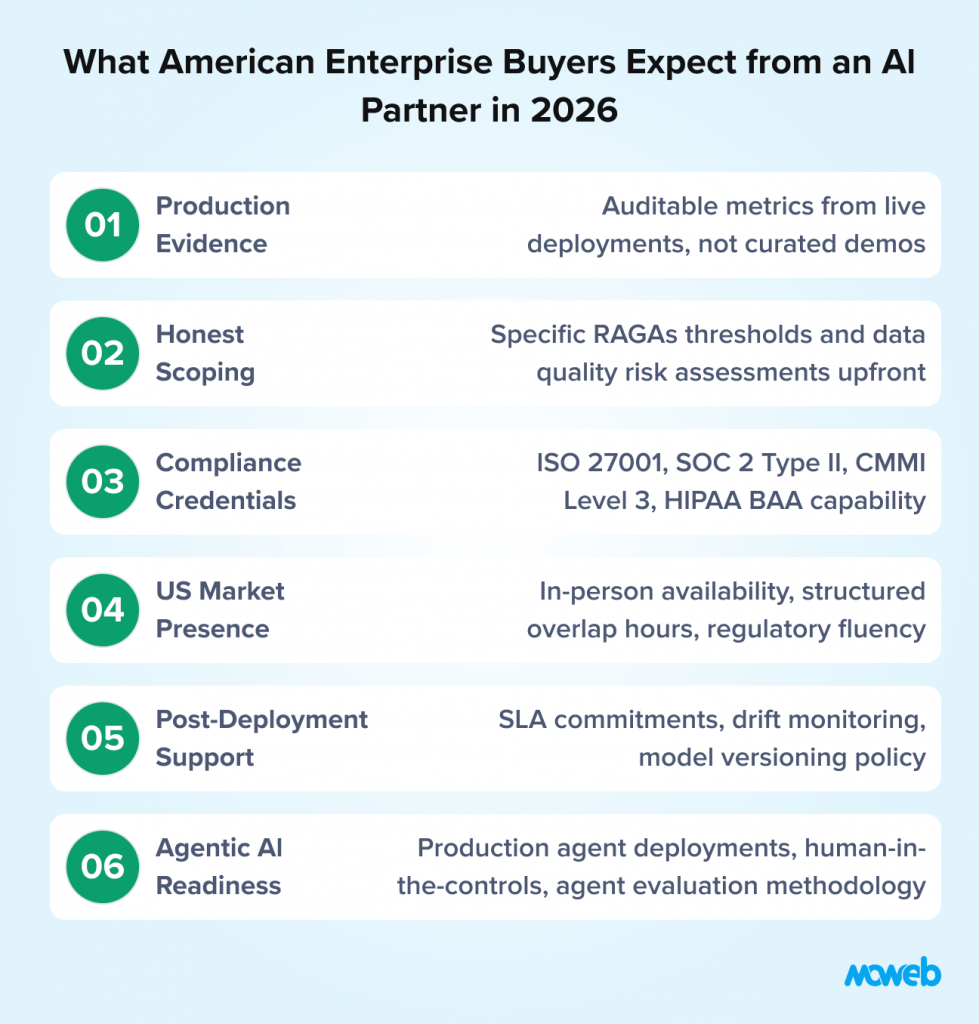
Expectation 1: Production Evidence, Not Demo Performance
The single biggest shift in US enterprise AI buying behaviour between 2023 and 2026 is the weight placed on production track record versus demo quality.
In 2023, a well-executed demo of an AI assistant on a curated dataset could close a sale. That window has closed. US enterprise buyers have now either experienced the gap between demo performance and production performance themselves, or they have heard enough stories from peers to be suspicious of demo-only evidence.
What credible production evidence looks like to a US buyer:
- A case study that names the industry (if not the client), describes the use case with specificity, states the quality metrics at deployment (RAGAS faithfulness and relevancy scores, precision/recall, task completion rates), and describes what the system looks like six months later – not just at launch
- A reference client in a comparable industry and use case who is willing to speak directly, not filtered through a vendor-selected reference process
- A vendor who can describe in technical detail what went wrong on a past project and what they did to fix it, because a vendor who has never encountered a production problem has never operated a system in production.
- For agentic deployments: documentation of agent reliability in production tool-call success rates, escalation frequency, and human-override rates, not just RAG quality metrics.
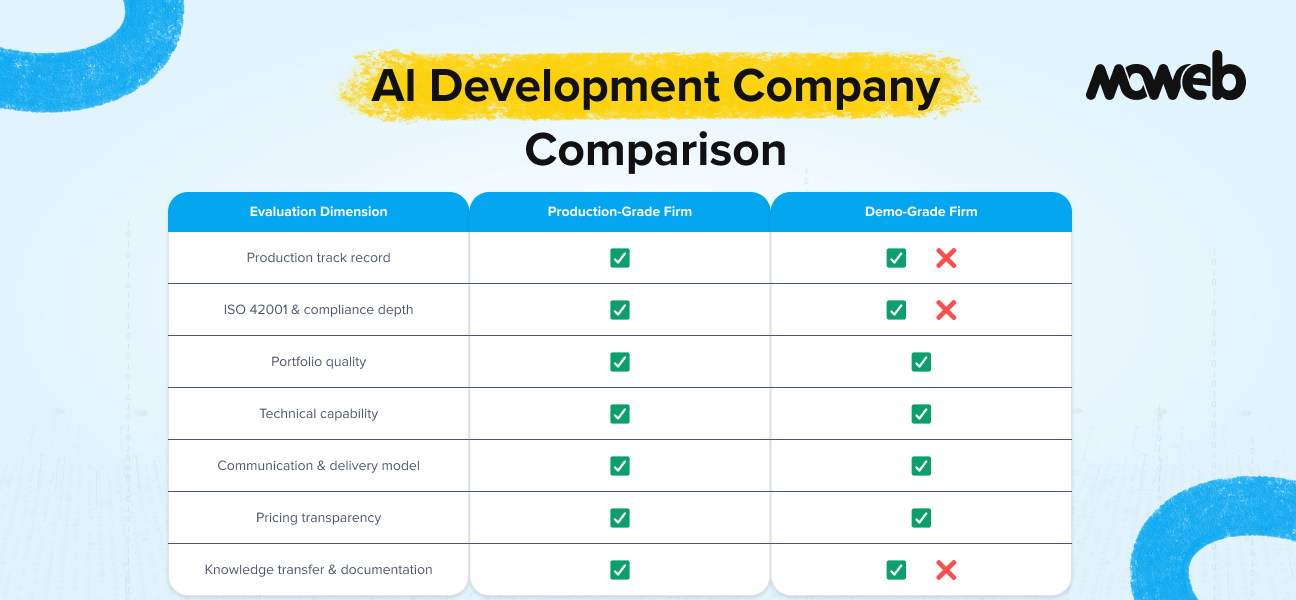
The corresponding failure to avoid: presenting a demo as if it were a production deployment. US technical buyers are asking questions specifically designed to distinguish the two. “What are your p99 latency numbers in production?” “What does your RAGAS faithfulness score look like on a representative query set?” “What happened when retrieval quality degraded six months post-launch?” A vendor who cannot answer these questions is confirming they have not operated systems in production. For the full vendor evaluation framework, including the questions that surface production experience, see our guide to how to choose an AI development company for enterprise projects.
Expectation 2: Honest Scoping with Specific Quality Commitments
US enterprise buyers in 2026 have learned to be suspicious of proposals that promise everything and commit to nothing. The pattern they have seen too often: a vendor scopes an AI project with optimistic language about capabilities, wins the contract, and then manages down expectations during delivery.
What honest scoping looks like to a US buyer:
- A proposal that explicitly states what the system will and will not do, including the edge cases it will handle and the situations where it will route to human review
- Specific quality thresholds defined before development begins: “We commit to a RAGAS faithfulness score of at least 0.85 and an answer relevancy score of at least 0.80 on your top 50 query types, evaluated on a held-out set drawn from your actual data,” rather than “We’ll deliver a high-quality knowledge assistant.”
- An honest assessment of data quality risks – including a statement of what will happen to the timeline and cost if the vendor’s data quality assumptions turn out to be wrong
- A clear definition of what constitutes project success versus project completion. Many AI projects are delivered on time but not successful – the distinction matters to a sophisticated US buyer
This level of scoping specificity requires the vendor to actually understand the buyer’s data environment and use case before proposing, which means investing real discovery time before writing a proposal. US buyers recognise and respect this. A vendor who submits a detailed, precise proposal after thorough discovery signals competence. One who submits a generic proposal within 48 hours of the first conversation signals the opposite.
For a detailed breakdown of what specific quality metrics look like in a well-scoped AI PoC, and what the engagement should cost, see our guide to what an AI proof of concept costs in 2026.
Expectation 3: US-Relevant Compliance and Security Credentials
Compliance and security credentials are table-stakes for US enterprise AI engagements in regulated industries – and the majority of high-value US mid-market AI projects are in regulated industries: financial services, healthcare, insurance, legal services, government contracting.
The certifications that matter to US buyers:
ISO 27001 is the international information security management standard and is widely recognised by US enterprise procurement teams as the baseline vendor security credential. A vendor without it is not automatically disqualified, but having it removes a meaningful objection.
SOC 2 Type II is the US-specific compliance framework that enterprise procurement teams in financial services, SaaS, and healthcare most commonly require. It covers security, availability, processing integrity, confidentiality, and privacy of customer data. Vendors with SOC 2 Type II certification have undergone an independent audit of their security controls – a significantly higher bar than self-reported security claims. Note: SOC 2 Type I is a point-in-time assessment. SOC 2 Type II requires at least six months of audited operating history, a meaningfully higher bar. Ask vendors to specify which type they hold.
CMMI Level 3 (or equivalent process maturity certification) signals that the vendor’s engineering and delivery processes meet an audited standard. US enterprise procurement teams, particularly in defence, government, and large enterprise contexts, are familiar with CMMI as a process quality signal.
HIPAA compliance awareness and contractual HIPAA Business Associate Agreement (BAA) capability are required for any engagement involving US healthcare data. A vendor who cannot sign a BAA cannot handle your healthcare data, full stop.
Multi-state privacy law awareness, including CCPA (California), Virginia’s VCDPA, Texas’s TDPSA, and Colorado’s CPA, is now relevant for any AI system processing personal data of US residents. A vendor deploying customer-facing or employee-facing AI for a US enterprise needs awareness of the applicable state privacy landscape, not just CCPA.
For US enterprises with EU operations or EU customer data, the EU AI Act compliance requirements are increasingly relevant to vendor selection in 2026. The Act’s obligations for high-risk AI systems, including human oversight mechanisms, audit logs, and transparency requirements, are now standard questions in enterprise procurement for vendors operating across jurisdictions.
Beyond certifications, US buyers are increasingly asking about the vendor’s data handling practices during the engagement: where is the client’s data processed, who has access to it, how is it deleted at engagement end, and what are the contractual protections if there is a breach? These are not adversarial questions – they are standard enterprise procurement due diligence in 2026.
Moweb holds ISO 27001:2022 certification and operates CMMI Level 3 compliant processes. Our standard engagement contracts include explicit data handling obligations, access control specifications, and data deletion procedures. For US healthcare clients, we execute BAAs as a standard component of the engagement agreement.
For the full compliance and governance framework a US enterprise AI deployment requires, see our guide to AI governance for LLMs and enterprise agents.
Expectation 4: Genuine US Market Presence and Time-Zone Coverage
The question of whether to work with an offshore AI vendor has become less about geography and more about operational presence. US enterprise buyers in 2026 are comfortable with offshore delivery – but they expect a specific operating model that makes that offshore relationship work in practice.
What “genuine US market presence” means to a US buyer:
A US point of contact who can attend meetings in person. For initial engagement, stakeholder alignment, and high-stakes delivery reviews, US buyers want the option of an in-person conversation. A vendor whose entire team is offshore with no US presence is asking the buyer to manage all relationship friction remotely – which is workable for some buyers and unacceptable for others.
Structured overlap hours for real-time collaboration. The India-to-US East Coast time overlap (approximately 8 am-12 pm IST overlaps with 10:30 pm-2:30 am EST, and the reverse morning overlap of 7:30 am-10:30 am EST with 5 pm-8 pm IST) requires deliberate scheduling. US buyers want to see a defined overlap commitment from the vendor, not a vague promise to “make themselves available.”
US regulatory context fluency. A vendor who understands that “we need HIPAA compliance” is not a simple checklist item, or that “CCPA” has specific implications for how customer data can be processed in an AI pipeline, signals US market familiarity. One who has to look up what CCPA stands for does not.
References from US clients. The most credible signal of genuine US market understanding is existing US clients who can speak to the vendor’s ability to navigate the specific operational and cultural dynamics of US enterprise delivery.
Moweb’s US office is based in Secaucus, New Jersey – a short drive from Midtown Manhattan and the heart of the New York metro business community. Our team works across Eastern, Central, and Pacific time zones. Deep Trivedi, Moweb’s CTO, is based in the US for significant periods and conducts in-person client meetings with US enterprise and mid-market companies throughout the year.
Expectation 5: A Defined Post-Deployment Support Model
One of the most consistent gaps US enterprise buyers identify when reflecting on past AI vendor relationships is the absence of a defined post-deployment support model. The project was delivered, the vendor moved on, and the US company was left with a system it could not maintain, a knowledge base that became stale, and no clear path to address degrading performance.
What a credible post-deployment model looks like to a US buyer:
- A defined SLA for production incidents: what constitutes a P1, what is the response time commitment, and who is the escalation contact?
- A clear monitoring and drift detection commitment: who is responsible for identifying when retrieval quality or model performance degrades below defined thresholds?
- A knowledge transfer deliverable: architecture documentation, operational runbooks, and training sessions for the internal team, delivered before the engagement formally closes
- An explicit statement of what the US company will be able to do independently after the engagement ends, and what will require vendor involvement
- A defined model versioning and re-deployment policy: as foundation model providers deprecate and update models, who is responsible for re-evaluating system performance and managing the migration to updated model versions? This is a standard post-deployment consideration in 2026, not an edge case.
The worst outcome for a US enterprise AI buyer is a delivered system that performs well at launch and then degrades over six months because no one is monitoring it, no one knows how to update it, and the vendor who built it has moved on to the next project. This outcome is common enough that sophisticated US buyers now ask about it explicitly before signing.
Before any engagement starts, a structured AI readiness assessment checklist helps US organisations understand their own data and governance baseline and gives the vendor the information they need to scope credibly.
Expectation 6: Agentic AI Readiness
A new expectation has emerged in 2026 buying conversations that did not exist in the 2023 or 2024 version of this guide: evidence that the AI vendor can build and operate agentic AI systems not just RAG-based assistants and standalone LLM integrations.
Agentic AI refers to AI systems that can reason across multiple steps, use approved tools, retrieve information from external systems, and complete multi-step tasks with defined human oversight checkpoints. According to Gartner, 40% of enterprise applications are expected to feature task-specific AI agents by 2026. US enterprise buyers in sectors from financial services to healthcare are actively evaluating vendors on this capability.
What agentic AI readiness looks like to a US buyer in 2026:
- Evidence of production agentic deployments not demos. Tool-call success rates, escalation frequency, and human-override rates in live environments
- A defined human-in-the-loop framework: how are agent actions reviewed, what are the escalation thresholds, and how are agent failures handled before they affect business workflows?
- Agent evaluation methodology: how does the vendor define and measure reliable agent behaviour before deployment? The evaluation standards for agents are meaningfully different from RAG quality metrics
- Contract clarity on agentic AI liability: as AI agents take autonomous actions, US buyers are increasingly asking about liability provisions for agent-caused errors or data exposure
A vendor who cannot speak to agentic AI in a 2026 enterprise conversation is signalling that their experience is at least one capability generation behind the current market.
What US Buyers Are NOT Looking For
It is worth being equally specific about what experienced US enterprise AI buyers are not impressed by in 2026, because these are the patterns that erode credibility in the vendor selection process:
Before that: the transition from “what buyers want” to “what erodes credibility” deserves a bridge: understanding what US enterprise buyers require is only half the picture. Equally important is recognising the patterns that sophisticated buyers are specifically screening for.
Impressive company size claims without production specifics. “We have delivered 900+ projects” is meaningless without context. Which of those projects were AI systems in production? In which industries? With what quality metrics?
Technology name-dropping without application context. “We use GPT-4o, LangChain, Pinecone, and RAGAS” is a list of tools. A US technical buyer wants to know how those tools were applied to a specific problem, what trade-offs were made in the architecture decisions, and what the evaluation results looked like.
Case studies that describe what was built rather than what it delivered. “We built a RAG-based knowledge assistant” is not a case study. “We built a RAG-based knowledge assistant that reduced first-contact resolution time by 34% across the client’s top 40 support query types, measured over the first 90 days of production” is a case study.
Proposals that arrive before discovery is complete. A vendor who submits a detailed proposal before conducting a meaningful data quality assessment, a use case definition conversation, and a technology environment review is proposing based on assumptions. US buyers who have been burned by this pattern are increasingly asking vendors to conduct discovery before proposing – and treating the quality of that discovery process as a signal of delivery quality.
Frequently Asked Questions About Working with Enterprise AI Partners as a US Buyer
What certifications should a US enterprise require from an AI development partner? At minimum: ISO 27001 for information security management and either SOC 2 Type II or CMMI Level 3 for process and quality assurance. For healthcare clients, the ability to sign a HIPAA Business Associate Agreement is non-negotiable. For financial services clients, demonstrated awareness of SOC 2, CCPA, and relevant sector-specific requirements (NYDFS, SEC, FINRA) is expected. These should be independently verifiable, not self-reported.For US enterprises in government contracting or federally adjacent work, alignment with the NIST AI Risk Management Framework (AI RMF 1.0) is an increasingly standard expectation alongside ISO 27001 and SOC 2.
How should US companies evaluate offshore AI vendors for production credibility? Ask for a specific production deployment they can walk through in technical detail: the LLM and vector database used, the chunking strategy and why it was chosen, the evaluation methodology and specific quality scores at deployment, and what the system looks like six months later. Ask for a direct reference call with a US client in a comparable industry. Ask what went wrong on a past project and how they addressed it. A vendor with genuine production experience will answer all three confidently and specifically.
What should be in an AI vendor contract for a US enterprise engagement? The contract must explicitly cover: IP ownership of all deliverables assigned to the US company, data handling and processing obligations (where data is stored, who has access, how it is deleted), SLA commitments for post-launch support, knowledge transfer deliverables before engagement close, and liability provisions for AI-generated outputs that cause harm. These terms are not standard in all vendor contracts and should be explicitly negotiated, not assumed.
How do US enterprise buyers think about offshore AI delivery in 2026? The offshore AI delivery question has shifted from “can offshore teams do this?” to “does this vendor have the specific operating model that makes offshore delivery work?” US enterprise buyers in 2026 are comfortable with offshore engineering – but they expect structured overlap hours, a US point of contact, US regulatory context fluency, and a communication discipline that keeps the relationship functioning across time zones. For a practical guide to engagement models, see our guide to AI consulting engagement models for US companies working with offshore teams.
What is the typical timeline for an enterprise AI project with a US partner? A focused proof of concept: 4 to 8 weeks. A production-ready first deployment with proper data engineering, access controls, audit trails, and monitoring: 12 to 20 weeks. The timelines vary by data quality, integration complexity, and the organisation’s internal decision-making speed. For a detailed breakdown of what drives AI PoC timelines and costs, see our guide to what an AI proof of concept costs in 2026.
How do US buyers evaluate AI partner proposals? The strongest proposals include: a precise use case definition developed from a real discovery conversation, specific quality commitments with defined measurement methodology, an honest data quality risk assessment, a named delivery team with verifiable backgrounds, clear IP and data handling terms, and a defined post-deployment support model. Proposals that are generic, vague on quality commitments, or submitted without discovery are increasingly treated as red flags by experienced US enterprise buyers.
What should US enterprise buyers ask AI vendors about agentic AI in 2026? As AI agents move from experimental to operational in 2026, buyers should ask: Does the vendor have production deployments of multi-step agents (not just RAG assistants)? What human-in-the-loop controls do they implement, and what are the escalation thresholds? How are tool-call failures and agent errors handled in production? And critically: what does their agent evaluation methodology look like how do they define and measure reliable agent behaviour before deployment? A vendor who cannot answer these questions specifically has not operated agents in production.
Conclusion: The US Market Rewards Transparency Over Enthusiasm
The US enterprise AI buyer in 2026 has seen enough of the AI hype cycle to have calibrated expectations. They are not looking for the most enthusiastic vendor. They are looking for the most credible one – the vendor who can demonstrate production experience honestly, scope precisely without overpromising, operate compliantly within US regulatory requirements, and be genuinely useful to the buyer’s team rather than impressive in a sales conversation.
This is a higher bar than it was in 2023. It is also a fair bar. The US market is large, the budgets are real, and the organisations investing in enterprise AI are serious about getting value from it. The vendors who will build lasting US client relationships are the ones who meet buyers where their expectations actually are, not where the vendor wishes they were.
Learn more about Moweb’s AI Strategy & Consulting and Generative AI & LLM development capabilities.Moweb is visiting the US market in May and June 2026. Deep Trivedi, our CTO, is available for in-person meetings with enterprise and mid-market companies across the East Coast and beyond. If you are a US organisation evaluating AI partners and want a direct conversation grounded in production experience, genuine credentials, and honest scoping, schedule a meeting with our team.
Found this post insightful? Don’t forget to share it with your network!




 India
India USA
USA