
HIPAA-Compliant Healthcare Software Development
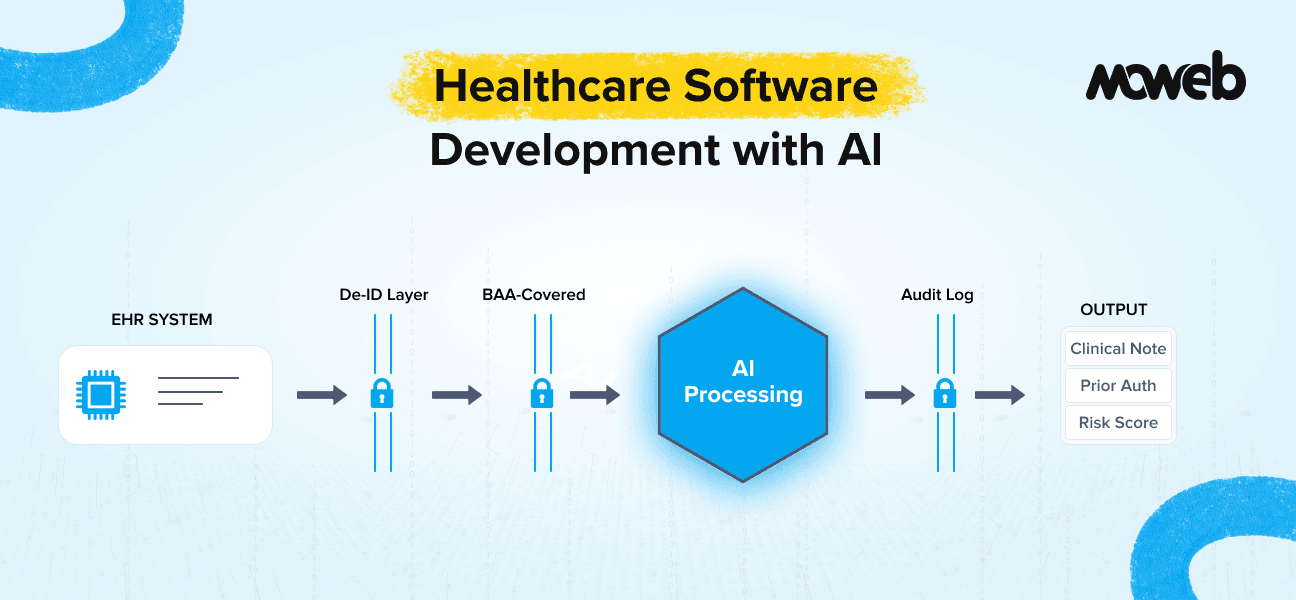
A practical guide to AI-enabled healthcare software development in 2026. Covers HIPAA-compliant AI architecture, EHR integration, clinical decision support, the four most common compliance failure points, FDA guidance, and a phased development roadmap.
What does HIPAA-compliant AI development in healthcare require? HIPAA-compliant AI development in healthcare requires compliance to be designed into the system architecture from the initial technical specification – not added as a post-development checklist. The four foundational requirements are: a signed Business Associate Agreement (BAA) with every vendor whose infrastructure processes Protected Health Information (PHI), de-identification of patient data before use in AI model training, secure PHI handling in LLM API integrations (accessing models through HIPAA-covered managed services like Azure OpenAI or AWS Bedrock rather than direct consumer APIs), and comprehensive audit logging of every system interaction involving PHI. Healthcare data breaches cost an average of $9.77 million per incident – the highest of any industry for the 14th consecutive year.
What AI applications are most valuable in clinical healthcare software in 2026? The five highest-value AI applications in clinical healthcare software are: clinical documentation assistance (AI ambient scribing and automated note generation, reducing documentation time by 1-2 hours per provider per day), patient flow and operational management (AI scheduling, bed management, and resource allocation), clinical decision support (AI-assisted diagnosis, treatment recommendations, and risk stratification), prior authorisation automation (AI cross-referencing coverage requirements, clinical guidelines, and patient records to accelerate approvals), and administrative workflow automation (billing, coding, prior auth, and patient communication).
A healthcare system deployed an AI diagnostic tool from a vendor with HIPAA-compliant cloud infrastructure, a state-of-the-art model, and clinically promising results. The compliance violation that cost nearly $5 million and triggered an 18-month corrective action plan was not the model, not the infrastructure, and not the data. It was the absence of a signed Business Associate Agreement.
This scenario – documented in HIPAA enforcement actions throughout 2025 and 2026 – captures the defining challenge of AI development in healthcare: the technology is capable, the use cases are compelling, and the regulatory compliance requirements are unforgiving. A single missing document can convert a clinically successful AI deployment into a regulatory catastrophe. The capability and the commercial imperative are clear. The global average across all industries sits at $4.88 million, making healthcare breaches more than twice as costly as the cross-industry norm.
What is less clear to many healthcare organisations and their development partners is how to build AI systems that deliver this clinical value within the regulatory framework that governs every aspect of how patient data is handled, processed, and stored. This guide covers the compliance architecture that every healthcare AI system requires, the four failure points that account for the majority of HIPAA violations in AI projects, the specific AI applications with the strongest clinical and operational evidence, and the development roadmap that sequences AI investment for healthcare organisations at different stages of readiness.
The HIPAA-AI Architecture Imperative
The most important principle in healthcare AI development is one that is consistently violated by teams without specific healthcare regulatory experience: HIPAA compliance is an architectural requirement, not a deployment checklist.
The distinction matters enormously. A development team that builds an AI system and then attempts to make it HIPAA-compliant before launch is performing compliance remediation.
The architectural requirements fall into five layers.
Layer 1: BAA coverage for every PHI-touching vendor. A Business Associate Agreement is the legal contract under which a vendor commits to protecting PHI in accordance with HIPAA requirements. HIPAA requires a BAA with every Business Associate – any entity that creates, receives, maintains, or transmits PHI on behalf of a covered entity. In an AI system architecture, BAA requirements extend to: cloud infrastructure providers (AWS, Azure, GCP – all offer BAAs; the BAA must be signed, not just available), LLM API providers (OpenAI, Anthropic, Google all offer enterprise BAAs for managed service deployments), database providers, monitoring and logging services, and any analytics or observability platforms that process data from clinical systems.
The specific implication for LLM integrations: you can use GPT-5, Claude, or Gemini in HIPAA-compliant healthcare applications, but you must access them through the cloud provider’s managed service – Azure OpenAI, AWS Bedrock, Google Vertex AI – with an active BAA, not through the direct consumer API. Direct API calls to OpenAI, Anthropic, or Google consumer endpoints without a BAA are a HIPAA violation with every call that involves PHI. A critical nuance for 2026: sending what appears to be de-identified data still constitutes a HIPAA violation if the combination of data elements could identify a patient. Sending ’58-year-old female, diabetes, prescribed metformin, ZIP 90210′ to a non-BAA provider is a violation even without a name (Glacis 2026). For healthcare organisations where PHI data residency requirements or air-gapped security posture make cloud LLM processing unacceptable, the self-hosted architecture alternative sits under AI security and governance.
Layer 2: PHI de-identification before AI training. Machine learning models can memorise training data. This phenomenon – training data memorisation – means that a model fine-tuned on real patient records can reproduce patient-specific information when prompted appropriately, a technique researchers call model inversion. Building AI models on raw, un-de-identified patient data extracted from EHR systems creates legal liability that persists in the deployed model even after the training data is deleted.
HIPAA’s Safe Harbor de-identification standard requires removal of 18 specific identifiers before patient data can be used for training purposes without HIPAA restriction. Expert Determination de-identification (statistical certification by a qualified expert that the data has very small risk of re-identification) is the alternative standard. Either approach must be applied to training data, and the de-identification process and its validation must be documented. Production stacks in 2026 typically use gateway-level PII redaction tools Microsoft Presidio, Skyflow, or Nightfall AI for automated Safe Harbor pre-processing before data leaves the EHR boundary (SWFTE 2026). These tools are BAA-coverable and integrate into the data pipeline rather than requiring manual de-identification.
Layer 3: Access control with minimum necessary standard. HIPAA’s minimum necessary rule requires that access to PHI is limited to the minimum amount needed for each specific use. In AI system architecture, this means granular role-based access control that enforces minimum necessary at the system level, not just the application level. A scheduling AI agent should have access to appointment data and calendar availability, not to clinical diagnosis records. The access scope for each AI component must be defined, implemented as tool-level permission constraints, and documented.
Layer 4: Comprehensive audit logging. The HIPAA Security Rule requires mechanisms to record and examine activity in systems that contain or use ePHI. For AI systems, audit logging must capture: every query or interaction involving PHI, the identity of the user or system making the request, the data accessed or modified, the timestamp, and the outcome. These logs must be immutable (not modifiable after creation), retained for the HIPAA-required minimum period (typically 6 years for covered entities), and accessible for OCR (Office for Civil Rights) audit review.
A specific 2026 compliance challenge: many AI systems, particularly deep learning models used in diagnostics and clinical decision support, operate as black boxes where the internal decision-making process is opaque even to developers. This creates a fundamental tension with HIPAA’s auditability requirements: Privacy Officers cannot validate how PHI is being used inside a model they cannot interpret. When OCR investigators examine an organisation’s AI systems, they will look for documentation of data flows, access controls, and processing logic. Deploying AI that cannot produce this documentation does not reduce liability it increases it (ITECS 2026).
Layer 5: Vector database PHI management. A specific architectural challenge that has emerged with RAG-based healthcare AI: when patient data is embedded in vector databases for semantic retrieval, PHI is encoded as numerical representations. Standard vector databases do not support targeted deletion of individual records. When a patient requests deletion of their data (under HIPAA or GDPR Article 17 where applicable), the organisation must identify and act on every record, including those embedded in vector indices. The solution requires complete provenance mapping from source records to vector embeddings, so that deletion requests can be fully executed across the complete data estate.
A critical 2026 clarification: embeddings generated from PHI are themselves PHI under HIPAA. They must be encrypted, access-controlled, and retained per HIPAA requirements even though they are numerical vectors rather than text. Most vector databases do not provide BAAs. Healthcare AI teams must verify BAA availability before storing PHI embeddings in any vector database, not just before storing raw patient records (TechAhead 2026).
The Four HIPAA Failure Points in Healthcare AI Projects
Analysis of OCR enforcement actions and industry compliance audits identifies four specific failure points that account for the majority of HIPAA violations in healthcare AI projects. Each is avoidable with the right architectural approach. For the broader framework within which healthcare AI compliance sits, see AI security and governance.
Failure Point 1: Training on raw EHR data without de-identification. The most common and costly compliance failure. Development teams extract patient records from EHR systems for model training without applying HIPAA-compliant de-identification. The risk compounds: the trained model may retain patient-identifiable information in its weights, creating ongoing liability that persists through deployment. The fix is straightforward – apply de-identification before any data leaves the EHR system boundary – but requires discipline in the development process to maintain.
Failure Point 2: Direct LLM API calls without BAA coverage. Development teams integrating LLM capabilities into clinical workflows frequently use direct API calls to foundation model providers without verifying BAA coverage. The direct consumer APIs of major LLM providers (OpenAI, Anthropic, Google) are not covered by BAAs and cannot legally receive PHI. The fix: route all PHI-processing LLM calls through managed cloud services (Azure OpenAI, AWS Bedrock, Google Vertex AI) with active BAAs, and implement PHI de-identification or tokenisation before any data leaves the hospital network boundary.
Failure Point 3: Missing or unsigned BAAs at any point in the vendor chain. BAA management in complex AI system architectures requires systematic vendor inventory. A multi-vendor AI stack – cloud provider, LLM service, vector database, monitoring platform, analytics service – can have BAA gaps at any node. A signed BAA with AWS does not cover AWS Lambda functions that call a third-party API that also processes PHI. The fix: a complete vendor dependency map for every data flow involving PHI, with BAA status confirmed and documented for each node.
Failure Point 4: Insufficient audit logging depth. Audit logs that record application-level events but not AI system-level actions miss the PHI access that regulators and incident investigators need. An AI agent that queries a patient’s medication history as part of a recommendation workflow must log that query – not just the final recommendation visible in the application interface. The fix: instrumented logging at the AI component level, not just the application interface level, with PHI-specific event capture that exceeds standard application logging requirements.
2026 HIPAA financial penalties note: penalties are now tiered from $137 to $68,928 per violation per year (2026 HITECH Act indexed amounts), capped at $2,067,813 per identical-violation annual maximum. OCR collected $8.33 million in HIPAA fines in 2025, indicating active enforcement, not theoretical risk (SWFTE 2026, Groovyweb 2026).
FDA Guidance Update: Clinical Decision Support Software (January 2026)
On January 6, 2026, the FDA published updated clinical decision support software guidance that directly affects how healthcare AI systems are architected. Healthcare development teams must understand these updates, as the architecture decisions they require must be made during system design, not after deployment.
The 2026 guidance clarifies that AI systems analysing medical images to generate diagnostic recommendations remain subject to FDA oversight as Software as a Medical Device (SaMD). The key distinction the guidance establishes is between clinical decision support software that:
Falls outside FDA device jurisdiction (and therefore does not require FDA clearance or approval): CDS software that displays, analyses, or prints medical information, or that helps a healthcare professional acquire, process, or analyse patient medical records – provided the software is not intended to replace clinical judgment and a healthcare professional can independently review the recommendations using their own expertise.
Falls within FDA device jurisdiction (and requires 510(k) clearance, De Novo classification, or PMA): AI software that analyses medical images to generate diagnoses or diagnostic recommendations, or whose recommendations are not transparent enough for a clinician to independently verify using their clinical expertise.
The practical architectural implication: clinical AI systems designed to support clinical judgment (explainable recommendations with accessible reasoning) can be structured to fall outside FDA device jurisdiction. Clinical AI systems designed to replace clinical judgment or that analyse imaging data for diagnostic purposes must navigate the FDA SaMD pathway.
For healthcare software development teams, this means the explainability architecture of the AI system is not a UX nice-to-have – it is a regulatory determinant. A clinical AI that surfaces a recommendation without accessible reasoning is more likely to be classified as a medical device than one that surfaces the same recommendation with documented reasoning that a clinician can verify independently. The FDA also finalised its Predetermined Change Control Plan (PCCP) guidance in December 2024, which allows AI SaMD developers to pre-specify the types of changes (algorithm updates, training data expansions) that can be made post-approval without requiring a new 510(k) submission. This is a significant practical relief for healthcare AI teams building systems that improve over time. The PCCP must be submitted with the initial 510(k) application. The FDA’s Digital Health Center of Excellence provides a Software Determination tool to assess a specific application’s regulatory pathway before committing to an architecture.
The Five Highest-Value AI Applications in Clinical Healthcare Software
Application 1: Clinical Documentation Assistance
Clinical documentation is the highest-adoption and highest-ROI AI application in healthcare in 2026, driven by a well-documented crisis: clinicians are spending more time documenting than caring for patients.
AI ambient scribing systems capture clinical conversations during patient encounters, generate structured clinical notes, and integrate those notes directly into the EHR. The physician reviews and approves the note rather than writing it. Leading ambient scribing products in 2026: Abridge, Nuance DAX Express (Microsoft), Suki AI, DeepScribe, and Augmedix are all reference implementations of the HIPAA-compliant ambient scribing architecture. Clinician edit rate (how often the AI-generated note requires modification) is the key quality metric for evaluating these systems; mature deployments target sub-15% edit rates (SWFTE 2026).
The architecture for compliant ambient scribing: audio capture on an on-device or edge-processed basis (PHI never leaves the facility network as raw audio), de-identification before any cloud processing, and note generation through a BAA-covered managed LLM service. The generated note is surfaced in the physician’s EHR workflow for review and approval before finalisation. For the full operational AI landscape in healthcare covering patient workflow, document intelligence, and clinical decision support beyond documentation, see our guide to AI in healthcare operations.
Application 2: Prior Authorisation Automation
Prior authorisation processing is one of the most significant administrative burdens in US healthcare. Reviews require cross-referencing coverage requirements, clinical guidelines, patient records, and appeal documents – all fragmented across different systems – and typically take hours per case.
AI prior authorisation systems retrieve coverage requirements from payer policies (CMS or custom plan documents), check clinical criteria against patient records in a HIPAA-compliant RAG architecture, identify supporting documentation for the authorisation request, and propose a determination with supporting materials for the physician or care team to review and submit. The physician retains decision authority; the AI handles the information assembly that previously consumed their time.2026 compliance note: California SB 1120 (effective January 2025) restricts AI in payer utilisation review; only a licensed physician or qualified clinician may make medical-necessity determinations. The DMHC audits denial rates and AI transparency. Prior authorisation AI must be architected for physician-in-the-loop determination, not autonomous approval; this is now a California statutory requirement, not just a clinical best practice, and similar legislation is advancing in other states.
This is one of the clearest applications of healthcare AI where the clinical value (faster patient access to approved care), the operational value (reduced administrative cost), and the compliance architecture (HIPAA-compliant RAG with physician review at every determination) are all aligned.
Application 3: Patient Flow and Operational Management
Hospital operational management – bed management, surgical scheduling, staffing allocation, capacity planning – is an information synthesis problem that AI is better positioned to solve than any manual process. The variables are numerous (patient census, acuity levels, discharge predictions, procedure scheduling, staff availability, equipment status) and the consequences of poor optimisation are both costly and clinically significant.
AI patient flow systems integrate with ADT (Admission, Discharge, Transfer) systems, EHR clinical data, surgical scheduling, and staffing databases to generate real-time recommendations: which beds to prepare for incoming patients, which discharges are likely in the next 4-8 hours, which procedures can be scheduled without creating downstream bottlenecks, and where staffing adjustments will prevent patient care delays.
The compliance architecture is standard healthcare AI: integration with existing EHR and clinical systems via FHIR APIs, BAA-covered data processing infrastructure, and role-based access controls that limit each system component to the minimum data required for its function.
Application 4: Clinical Decision Support and Risk Stratification
Clinical decision support AI ranges from relatively simple rule-based alerting (flag a drug interaction, alert to a critical lab value) to sophisticated ML-based risk stratification (predict which patients are at elevated risk of sepsis, readmission, or clinical deterioration) to the most regulated and architecturally complex category: AI that analyses imaging or clinical data to generate diagnostic recommendations.
The architecture selection depends critically on the FDA regulatory classification analysis described above. For administrative and operational decision support that does not generate clinical diagnoses: standard HIPAA-compliant architecture with appropriate role-based access and audit logging. For imaging analysis or diagnostic recommendations: FDA SaMD pathway analysis before architecture design begins, with explainability architecture as a foundational requirement that determines regulatory classification.
Risk stratification models – identifying patients at elevated risk of deterioration, readmission, or non-adherence – sit in the operationally clear part of the spectrum. They support clinical judgment without replacing it, they do not analyse images diagnostically, and their recommendations are transparent and independently verifiable. They are high-value, architecturally tractable, and regulatory-navigable.A 2026 distinction that matters: AI assisting a licensed physician who makes the final determination is generally outside FDA device jurisdiction. AI making autonomous recommendations without clinician verification, even for risk stratification, faces increasing scrutiny from both FDA and state medical boards. The human-in-the-loop requirement is becoming a regulatory bright line, not just a clinical best practice.
Application 5: Administrative Workflow Automation
Healthcare administrative workflows – claims processing, benefits verification, patient registration, appointment reminders, referral management – are high-volume, rule-driven processes that AI agents can handle autonomously for the standard case, with exception routing to human staff for non-standard situations.
AI administrative agents in healthcare operate within the same HIPAA compliance architecture as clinical AI systems, with the additional requirement that patient communication must comply with applicable communication consent requirements. The BAA-covered vendor chain, minimum necessary access controls, and comprehensive audit logging apply to administrative AI workflows involving PHI exactly as they apply to clinical AI systems.
The ROI of administrative AI automation in healthcare is particularly clear because the cost of administrative work is a significant and well-documented burden: administrative costs account for approximately of US hospital spending. AI automation of standard administrative workflows – claims submission, eligibility verification, appointment confirmation, referral tracking – generates measurable cost reduction against a baseline that healthcare CFOs can readily calculate.2026 California compliance requirement: AB 3030 (effective January 2025) requires that any patient-facing communication generated by generative AI carries a prominent disclosure that the message was AI-generated, plus instructions for contacting a human provider. Communications reviewed by a human before sending are exempt. Civil penalty: up to $25,000 per violation at licensed facilities. Administrative AI generating patient-facing communications must include this disclosure or route through human review an architectural requirement for California-operating health systems. Healthcare administrative AI agents follow the same agentic architecture principles covered in our guide to agentic AI for enterprise operations, with the additional HIPAA compliance layer specific to healthcare.
EHR Integration Architecture: The Foundation of Clinical AI
Every clinical AI application described above depends on integration with the healthcare organisation’s Electronic Health Record (EHR) system. EHR integration is both the prerequisite for clinical AI capability and one of the most technically complex aspects of healthcare software development.
The dominant EHR platforms in US healthcare – Epic, Oracle Health (Cerner), athenahealth, MEDITECH, NextGen – each have different integration architectures, different API standards support, and different configuration requirements for AI system access.
FHIR as the interoperability standard: HL7 FHIR (Fast Healthcare Interoperability Resources) is the modern standard for healthcare data exchange. The 21st Century Cures Act’s interoperability rules require certified EHR systems to support FHIR R4 APIs, making FHIR the correct foundation for new healthcare AI integration development. FHIR APIs enable structured access to patient demographics, clinical data, scheduling, and administrative records in a standardised format that AI systems can consume without bespoke per-EHR parsing.
Epic’s App Orchard and SMART on FHIR: Epic, the dominant US hospital EHR, operates the App Orchard marketplace for third-party application integration. AI applications integrating with Epic systems typically use SMART on FHIR authorisation (OAuth 2.0-based authentication that grants application access to specific FHIR resources for specific patients in the current user’s session) and Epic’s RESTful FHIR APIs. Epic also supports embedded applications within the Epic workflow through their Hyperspace embedding capability, allowing AI-powered tools to surface within the clinician’s native Epic interface.
Bidirectional integration requirements: Most clinical AI applications require bidirectional EHR integration – reading clinical data for AI processing and writing results (AI-generated notes, clinical recommendations, workflow updates) back to the EHR. Bidirectional integration requires write permissions in the FHIR API scope, which must be explicitly granted by the health system’s EHR administrator and which require additional security architecture review relative to read-only integration.
For the data engineering architecture that feeds AI systems from EHR and clinical data sources, our guide to data engineering for AI: building the foundations covers the pipeline design and data quality requirements. For the RAG architecture that powers knowledge-based clinical AI applications, our guide to RAG development for enterprise knowledge systems covers the retrieval architecture that clinical knowledge assistants require.
Healthcare AI Development Roadmap
The phased approach to healthcare AI development prioritises use cases by compliance complexity, implementation risk, and clinical value, building toward more complex clinical applications on the foundation established by earlier deployments.
Phase 1 (Weeks 1-10): Compliance architecture and administrative AI. Establish the HIPAA compliance architecture before any clinical AI deployment: BAA vendor inventory and signing, audit logging infrastructure, role-based access control framework, and de-identification pipeline. Deploy the first AI application in the lowest-PHI-risk, highest-volume administrative workflow – appointment reminder automation, benefits eligibility verification, or standard FAQ patient communication. This phase validates the compliance architecture before clinical data is involved and generates measurable operational ROI. Before Phase 1 begins, a structured AI readiness assessment evaluates data quality, infrastructure maturity, and EHR integration readiness to prevent mid-project compliance discoveries. Readiness assessment is part of our AI strategy and consulting work.
Phase 2 (Weeks 10-20): Clinical documentation and operational management. With compliance architecture validated, deploy clinical documentation assistance (ambient scribing or note generation) and operational management AI (patient flow, bed management, scheduling optimisation). These applications have clear ROI, limited FDA regulatory complexity (they support clinical judgment without replacing it), and well-established implementation patterns from health systems that have deployed them at scale.
Phase 3 (Months 5-12): Decision support and prior authorisation. Risk stratification models and prior authorisation automation require more sophisticated EHR integration and a more carefully designed explainability architecture than Phase 1-2 applications. They also generate higher clinical and financial value. Build on the EHR integration and compliance infrastructure established in Phases 1-2 rather than rebuilding for each new application.
Phase 4 (Months 12+): Advanced clinical AI and FDA pathway navigation. For applications that may require FDA SaMD classification – imaging analysis, diagnostic recommendation systems, high-risk clinical decision support – Phase 4 begins the FDA regulatory engagement process alongside continued architecture development. This phase is appropriate only after Phases 1-3 have established the compliance infrastructure, EHR integration, and clinical trust that advanced clinical AI requires.
Frequently Asked Questions About Healthcare Software Development with AI
What makes an AI system HIPAA-compliant? An AI system is HIPAA-compliant when: every vendor processing PHI has a signed Business Associate Agreement, training data was de-identified before use, LLM API calls involving PHI are routed through BAA-covered managed services rather than direct consumer APIs, access to PHI is limited to the minimum necessary for each AI component through granular RBAC, and comprehensive audit logs capture every system interaction involving PHI. Compliance must be designed into the architecture from the initial specification, not added after development.
What is the difference between HIPAA-covered cloud services and direct LLM APIs? Major LLM providers (OpenAI, Anthropic, Google) offer their models through both direct consumer APIs and managed cloud services. Direct consumer APIs are not covered by HIPAA BAAs and cannot legally receive PHI. The same models are available through managed cloud services – Azure OpenAI, AWS Bedrock, Google Vertex AI – where the cloud provider offers a BAA covering the service. Healthcare AI applications must route all PHI-involving LLM calls through BAA-covered managed services. This is an architectural requirement that must be established at system design, not after integration is built.
When does a healthcare AI system require FDA clearance? Per the FDA’s updated guidance published January 6, 2026: AI software that analyses medical images to generate diagnostic recommendations, or whose outputs cannot be independently verified by a clinician using their own clinical expertise, is classified as Software as a Medical Device (SaMD) and requires FDA clearance or approval through 510(k), De Novo, or PMA pathways. Clinical decision support software that displays information to support clinical judgment – where a clinician can independently verify the recommendations using their expertise – falls outside FDA device jurisdiction. The explainability architecture of the AI system is a regulatory determinant.
How do we handle patient data deletion requests in AI systems? Patient deletion requests under HIPAA (and GDPR Article 17 for EU/UK-exposed data) must extend to all data stores, including vector databases used for RAG-based clinical AI. Standard vector databases do not support targeted record deletion without complete provenance mapping. Healthcare AI systems using vector databases for clinical knowledge retrieval must implement provenance tracking that maps source patient records to their vector embeddings, enabling complete deletion across all data stores. This is an architectural requirement that must be designed in, not retrofitted.
What is the cost of building HIPAA-compliant healthcare AI?A focused HIPAA-compliant healthcare AI feature from a qualified development partner typically starts at $80,000-$150,000. Enterprise healthcare AI platforms with comprehensive compliance frameworks range from $300,000 to $1 million or more. The compliance investment is the risk management that protects the larger technology investment from a regulatory event that would dwarf the development cost.
What EHR integration standards should healthcare AI use? HL7 FHIR R4 is the correct foundation for new healthcare AI integration development. The 21st Century Cures Act interoperability rules require certified EHR systems to support FHIR R4 APIs. For Epic integrations: SMART on FHIR authorisation with App Orchard compliance review. For other major platforms (Oracle Health, athenahealth, MEDITECH): FHIR API integration with platform-specific configuration requirements. HL7 v2 interfaces remain necessary for some legacy clinical system integrations but should not be the primary integration architecture for new healthcare AI development. The organisations that will capture the largest share of that value are not those that move fastest to deploy AI – they are those that move correctly, with compliance architecture designed in from the first technical specification and clinical workflows that earn physician trust through explainability and demonstrated accuracy.
The compliance gap between healthcare organisations that build correctly and those that retrofit is not primarily a financial gap, though the $9.77 million average cost of a data breach makes the financial argument clear. It is a trust gap. Healthcare organisations that experience HIPAA violations in AI deployments lose the physician and patient trust that AI adoption requires to generate clinical value. That trust is significantly harder to rebuild than the technical architecture.
The four failure points in this guide – raw EHR data in training, direct LLM APIs without BAAs, missing vendor BAAs, insufficient audit logging – are all avoidable with the right development partner and the right development sequence. The five clinical applications with the strongest evidence – documentation, prior auth, patient flow, decision support, administrative automation – are all commercially viable with the right compliance architecture.
Healthcare AI development is not harder than it appears. It is different from general enterprise AI development in ways that require specific regulatory experience and architectural discipline. With those in place, the clinical and operational value is achievable.
Moweb’s AI & ML development services and enterprise software development practices work with healthcare organisations, health-tech companies, and digital health startups to design and build HIPAA-compliant AI systems – covering BAA-covered infrastructure architecture, de-identification pipelines, FHIR EHR integration, clinical documentation AI, and the compliance documentation that healthcare regulators require. Talk to us about your healthcare AI programme.
Found this post insightful? Don’t forget to share it with your network!