
AI for Legal and Compliance Teams
A practical guide to AI for legal and compliance teams in 2026. Covers contract intelligence, regulatory change monitoring, risk scoring, CLM automation, the EU AI Act impact, and a phased implementation roadmap for in-house legal teams.
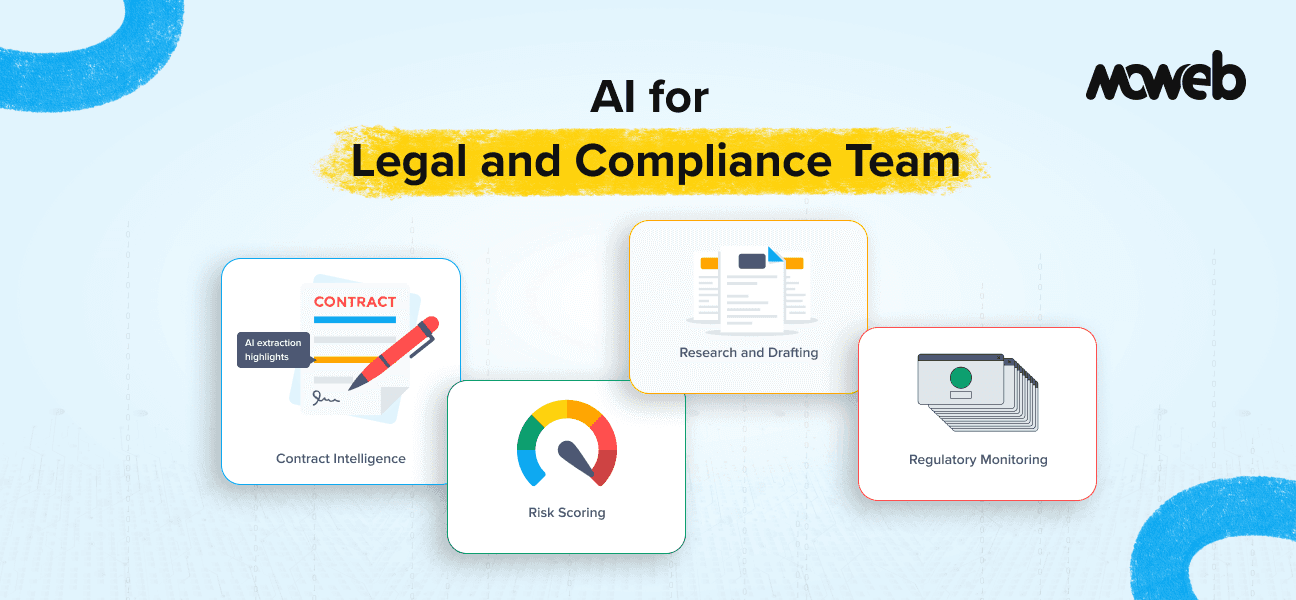
What AI capabilities are most valuable for in-house legal and compliance teams in 2026? The four AI capabilities delivering consistent, measurable value for in-house legal and compliance teams in 2026 are: contract intelligence (automated extraction of key commercial terms, obligation tracking, risk clause flagging, and renewal management across contract portfolios), regulatory change monitoring (continuous tracking of regulatory updates across jurisdictions with automatic mapping to internal policies and controls), compliance risk scoring (AI-driven assessment of contract-level and portfolio-level compliance risk against defined frameworks), and legal research and drafting assistance (AI-assisted research, first-draft generation, and redlining acceleration).
How is the EU AI Act affecting legal and compliance teams in 2026? Legal and compliance teams face the EU AI Act on two fronts: as deployers of AI systems in their own operations, and as the internal function responsible for ensuring the organisation’s broader AI deployments comply with the Act. The EU AI Act’s compliance picture is more nuanced than most briefings convey and critically important to get right. The Digital Omnibus agreement of 7 May 2026 (provisional, expected formal adoption July 2026) deferred the high-risk system obligations for standalone Annex III systems (recruitment, credit scoring, law enforcement, education, essential services) from 2 August 2026 to 2 December 2027 a 16-month reprieve. Annex I product-embedded systems are deferred to 2 August 2028. However, Article 50 transparency obligations (disclosure and watermarking of AI-generated content) and Article 99/101 enforcement powers take effect on 2 August 2026 as originally scheduled. The Omnibus did not delay everything it split the August 2026 deadline into obligations that moved and obligations that did not. Legal teams that read the headline “AI Act delayed” and stood down their compliance programmes have a live exposure opening on 2 August 2026 regardless. Penalties for non-compliance with provisions that remain on the August 2026 schedule can reach €35 million or 7% of global annual revenue for the most serious violations.
If 2024 was the year of AI hype in legal services, and 2025 was the year of AI accountability, then 2026 is the year of AI operational dependency. The question in most corporate legal departments has shifted from “should we use AI?” to “how do we govern the AI we are already using, and how do we accelerate the AI programmes that are demonstrably working?”
The commercial pressure is clear.
Against this productivity opportunity sits a governance challenge that is both urgent and consequential. The EU AI Act’s compliance picture split on 7 May 2026 when the Digital Omnibus provisional agreement was reached: high-risk system obligations for Annex III categories (recruitment, credit scoring, law enforcement, education, essential services) deferred to 2 December 2027, but Article 50 transparency obligations and enforcement powers remain live from 2 August 2026. The Colorado AI Act came into force on 1 February 2026 (not June 2026, its effective date was moved up during the legislative process). Over a dozen US states have enacted or are enacting AI-specific legislation. Courts and state bars are issuing increasingly specific guidance on lawyers’ professional responsibility when using AI. ABA Formal Opinion 512 established that lawyers must have a reasonable understanding of AI capabilities and limitations and must verify all AI-generated output.
Legal and compliance teams in 2026 are simultaneously the biggest opportunity beneficiaries of enterprise AI and the function responsible for governing the organisation’s AI risk. This guide covers both dimensions: the AI capabilities delivering measurable value in legal and compliance operations, and the governance obligations that come with them.
The In-House Legal and Compliance AI Landscape: Four Capability Areas
Capability 1: Contract Intelligence and CLM Automation
Contract intelligence is the most mature and most widely adopted AI application in corporate legal departments. The underlying reason is straightforward: contract review is one of the highest-volume, most time-intensive activities in in-house legal, and the data – the contracts themselves – is already in digital form for most organisations.
AI contract intelligence operates across three distinct workflow layers.
Contract extraction and population. AI systems read contracts and extract structured data fields into the contract lifecycle management system: parties, effective date, expiry date, governing law, liability cap, termination provisions, renewal options, payment terms, and key obligation milestones. This extraction, which previously required 30-60 minutes per contract for a legal professional, is reduced to seconds with AI, with field-level accuracy typically running on standard commercial agreements. For organisations managing portfolios of hundreds or thousands of contracts, this extraction capability makes systematic contract data management practically achievable for the first time.
Risk clause identification and benchmarking. AI systems flag clauses that deviate from standard positions – below-standard liability caps, unusual indemnity language, missing representations, non-standard termination rights, or data processing provisions that do not meet the organisation’s standard requirements. This risk flagging focuses human reviewer attention on the clauses that matter rather than requiring end-to-end review of every contract. For high-volume, low-complexity contracts (NDAs, standard supplier agreements, software licences), AI-driven risk flagging enables near-automated processing with human review only of flagged exceptions.
Obligation tracking and renewal management. AI systems extract and calendar key obligation milestones: notice periods before renewal or termination, payment milestones, compliance certification dates, and audit rights windows. Contract obligations buried in a portfolio of 500 agreements represent significant legal and financial exposure when they are missed. AI obligation tracking converts static contract documents into a managed, monitored compliance calendar. These are not distant futures – they are current capabilities in well-implemented CLM programmes.
The document intelligence architecture underlying AI contract extraction uses the same RAG and vector search foundations as enterprise knowledge systems. See our guide to RAG development for enterprise knowledge systems for the technical architecture.
Capability 2: Regulatory Change Monitoring and Intelligence
The volume of regulatory change that legal and compliance teams must track has grown substantially. The EU AI Act, DORA, CSRD, NIS2, updated AML frameworks, evolving data protection guidance, and a proliferating landscape of state-level AI legislation in the US have created a monitoring burden that manual processes cannot sustain at the speed regulatory developments now move.
AI regulatory intelligence systems address this by continuously monitoring regulatory sources – legislative databases, regulatory agency publications, court decisions, guidance documents, and enforcement actions – and automatically identifying changes relevant to the organisation’s specific jurisdictions, industries, and risk profile.
The specific capabilities that differentiate AI regulatory intelligence from manual monitoring are:
Automated relevance filtering. A human team monitoring 50+ regulatory sources daily for an organisation operating across 12 jurisdictions and three industry verticals cannot read every publication. AI systems filter by relevance – matching new publications against the organisation’s regulatory profile – and surface only the changes requiring attention, with a relevance assessment and preliminary impact summary.
Obligation mapping to internal controls. When a relevant regulatory change is identified, AI systems map the new or changed obligation to the internal policies, procedures, and controls that it affects. Instead of receiving a regulatory change alert and beginning the manual process of identifying what needs to change internally, the legal team receives a pre-mapped impact assessment: “this change affects Policy 3.7, Control Framework Section 12, and Supplier Agreement Template B.”
Regulatory change audit trail. Every regulatory change identified, its relevance assessment, its impact mapping, and the internal response actions taken are logged in an auditable record. When a regulator asks “how did you become aware of this regulatory change and what did you do in response?”, the organisation has a complete, timestamped answer.
The EU AI Act’s own multi-phase rollout GPAI obligations from August 2025, transparency from August 2026, and high-risk (Annex III) from December 2027 illustrate precisely why manual monitoring of regulatory timelines creates material risk. The Omnibus deferral was agreed on 7 May 2026 and expected to be formally published in the Official Journal in July 2026. Organisations relying on manually curated regulatory calendars would have missed the interim status and continued preparing for the wrong deadline. Automated regulatory intelligence systems that track provisional agreements, trilogue outcomes, and official journal publication dates as distinct events are the correct infrastructure for this regulatory environment.
For financial services organisations, the regulatory monitoring challenge is particularly acute. Our guide to AI in fintech: fraud detection, underwriting, and compliance automation covers the specific regulatory AI applications relevant to financial institutions in detail.
Capability 3: Compliance Risk Scoring and Assessment
Compliance risk scoring applies AI to the assessment of contract-level and portfolio-level compliance risk, producing prioritised risk registers that direct human compliance attention to the highest-risk items rather than requiring uniform review intensity across the full portfolio.
Contract-level compliance scoring evaluates individual contracts against a defined compliance framework – the organisation’s standard contract requirements, applicable regulatory standards, and sector-specific obligations – and assigns a risk score that reflects the number, severity, and combination of deviations. A contract with a missing data processing agreement, a non-standard liability limitation, and a governing law clause for a jurisdiction the organisation cannot enforce is scored higher than a contract with a single minor formatting deviation from the standard template.
Third-party risk assessment applies AI to the screening of suppliers, counterparties, and vendors against compliance criteria: sanctions lists, adverse media, politically exposed persons databases, beneficial ownership records, and ESG compliance profiles. Manual third-party due diligence for an organisation with hundreds of active suppliers is a significant compliance team resource commitment. AI screening handles the routine checks automatically, flagging items for human review only when the automated assessment identifies a potential concern.
Regulatory gap analysis compares the organisation’s current policies and procedures against regulatory requirements and identifies gaps – areas where current documentation does not address regulatory obligations, where policies are outdated relative to regulatory changes, or where control evidence would not survive an audit examination.
Capability 4: Legal Research and Drafting Assistance
The generative AI capability that received the most attention in the legal sector is the use of LLMs for legal research and document drafting. The commercial reality in 2026 is that AI legal research and drafting tools are delivering meaningful productivity gains for in-house teams, but only when used with the human oversight and verification discipline that the ABA and courts are now explicitly requiring.
AI-assisted legal research generates initial research memoranda, case summaries, and regulatory analysis from briefing questions. The productivity gain from using AI to produce a first research draft that a lawyer then verifies, supplements, and takes professional responsibility for, rather than starting research from scratch, is substantial. The professional risk is specific and documented: courts have now sanctioned lawyers in multiple jurisdictions for submitting AI-hallucinated case citations. Mata v. Avianca (SDNY 2023) was the landmark case, but there have been over 20 documented court sanctions globally by mid-2026. Hallucination rates for legal citations specifically run higher than general hallucination rates because AI models generate plausible-sounding case names and citations that do not exist. The ABA’s guidance is clear: AI generates; lawyers verify. This is not optional diligence; it is a professional responsibility.
Contract drafting and redlining acceleration uses AI to generate first-draft contract language, populate standard clauses from approved playbooks, and suggest redline responses to counterparty markup. It does not apply to highly negotiated, non-standard, or bespoke agreements where human drafting remains essential.
Policy and procedure generation uses AI to generate first drafts of internal policies, procedures, and compliance documentation from regulatory requirements and internal standards. Like contract drafting, the value is in generating a structured, comprehensive first draft that a legal professional then reviews, modifies, and takes ownership of – not in using AI output as final documentation without review.
The Governance Layer: When Legal Teams Are Both User and Regulator
The most significant structural challenge for legal and compliance teams in 2026 is their dual role in enterprise AI: they are both users of AI tools for their own productivity and the function responsible for governing the organisation’s broader AI risk.
This dual role has specific implications that do not apply to other functions deploying AI.
Professional responsibility obligations apply to lawyer AI use. ABA Formal Opinion 512 established that lawyers must have a reasonable understanding of AI capabilities and limitations. Using AI for legal work without understanding what it can and cannot do reliably is an ethical violation, not just an operational risk. Lawyers who submit AI-generated content to courts without verification face sanctions that courts have been willing to impose. The duty to supervise – which applies to lawyer supervision of non-lawyer staff – extends to supervision of AI tools used for legal work.
Legal AI creates evidence preservation obligations. Courts have begun to treat AI use in legal proceedings as creating discovery obligations. If AI were used to review documents, generate contract language, or conduct legal research that influenced a transactional decision, that AI use may be discoverable. Legal teams deploying AI tools should ensure that their AI governance framework addresses the evidence preservation obligations that come with AI use in legal contexts.
Board-level AI governance is a fiduciary duty question. WilmerHale’s 2026 AI governance analysis notes that recent Delaware Court of Chancery decisions suggest courts may be more willing to allow oversight-related claims to proceed when boards failed to exercise adequate oversight of AI-related risks. Where AI is integral to a company’s core products or heavily regulated operations, board oversight of AI risk is a fiduciary duty question, not a technology governance question. Legal teams advising boards on AI governance need to understand this exposure. The practical implication: AI governance documentation risk registers, system inventories, oversight policies, and incident response plans is not just internal best practices. It is increasingly potential evidence in director liability proceedings and regulator examinations. The standard of care is being set by what leading organisations are documenting, not by what the regulations prescribe.
For the comprehensive AI governance framework that legal teams are now required to help implement and maintain, our guide to AI governance for LLMs and enterprise agents covers the eight controls in detail.
The EU AI Act: What Legal Teams Must Do Before and After August 2026
The EU AI Act’s compliance picture is the most consequential regulatory development for in-house legal teams in 2026 and the most frequently misread. Here is the precise current status as of June 2026. On 7 May 2026, the European Parliament and Council reached a provisional political agreement on the Digital Omnibus on AI. Formal adoption is expected in the Official Journal in July 2026. Once formally adopted, the following deadlines apply:
• 2 August 2026 (unchanged): Article 50 transparency obligations disclosure requirements for AI-generated content, deployer transparency duties, and Article 99/101 enforcement powers for the most serious violations. These obligations were NOT deferred by the Digital Omnibus. Legal teams that read the headline ‘EU AI Act delayed’ and stood down Article 50 preparations have a compliance gap opening on this date.
• 2 December 2026 (new obligation): New prohibitions under Article 5 on AI systems generating non-consensual intimate imagery and child sexual abuse material take effect. If your organisation’s AI tools can generate images or audio, technical and contractual safeguards against these uses must be in place by this date.
• 2 December 2027 (deferred from 2 August 2026): High-risk system obligations for standalone Annex III systems, the categories most relevant to in-house legal and compliance work: recruitment and HR AI, credit scoring and financial AI, essential services AI, law enforcement, education, and border management. This 16-month deferral provides real headroom for conformity assessments, technical documentation, human oversight architecture, and post-market monitoring.
• 2 August 2028 (deferred from 2 August 2027): High-risk obligations for Annex I systems embedded in regulated products, medical devices, machinery, and vehicles.
Critical practical nuance: the Annex III deferral to December 2027 applies to new or substantially modified systems. Systems placed on the EU market before the new deadline that are not substantially modified may benefit from grandfathering. However, “substantial modification” is undefined in the current text, making this a live legal question that will be determined by implementing guidance from the AI Office. Legal teams should not treat grandfathering as reliable protection for existing deployments without counsel-led analysis.
Direct compliance obligations for legal team AI deployments. AI systems used in legal contexts that fall within the EU AI Act’s high-risk categories – automated decision-making systems that influence access to essential services, systems used in HR decisions about hiring and performance, systems used in credit or financial assessments – require conformity assessments, technical documentation, human oversight mechanisms, and registration in the EU database of high-risk AI systems. Legal teams using AI for document review, contract analysis, and research must assess whether their specific applications fall within these categories.
Organisational AI inventory as a legal obligation. The EU AI Act requires organisations to know what AI systems they deploy, how they are categorised, and whether their high-risk systems meet required standards, regardless of the revised deadline. CPO Magazine’s 2026 AI Legal Forecast is explicit: “You cannot govern what you do not know, so map all shadow AI use across the enterprise.” For legal teams responsible for AI governance, this means leading or participating in an enterprise-wide AI system inventory. Formal adoption of the Omnibus is expected in July 2026 ahead of the August 2 date, and the AI Office’s high-risk registration database is standing up in parallel. Systems will be required to register before being placed on the EU market, making the inventory exercise a prerequisite for the registration process, not just a governance best practice. A structured process for conducting this inventory is covered in detail in our guide to how to build an AI Center of Excellence.
Vendor contract obligations. CPO Magazine recommends updating vendor agreements to shift liability for IP infringement and autonomous errors back to AI providers. This is a practical legal strategy – not a guarantee – and requires specific contractual language addressing AI-generated outputs, hallucination liability, data handling under training exclusions, and compliance with applicable AI regulations. Legal teams reviewing AI vendor contracts should ensure these provisions are explicitly addressed rather than left to general terms.
State law monitoring for US operations. Beyond the EU AI Act, US legal teams must monitor a rapidly evolving state law landscape. The Colorado AI Act took effect on 1 February 2026 (not June 2026, as sometimes cited the enforcement date was set at February 1 during the legislative process). It requires risk management policies, impact assessments, and transparency for consequential decisions made using high-risk AI systems. Illinois’s AI in Employment Law (effective January 2026) mandates disclosure when AI influences employment decisions. California, Utah, Texas, and New York have active AI legislation at various stages. Legal teams without automated regulatory change monitoring for AI-specific legislation are managing this landscape manually an increasingly unsustainable approach.
For organisations where EU AI Act data residency obligations or professional confidentiality requirements make external AI API processing problematic, see our guide to sovereign AI and on-premises model deployment.
Implementation Roadmap: Where In-House Legal Teams Should Start
The right starting point for AI in legal and compliance depends on the team’s size, the organisation’s contract volume, and the regulatory complexity of the sector. A phased approach prevents the investment misallocation that comes from attempting too much simultaneously.
Phase 1 (Weeks 1-6): Contract data foundation and AI inventory. The most valuable immediate investment for most legal teams is contract data quality. Before AI contract intelligence can be deployed at production quality, the contract repository must be consolidated – contracts accessible in a single location, in digital format, with consistent naming and basic metadata. For most organisations, this consolidation exercise takes 2-4 weeks and surfaces the contract management gaps that were invisible when contracts were managed in email attachments and shared drives.
Simultaneously, conduct the AI system inventory required for EU AI Act compliance and general AI governance. Document every AI tool used by the legal team and the broader organisation. Classify each by risk level. Identify which require formal governance documentation.
For a structured framework to assess data quality, infrastructure, and governance readiness before beginning AI deployment, see our AI readiness assessment checklist.
Phase 2 (Weeks 6-12): CLM and contract intelligence deployment. With the contract data foundation established, deploy AI contract extraction and risk flagging on the existing portfolio. Start with a defined contract type (supplier NDAs, software licences, or standard service agreements) rather than the full portfolio – this limits the scope of the initial deployment and generates validated accuracy metrics before scaling.
Establish the human review process for AI-flagged exceptions. Define who reviews flagged contracts, what standards they apply, and how review decisions are documented. This review process is both an operational requirement and a compliance control.
Phase 3 (Months 3-6): Regulatory monitoring and risk scoring. Add automated regulatory change monitoring for the organisation’s primary regulatory frameworks. Configure the relevance filtering to match the organisation’s jurisdictions and industry profile. Establish the obligation mapping workflow that connects regulatory changes to internal policies and controls.
Deploy compliance risk scoring on the newly extracted contract data, generating a prioritised risk register for the existing portfolio. Use this risk register to direct the human review resource that previously had to apply uniform attention across all contracts.
Phase 4 (Months 6+): Legal research, drafting assistance, and AI governance programme. Add AI-assisted research and drafting capabilities with appropriate professional oversight frameworks. Establish the AI acceptable use policy for the legal team that meets ABA guidance requirements. Lead the organisation’s broader AI governance programme, using the legal team’s governance framework as the template for enterprise-wide AI governance.
For the data infrastructure that AI contract intelligence depends on, our guide to data engineering for AI: building the foundations covers the document ingestion, extraction, and storage architecture in detail.
Frequently Asked Questions About AI for Legal and Compliance Teams
Is AI-generated legal output reliable enough for professional use? AI legal tools produce useful first drafts, research summaries, and contract extractions, but all require professional review before use. Hallucination rates for generative AI range from, depending on the task and model, with legal citation hallucinations running particularly high because AI models generate plausible-sounding case names and citations that do not exist. Courts have now issued sanctions in over 20 documented cases globally for submission of AI-hallucinated citations, with Mata v. Avianca (SDNY 2023) the landmark precedent. ABA Formal Opinion 512 requires lawyers to verify AI-generated output. The appropriate model is AI as a co-pilot generating drafts and flagging issues that lawyers then review, verify, and take professional responsibility for. AI replaces the blank page, not the lawyer.
What is the EU AI Act’s impact on in-house legal AI tools? The EU AI Act’s compliance picture split on 7 May 2026 with the Digital Omnibus provisional agreement. The precise current timeline: Article 50 transparency obligations and enforcement powers (Articles 99/101) remain due 2 August 2026, not deferred. New prohibitions on AI-generated non-consensual intimate imagery take effect on 2 December 2026. High-risk system obligations for standalone Annex III systems (recruitment, credit scoring, essential services, education, law enforcement) were deferred from 2 August 2026 to 2 December 2027, a 16-month reprieve. Annex I product-embedded systems deferred to 2 August 2028. Penalties for the most serious violations reach €35 million or 7% of global annual revenue. Legal teams must assess which obligations remain on the August 2026 schedule and which have moved. Treating the headline “EU AI Act delayed” as applying to all obligations is a compliance error.
How do AI contract intelligence tools handle non-standard or highly negotiated contracts? AI contract intelligence performs best on standard agreement types where the clause language is predictable and the field extraction schema is consistent. Non-standard, highly negotiated, or bespoke contracts require more human review because AI extraction accuracy drops when clause language deviates substantially from the training distribution. The practical approach is to use AI extraction for all contracts and configure confidence thresholds that route low-confidence extractions to human review rather than accepting them automatically.
What is the difference between a CLM system and AI contract intelligence? A CLM system is the repository and workflow platform that manages the contract lifecycle – storage, routing, signing, and obligation tracking. AI contract intelligence is the capability layer that extracts meaning from contract documents – reading the text, identifying key terms, flagging risks, and populating the CLM system’s data fields. Most modern CLM platforms (Ironclad, Conga, Icertis, DocuSign CLM) have integrated AI capabilities. AI contract intelligence can also be added as a separate capability on top of existing CLM systems or document management platforms that lack native AI features.
How should legal teams approach the ABA’s guidance on AI use? ABA Formal Opinion 512 requires a reasonable understanding of AI capabilities and limitations and verification of all AI-generated output. In practice, this means: understand what the specific AI tool you are using does and does not do reliably; never submit AI-generated content to a court or counterparty without review and verification; maintain human oversight over all AI-influenced legal work products; document your review process for AI-assisted work; and ensure your firm’s or organisation’s AI acceptable use policy reflects these obligations. The standard is not that AI cannot be used – it is that lawyers remain responsible for the output, regardless of whether AI generated it.
What data governance requirements apply to AI tools used for legal work? Legal work frequently involves privileged communications, confidential client information, and personally sensitive data. AI tools used for legal work must: operate under enterprise agreements with explicit data processing commitments (not consumer terms), commit to not training on client data, store data in jurisdictions consistent with applicable confidentiality and data protection obligations, and support data deletion on request. Using public AI tools (ChatGPT free tier, consumer Copilot) for work involving privileged or confidential information is an ethical violation under most state bar rules, regardless of the AI tool’s terms of service.
What does the Digital Omnibus mean for legal teams that were preparing for August 2026? For legal teams that were genuinely unprepared for August 2026, the Digital Omnibus deferral of Annex III high-risk obligations to December 2027 provides meaningful headroom for conformity assessment, technical documentation, and human oversight architecture work. For legal teams that had stood down all EU AI Act preparations based on headlines about the delay, the deferral has created a false sense of relief: Article 50 transparency obligations, deployer disclosure duties, and enforcement powers are NOT deferred; they apply from 2 August 2026 as originally scheduled. The DLA Piper analysis (June 2026) is precise: formal adoption is expected in the Official Journal in July 2026, ahead of the 2 August date, but organisations should continue compliance preparations on the August 2026 timetable until formal adoption confirms the new deadlines. Use the deferral time for high-risk work; do not treat it as permission to pause.
Conclusion: Legal and Compliance Teams Face Both the Opportunity and the Obligation
The productivity opportunity for legal and compliance teams from AI is real, documented, and accelerating. Contract cycle times reduced. Audit preparation time cut. Regulatory monitoring coverage that no human team could achieve at equivalent depth and speed. These are current operational results, not projections.
The governance obligation is equally real and more nuanced than the headlines convey. The EU AI Act did not simply “get delayed” in May 2026. It bifurcated: transparency obligations and enforcement powers live from August 2026; high-risk system obligations deferred to December 2027. Legal teams that have not read the distinction carefully are exposed to one and have meaningful headroom on the other but only if they act. US state legislation, ABA professional responsibility guidance, and emerging board-level fiduciary duty frameworks are combining to make AI governance not just a best practice but a legal requirement.
The organisations that will navigate this successfully are those that start with a clear-eyed inventory of their AI exposure, deploy contract intelligence and regulatory monitoring on the strongest data foundations they can build, and treat professional oversight of AI output as a design requirement rather than an optional quality check.
Moweb’s Generative AI and LLM development and AI Security and Governance practices work with legal teams and compliance functions to build AI systems that meet the professional responsibility and regulatory requirements of the legal sector, including contract intelligence systems, regulatory monitoring platforms, and the governance documentation that the EU AI Act and US state law compliance require. Talk to us about your legal AI programme.
Found this post insightful? Don’t forget to share it with your network!