
AI Workforce Transformation and Reskilling
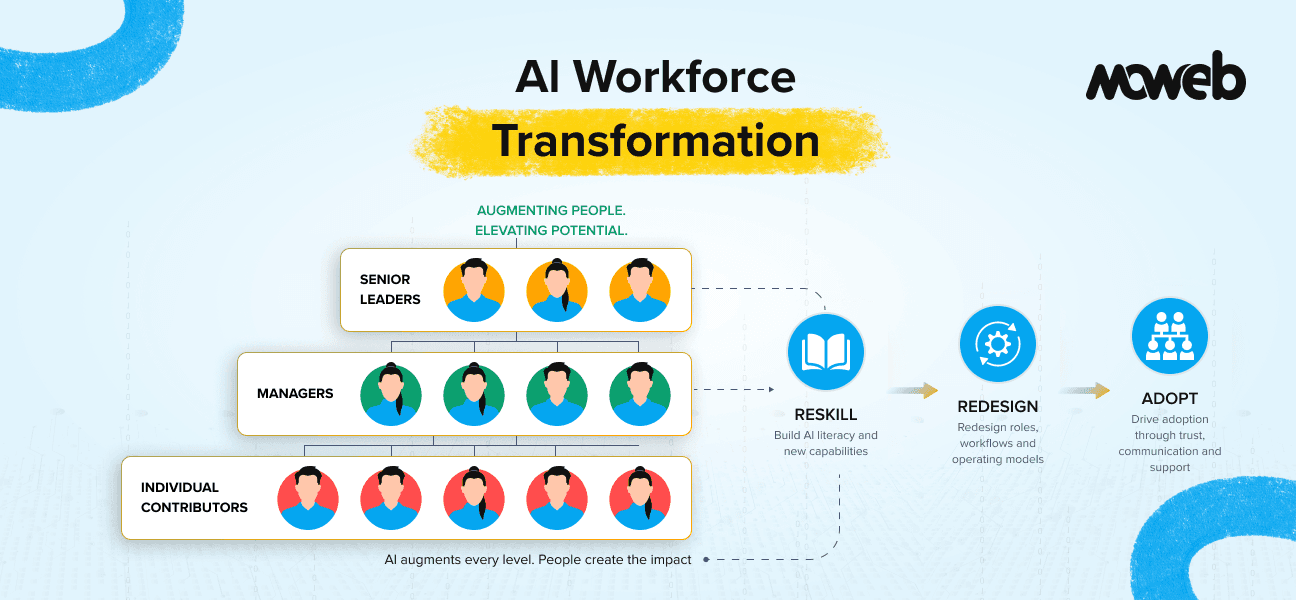
A practical guide to AI workforce transformation for enterprise leaders in 2026. Covers re-skilling frameworks, change management principles, the AI fluency gap, role redesign, and how to build an AI-ready organisation without losing your best people.
What is AI workforce transformation? AI workforce transformation is the organisational process of preparing employees, teams, and enterprise structures to work effectively alongside AI systems. It encompasses three interconnected workstreams: reskilling and upskilling (building the AI fluency and tool proficiency that employees need to do their jobs well in an AI-augmented environment), role and workflow redesign (restructuring jobs and processes so that AI handles the routine and humans focus on the judgment, creativity, and relationship work that AI cannot replicate), and change management (the communication, governance, and cultural leadership required to move from resistance and anxiety to genuine adoption). Organisations that invest in all three workstreams consistently outperform those that invest in AI technology alone.
What is the biggest barrier to AI adoption in enterprises? The biggest barrier is not budget, technology maturity, or vendor selection. The technology is ahead of the people strategy in most enterprises and that gap is the primary reason AI programmes stall. More adoption, less confidence the consequence of deploying tools without the support infrastructure to use them well.
The most consistent finding across every major enterprise AI study in 2026 is that the barrier to AI value is not the technology. The technology works. The models are capable. The tools are accessible. The barrier is the organisation.
One third of workers experienced 15 or more major changes in the past year alone, according to Gloat’s Q2 2026 AI Workforce Trends report.
Against this backdrop, most enterprise AI programmes invest of their budget in technology and in the people strategy required to make that technology generate value. The result is a pattern that is now familiar: the AI system is built and deployed, and adoption is disappointing because the workforce was not prepared to use it effectively, trust it appropriately, or integrate it into their actual work practices. Deploying tools faster than confidence can keep up is not an adoption strategy; it is an anxiety factory.
This guide covers the three workstreams of AI workforce transformation – reskilling, role redesign, and change management – the specific approaches that work at enterprise scale, and the practical sequence for building an AI-ready organisation without losing the people, trust, and institutional knowledge that effective AI systems depend on.
For the broader AI readiness framework that workforce readiness sits within, see our guide to what AI readiness means for enterprises.
Why Most AI Workforce Transformation Programmes Fail
Before examining what works, it is worth being precise about why the conventional approach to AI change management in enterprises consistently underperforms.
Training is treated as a one-time event rather than a continuous practice. A two-day AI awareness workshop is the most common first response to the reskilling challenge. It generates initial engagement, provides a common vocabulary, and typically produces no lasting behaviour change. This is not a finding about laziness; it is a finding about how adults actually learn tools they will use every day. One-time training is structurally misaligned with how skill acquisition actually works. AI tools evolve faster than traditional training cycles can accommodate. Skills that remained relevant for 5-10 years now become obsolete in months. One-time training is structurally incapable of keeping pace.
The communication focuses on capability and efficiency, not on what changes for the individual. “This AI system will make our processes 30% more efficient” is a communication about the organisation’s needs. “Here is specifically how this AI tool changes your daily work, what it takes off your plate, what it makes easier, and what new skills it creates demand for in your career” is a communication about the individual’s needs. Programmes that neglect the individual-level question – “what does this mean for me?” – consistently generate anxiety and resistance that technical capability alone cannot overcome.
Role redesign is absent or symbolic. The most common approach to AI workforce transformation is to add AI tools to existing job descriptions without changing the job. Employees are expected to use AI assistants to do their current job faster, while all the same tasks remain in scope. This approach generates neither the productivity uplift the organisation expects nor the career development the employee needs. Genuine transformation requires restructuring roles – removing the work that AI will now do, adding the work that AI creates demand for, and redesigning performance expectations accordingly.
Change management is delegated to HR rather than owned by line management. AI adoption happens or fails at the workflow level – in the daily decisions individual managers and team members make about whether to use an AI tool, how much to trust its outputs, and whether to raise concerns about its behaviour. A centralised HR-led change programme cannot create that adoption. What creates it is line managers who are genuinely proficient with the tools they are asking their teams to use, who visibly use them in team meetings, and who create psychological safety for team members to raise concerns and share learning. The change management problem is a leadership problem, not a training problem.
The Three AI Fluency Levels Every Enterprise Needs
AI fluency is not binary. Different roles require different depths of AI capability, and conflating them produces reskilling programmes that are either too shallow for technical roles or too demanding for business users.
A practical enterprise AI fluency framework has three levels:
Level 1: AI Awareness and Productive Use (all employees) Every employee in an AI-augmented enterprise needs the ability to use AI tools effectively for the productivity tasks relevant to their role (drafting, research, summarisation, data analysis), to understand what AI can and cannot reliably do in their specific work context, to recognise when AI output requires human verification before acting on it, and to know how to raise concerns when AI behaviour seems wrong. This is not a technical capability – it is a professional literacy comparable to being able to use email effectively. It is the floor, not the ceiling.
Level 2: AI Application and Workflow Integration (managers and domain specialists) Managers and domain specialists need the additional ability to identify where AI can improve their team’s workflows, to evaluate AI tools for their specific use cases, to design workflows that appropriately combine AI and human judgment, and to set meaningful quality standards for AI-assisted work. A finance manager who cannot distinguish between an AI-generated analysis that is reliable and one that requires specialist review is not yet at Level 2. A marketing director who can identify which content creation tasks AI handles well and which require human creative judgment has reached it.
Level 3: AI Architecture and Governance (technical and senior leadership roles). Technical teams and senior leaders need the additional ability to understand AI system architecture at a level sufficient to make sound build-vs-buy decisions, to design governance frameworks appropriate to AI system risk levels, to evaluate vendor technical claims critically, and to identify when an AI system’s failure mode creates business or compliance risk. This is the level at which the organisation’s strategic AI decisions are made, and it requires genuine technical depth alongside business judgment. The implication is that Level 1 fluency for the full workforce is the foundational investment, not the afterthought. For a concrete introduction to AI tool categories that should inform Level 1 training content, our guide to the difference between AI chatbots, Copilot, and AI agents is a useful foundation for enterprise AI awareness programmes.
The Reskilling Framework: What Actually Works at Enterprise Scale
Reskilling at enterprise scale requires a different approach from individual learning and development. The approaches that work in production at the thousands-of-employees scale share consistent characteristics.
Embed learning in work rather than extracting employees for training. The most effective enterprise reskilling at scale happens when learning is integrated into daily work rather than conducted in separate training sessions. Structured use of AI tools on real work tasks – with coaching on quality evaluation and prompt improvement – produces faster and more durable skill development than classroom training on simulated scenarios. The implication is not that formal training is worthless; it is that the training infrastructure should scaffold those preferred learning modes (experiential, social) rather than fighting against them. Amazon’s internal AI Skills Builder programme, which embeds AI learning modules directly into employee workflows, is one of the most cited examples of this approach at scale.
Make learning immediately career-relevant. Programmes that connect AI skill development explicitly to career advancement – “employees at Level 2 AI fluency are eligible for X roles and Y compensation bands” – generate substantially higher engagement than those that frame reskilling as a company obligation. Use it. The question “what does this mean for my career?” is the single most important question reskilling programmes need to answer clearly. Programs that do not answer it see low participation and low knowledge retention.
Use cohort-based learning for middle management. Middle managers are the most critical and most neglected segment in enterprise AI reskilling. They are the primary determinants of whether AI tools get used in their teams’ daily work. Cohort-based learning programmes for middle managers – where groups of 8-12 work through the same AI tools and workflow integration challenges together over 4-6 weeks – produce both skill development and the peer network that sustains ongoing learning. Managers who cannot demonstrate AI-enabled productivity gains are at materially higher career risk than those who can. Cohort-based learning that delivers demonstrable outcomes is not just a training investment; it is a retention strategy for the layer of the organisation most exposed to AI-driven restructuring.
Build internal AI champions rather than relying on external expertise. Every business unit and function should have at least one identified AI champion – someone who goes deeper on AI tools relevant to their function, becomes the first port of call for colleagues with questions, and provides feedback to the central AI programme on what is working and what is not. These champions do not need to be the most senior people in the unit – they need to be interested, credible, and willing to share their learning. Building this network costs less than a single external consultant engagement and has a longer-lasting impact on adoption.
Measure learning outcomes, not training hours. The default metric for enterprise training programmes is completion rate and hours of training delivered. These metrics measure input, not outcome. Effective AI reskilling programmes measure whether employees are actually using AI tools in their daily work, whether the quality of AI-assisted work meets defined standards, and whether employees can identify when AI output is unreliable. These outcomes require more effort to measure, but are the only metrics that reflect whether the reskilling investment is creating value.
For specific examples of how US mid-market organisations are executing AI adoption, see our analysis of how US mid-market companies are adopting AI in operations.
Role Redesign: The Work That Reskilling Cannot Do Alone
Reskilling improves individuals’ ability to work with AI tools. Role redesign changes what individuals are expected to do. Both are required. Neither is sufficient without the other.
The core principle of AI-era role redesign is: remove from human job descriptions the tasks that AI now handles reliably, and add the tasks that AI creates demand for but cannot perform.
Tasks that AI handles reliably and that should be redesigned out of human job descriptions: First-draft generation of standard documents, reports, and communications; initial research and information synthesis from defined sources; routine data entry, classification, and formatting; first-pass review of standard contracts and compliance documents against defined criteria; scheduling, calendar management, and meeting summarisation; and basic customer query triage and response to FAQ-type questions.
Tasks that AI creates demand for and that should be redesigned into human job descriptions: Quality review of AI-generated outputs (AI makes first drafts; humans validate, refine, and take responsibility); exception handling for cases that fall outside AI system parameters; relationship management in client and customer contexts where human connection is the commercial value; governance and oversight of AI systems (someone must own the quality and compliance of AI outputs at every level); AI tool evaluation and workflow optimisation for the team; and domain expertise applied to the genuinely novel, complex, or ambiguous situations that AI handles poorly.
The organisations that have executed this redesign successfully are treating it as a job architecture project, not an HR project. They are mapping current job tasks, identifying which are AI-automatable, which require augmentation, and which require full human judgment, and redesigning job families from the ground up rather than editing existing job descriptions. That is the competitive benchmark, and it means the organisations executing role redesign well are still a small minority. The fear of mass displacement that dominated early AI discourse has not materialised in the data, but the shift in job content is real and needs to be managed rather than denied.
Change Management Principles for AI Deployments
Technical change management – managing the deployment of new software – is well understood. AI change management has additional dimensions because AI systems behave differently from traditional software: their outputs are probabilistic rather than deterministic, they can produce plausible-sounding errors without warning, their capabilities change as models update, and the appropriate level of trust and autonomy is calibrated over time through experience rather than established at deployment.
These characteristics require a change management approach specifically designed for AI.
Transparency about AI capabilities and limitations from deployment day one. Employees who discover AI limitations through unpleasant surprises – a confidently wrong answer accepted and acted upon, a hallucinated reference in a document sent to a client – lose trust that is difficult to rebuild. Explicit upfront communication about what the AI system does reliably, what requires human verification, and how to identify low-confidence outputs prevents the trust damage that comes from undisclosed limitations.
Create psychological safety to raise concerns. Employees who observe AI system behaviour they believe is wrong, biased, or producing poor outputs need a clear, low-friction mechanism to raise that observation. If the reporting mechanism is bureaucratic or if raising concerns is perceived to reflect negatively on the employee, concerns go unreported, and system quality degrades silently. A simple, anonymous feedback mechanism with a defined owner and response process is a governance requirement, not an optional feature.
Start with augmentation, move to automation. The appropriate initial deployment model for most enterprise AI is augmentation: AI assists the human, who retains full decision authority and accountability. As the organisation accumulates evidence that the AI system performs reliably in specific contexts, the autonomy level can be gradually increased. Starting with high autonomy and reducing it after problems emerge is significantly more damaging to trust and adoption than starting with lower autonomy and increasing it as confidence builds.
Celebrate and communicate AI adoption wins. The employees and teams generating genuine productivity improvements from AI tools are the most credible communicators of AI value to their colleagues. Internal case studies – presented by the team members who ran them rather than by senior leaders or external consultants – are among the most effective AI adoption tools available. They answer the question “Does this actually work for people like me?” in the most credible way possible. Psychological safety for raising concerns is part of maintaining that capability.
Building AI-Ready Organisational Structure
Beyond individual reskilling and change management, AI-ready organisations have structural characteristics that differ from those designed for pre-AI operations.
A central AI function or AI Centre of Excellence that owns AI strategy, governance standards, shared infrastructure, and enablement – as covered in detail in our guide to how to build an AI Center of Excellence: structure, roles, and 90-day roadmap. This function prevents duplication, enforces governance, and provides the shared infrastructure that individual business units benefit from without needing to build independently. Organisations without dedicated AI leadership are more likely to achieve fragmented, department-level adoption than coordinated, enterprise-wide value.
Clear AI decision rights that specify who can approve AI deployments at different risk levels. A low-risk internal productivity tool might be approved by a team lead. A customer-facing AI system might require CTO and compliance sign-off. A high-risk decision-influencing system in a regulated context might require board-level approval and regulatory notification. Undefined decision rights produce either paralysis (nothing gets approved) or proliferation (everything gets deployed without oversight). Neither is the intended outcome. For the governance framework that AI-ready decision rights build on, see our guide to AI governance for LLMs and enterprise agents.
AI-aware performance frameworks that define how AI-augmented performance is measured and evaluated. If an employee produces twice the output using AI tools but the performance framework still measures output volume as a signal of effort and capability, the framework creates perverse incentives. AI-era performance frameworks measure quality of judgment, creativity, relationship outcomes, and the ability to leverage AI tools effectively – not hours of effort or volume of output.
Frequently Asked Questions About AI Workforce Transformation
Will AI replace my team’s jobs? The data does not support widespread job replacement in the near term. What is happening – and what requires active management – is significant changes to job content: the tasks that make up roles are shifting as AI takes on routine work and humans focus on judgment, creativity, oversight, and relationships. Managing this transition well is an organisational responsibility, not something individuals can navigate alone. Managing this transition well is an organisational responsibility, not something individuals can navigate alone.
How do you measure whether AI reskilling is working? Measure outcomes, not inputs. Completion rates and training hours delivered measure whether employees attended the training; they do not measure whether the training changed behaviour. Effective AI reskilling measurement tracks: percentage of employees using AI tools in daily work (tool adoption rate), quality of AI-assisted outputs against defined standards (quality metrics), time saved on tasks identified as AI-amenable (productivity metrics), and employee confidence self-assessment at defined intervals. Tracking confidence separately from usage is essential for organisations that want to close the gap before it becomes a crisis.
How do you handle employees who resist AI adoption? Resistance is almost always an information problem, a trust problem, or a change management problem – not a capability problem. Employees who resist AI adoption typically have one of three concerns: concern about job security (addressed by honest communication about what is changing and what is not), concern about quality and reliability (addressed by transparency about what AI does reliably versus what requires human judgment), or concern about change fatigue (addressed by pacing and prioritisation – not every workflow should change simultaneously). Resistance that persists after these concerns are addressed usually indicates management behaviour that is not modelling or reinforcing AI adoption.
What new roles does AI create in enterprises? Many of these roles do not require new hires; they are best filled by redeploying existing employees who understand the business context and have a genuine interest in AI.
How long does AI workforce transformation take? The honest answer is that it is not a project with an end date – it is an ongoing capability. The initial phase – building Level 1 AI fluency for the full workforce, deploying AI champions in each business unit, and completing the first role redesign cycle – typically takes 6-12 months for a mid-market enterprise. After that, the capability requires ongoing investment as AI tools evolve, as new deployments create new learning requirements, and as the workforce naturally turns over. The organisations that treat AI workforce transformation as a continuous function rather than a one-time programme are the ones that maintain their adoption advantage over time.
What is “job hugging” and why does it matter for AI adoption? It matters for AI adoption because job hugging concentrates institutional knowledge in the short term, which is helpful but signals high anxiety and low confidence that, if unaddressed, produces passive resistance to AI tools rather than active experimentation. Organisations seeing high retention alongside low AI tool adoption rates may be observing job hugging rather than genuine satisfaction. Addressing the underlying confidence and career clarity concerns is the intervention, not more training hours.
How should organisations communicate about AI to reduce employee anxiety? Be specific, honest, and employee-centric. Specific means naming the tools being deployed and the workflows they affect – vague communications about “AI capabilities” create more anxiety than specific communications about actual changes. Honest means acknowledging the uncertainty in how AI will affect specific roles rather than offering false reassurance that nothing will change. Employee-centric means answering “what does this mean for me?” before communicating about organisational benefits. The communications that most reliably reduce anxiety are those delivered by direct managers rather than centralised communications, because employees trust their own manager’s interpretation of what changes mean for them more than they trust corporate messaging.
Conclusion: The Organisations That Invest in People Alongside Technology Will Win
The enterprise AI ROI gap – between the organisations generating transformative operational value from AI and those generating marginal productivity improvement – is not primarily explained by technology choices. It is explained by the organisations’ investments in the human side of AI transformation. They do not wait for the AI deployment to force workforce changes. They design the workforce transformation programme before the AI system launches, so that the system launches into an environment where people know what it is, how to use it, what to trust it with, and how to escalate concerns.
This is not a soft skill or an HR programme. It is the operational prerequisite that determines whether AI systems produce value or collect digital dust in the enterprise technology stack.
Moweb’s AI Strategy & Consulting practice works with enterprise clients to design AI workforce transformation programmes that run alongside technical AI deployments, covering AI fluency frameworks, change management design, role redesign, and AI Centre of Excellence structures that sustain adoption over time. Talk to us about your AI workforce transformation programme.
Found this post insightful? Don’t forget to share it with your network!