
Flutter for Enterprise Apps: A 2026 Guide
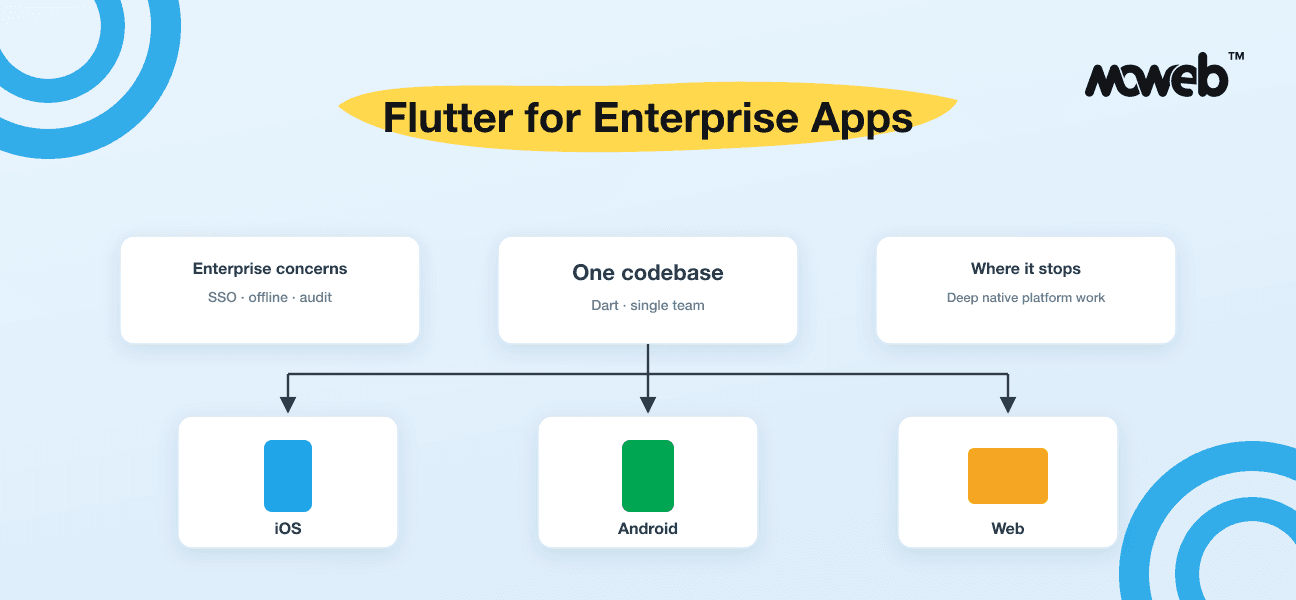
When Flutter is the right choice for enterprise app development: cross-platform trade-offs, architecture, team model, migration, and a decision framework.
The real question behind "should we use Flutter?"
When an enterprise asks whether to build its next app in Flutter, it is rarely asking about a framework. It is asking a business question wearing a technical costume: can we serve iOS and Android from one team and one codebase without the app feeling second-rate, and will that decision still look smart in three years? The stakes are real because mobile is where much of the growth is. Grand View Research values the global mobile application market at $285.7 billion in 2025 and projects it to reach $885.3 billion by 2033, a 15.5% compound annual growth rate (Grand View Research). In a market growing that fast, the cost of maintaining two separate native codebases — and two separate teams — is a tax most organizations would rather not pay twice.
Flutter, Google's open-source UI toolkit, has become one of the two dominant answers to that problem, alongside React Native. This guide is written for the engineering and product leaders weighing that choice, and it tries to be candid about where Flutter shines and where it does not.
What Flutter is, in plain terms
Flutter lets a single codebase compile to native iOS and Android apps — and, from the same source, to web and desktop. Unlike approaches that wrap web views or bridge to native UI components, Flutter draws its own interface through a high-performance rendering engine, which is why its apps tend to feel smooth and behave consistently across devices. Applications are written in Dart, a language designed for fast, predictable UI work. The practical consequence for an enterprise is that most of the codebase — business logic, screens, state, networking — is written once and shared, with platform-specific code reserved for the genuinely platform-specific bits. You can read a fuller technical overview on our Flutter app development page, and Google maintains the canonical documentation at flutter.dev.
Where Flutter is the right call
Flutter earns its place in a well-defined set of situations, and naming them honestly is more useful than a feature list.
You need both platforms and one team
The core promise is economic. A single Flutter team ships to iOS and Android at once, which compresses timelines and removes the chronic problem of the two native apps drifting apart in features and behavior. For most business apps, this is the whole reason to adopt it.
Consistent, branded UI matters
Because Flutter renders its own widgets, a carefully designed interface looks the same on a flagship phone and a budget device. For products where brand consistency and pixel-level control matter, that predictability is an asset rather than a constraint.
You want a path to web and desktop
The same codebase can target web and desktop. Enterprises rarely need all four platforms on day one, but having a credible path to them without a rewrite is a genuine strategic option.
Speed of iteration
Flutter's hot reload lets developers see UI changes almost instantly, which shortens the design-build-test loop. Over a long project, that velocity compounds into real schedule savings.
Where Flutter is the wrong call
A consultative answer has to include the cases where a different tool wins, because pretending otherwise leads to expensive regret.
Deeply platform-specific or hardware-heavy apps
If the app's value lives in bleeding-edge, platform-specific capabilities — advanced AR, specialized camera or sensor pipelines, tight integration with the newest OS features on launch day — fully native development often remains the safer path. Flutter can reach native code through platform channels, but if you are constantly crossing that bridge, the cross-platform savings evaporate.
A team already fluent in another stack
If your organization has a deep bench of React engineers, React Native may let you move faster and hire more easily, even if Flutter is technically comparable. The best framework is frequently the one your people can staff and maintain. This is a team-capability decision as much as a technical one.
Very small, single-platform apps
For a simple app that will only ever target one platform, the cross-platform machinery is overhead you do not need.
Architecting a Flutter app for the enterprise
Choosing Flutter is the easy part; building it to survive years of change is the discipline that separates a prototype from a product.
State management and structure
Enterprise apps outgrow ad-hoc state quickly. Settling early on a clear state-management approach and a layered architecture — separating UI, business logic, and data — keeps the codebase maintainable as teams and features grow. The specific library matters less than the consistency of the pattern.
Native integration through platform channels
Reserve platform channels for the genuinely native work — a specific SDK, a hardware feature, an OS capability — and keep the shared Dart layer as the center of gravity. A clean boundary here prevents the codebase from quietly turning into two native apps with a Dart veneer.
Security and compliance
An enterprise app must handle authentication, secure storage, and data protection to the same standard as any native application. These are architectural decisions made at the start, not features bolted on before launch, and they should map to whatever regulatory regime the product operates under.
Testing and delivery
Flutter's testing tools support unit, widget, and integration tests, and a mature deployment pipeline treats the app like any other production system. Investing in automated testing and CI/CD is what makes frequent, low-drama releases possible.
Migrating an existing app to Flutter
Enterprises rarely start from a blank page; more often they are weighing whether to move an aging app. The honest guidance is that a rewrite is a serious undertaking and should be justified by the same logic as any legacy modernization decision: modernize when the current system's cost, risk, or limitations clearly outweigh the effort to replace it, not simply because a newer framework exists. Flutter supports incremental adoption, so a common pattern is to rebuild high-value screens or a new module in Flutter first, prove the approach, and expand from there rather than betting everything on a single big-bang rewrite.
A short decision framework
Cutting through the debate, Flutter is usually the right choice when you need both mobile platforms from one team, want consistent branded UI, and value a path to web and desktop, and when your team can commit to the Dart ecosystem. It is usually the wrong choice when the app depends on cutting-edge platform-specific features, when your organization is already deeply invested in another stack, or when only a single platform will ever be targeted. Most real decisions are not close once framed this way — the trouble comes from arguing frameworks in the abstract instead of against your actual product and team.
Frequently asked questions
Is Flutter better than React Native?
Neither is universally better; they are the two leading cross-platform frameworks and they win in different situations. Flutter offers strong UI consistency and performance through its own rendering engine, while React Native lets teams already fluent in React and JavaScript move quickly. The right pick usually comes down to your existing team skills and how much custom, brand-consistent UI you need.
Can Flutter handle complex, large-scale enterprise apps?
Yes, provided it is architected for it. Large Flutter apps succeed on the strength of disciplined state management, a layered architecture, clean native integration, and a real testing and delivery pipeline — the same engineering rigor any large app requires, regardless of framework.
Does one codebase really mean lower cost?
For apps that genuinely need both iOS and Android, yes — one team and one shared codebase remove most of the duplication of building and maintaining two native apps. The savings shrink if the app requires heavy platform-specific work, because that code cannot be shared.
Should we rewrite our existing native app in Flutter?
Only if the current app's maintenance cost, risk, or limitations justify it, and even then, incrementally. Flutter supports adopting it screen by screen, so most enterprises prove the approach on a high-value module before committing to a full migration.
Building it with Moweb
Flutter is a strong default for enterprises that need both mobile platforms from one team without sacrificing quality — but the decision, the architecture, and the migration path deserve a clear-eyed assessment against your specific product and team. Moweb's mobile app development and broader product engineering practices help enterprises choose the right approach and ship apps built to last. Tell us what you are building and a senior engineer will help you pressure-test the choice before you commit.