
Legacy System Modernisation with AI
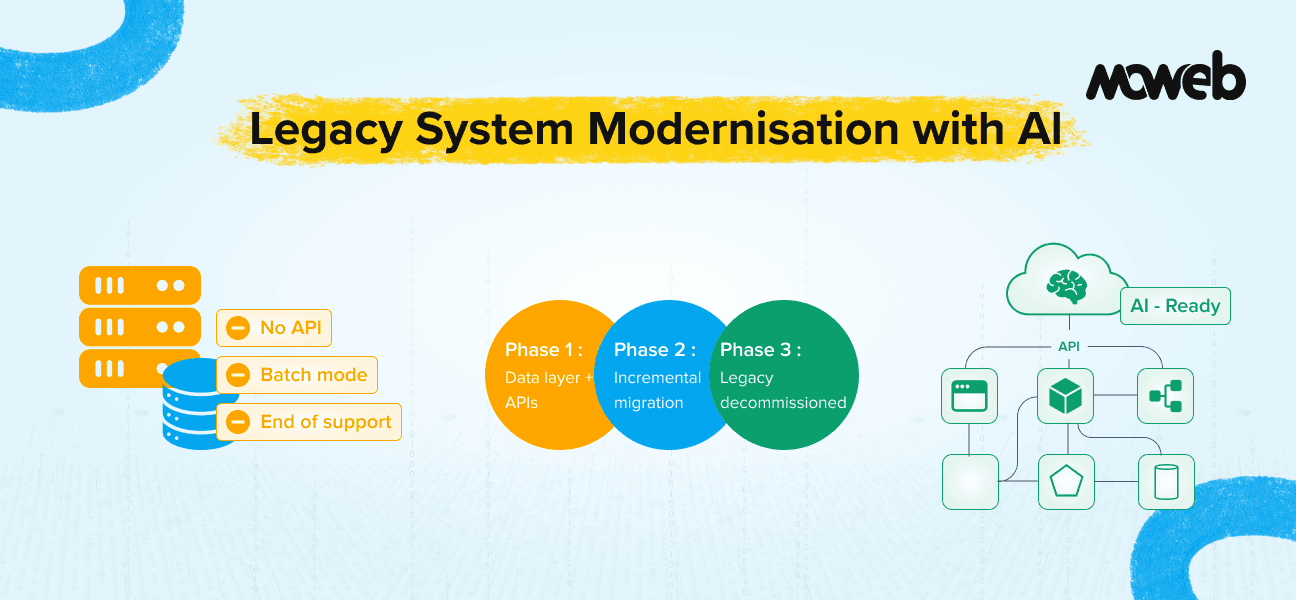
A practical guide to AI-assisted legacy system modernisation for enterprise technology leaders in 2026. Covers the 6R strategies, how AI accelerates modernisation, the Strangler Fig pattern, data modernisation, and a phased implementation roadmap.
What is legacy system modernisation? Legacy system modernisation is the process of updating, refactoring, re-platforming, or replacing outdated enterprise software and infrastructure so it meets current requirements for performance, security, scalability, cloud integration, and AI capability. It is not always the same as replacement. The six standard modernisation strategies (Retire, Retain, Rehost, Replatform, Refactor, Replace) offer a spectrum from minimal change to complete rebuild, with most enterprise programmes using different strategies for different systems based on their business criticality, technical debt level, and strategic relevance.
How is AI changing the cost and timeline of legacy system modernisation in 2026? AI is fundamentally changing the economics of legacy modernisation. AI tools now perform automated codebase analysis, dependency mapping, code translation between legacy and modern languages, test suite generation, and documentation tasks that previously required large teams of specialist engineers working for months. AI cuts well-scoped modernisation timelines on structured, governed team workflows. The productivity gains require structured team workflows and human oversight, not ad-hoc tool usage. This acceleration means modernisation programmes that were previously unaffordable or too disruptive for mid-market enterprises are now within reach.
There is a conversation that happens in most enterprise technology leadership teams every year, usually triggered by a significant incident: a security vulnerability in an unsupported system, a failed integration attempt between the old ERP and a new AI tool, a compliance audit that surfaces a system running software three versions behind support.
The conversation is always the same. “We need to modernise the legacy systems.” Then the estimates come in, and the conversation moves to other priorities.
In 2026, the economics of that conversation have changed in three ways that make deferral more expensive than it has ever been. The global cost of application maintenance now exceeds $1.68 trillion annually. The cost of maintaining the status quo is no longer just the maintenance bill it is the AI capability that the organisation cannot access while its data and processes are locked in systems that modern AI cannot connect to. Anthropic published a COBOL modernisation playbook in February 2026, specifically demonstrating how AI agents compress the discovery, analysis, and documentation phases that make legacy migration prohibitively expensive. The effort and cost that made modernisation feel prohibitive two years ago has been substantially reduced, but only for teams with structured oversight workflows, not ad-hoc individual tool usage.
Third, the regulatory pressure is no longer theoretical. DORA for financial services, the EU AI Act’s requirements for documented and governable AI systems, NIS2 for network security, and sector-specific compliance frameworks are creating hard deadlines around system modernisation that the previous regime of “we’ll get to it” does not accommodate. The question for enterprise technology leaders is no longer whether to modernise. It is which systems to modernise first, which strategy to apply to each, and how AI changes the delivery approach.
Why Legacy Systems Block AI Adoption
The most commercially urgent argument for legacy modernisation in 2026 is not security, compliance, or maintenance cost. It is an AI capability. The talent dimension compounds this urgency: 5,000 to 10,000 mainframe developers retire annually, and the pool of engineers who can maintain COBOL, VB6, and classic ASP systems is contracting faster than the systems themselves are being retired.
Every enterprise AI capability covered in this blog series, from RAG-based knowledge assistants to predictive models to AI agents, depends on data being accessible, current, and in a format that AI systems can process. Legacy systems that store data in proprietary formats, expose no APIs, require batch-mode data extraction on overnight schedules, and use data models designed before the concept of AI integration existed are structural barriers to every AI use case the organisation wants to deploy.
The specific blockers are consistent across industries:
No API layer. Legacy systems built in the 1990s and 2000s were designed for human users through thick-client interfaces, not for machine-to-machine integration. An AI agent that needs to query the ERP for inventory data or update the CRM with a transaction outcome cannot do so through a system that has no integration interface. Wrapper API development is the minimum investment; full modernisation creates a native integration layer.
Batch data architecture. Legacy systems that update nightly via batch processes cannot support AI use cases that require real-time or near-real-time data. A demand forecasting model that runs on yesterday’s inventory snapshot cannot support same-day procurement decisions. A customer service AI that references week-old account data cannot provide accurate responses to current queries.
Proprietary or undocumented data models. Legacy systems frequently store data in formats and schemas that are neither documented nor accessible through standard data engineering approaches. Before AI can be applied to that data, the schema must be reverse-engineered, the data extracted, and the relationships mapped – a data engineering project that often surfaces as an unwelcome surprise mid-way through an AI programme.
Unsupported technology stacks. AI development teams working in Python, deploying on Kubernetes, and integrating through REST APIs cannot easily work alongside systems running COBOL on mainframes, Classic ASP on IIS, or VB6 on Windows Server 2008. The skill gap is as much an integration barrier as the technical architecture.
The practical implication: for many enterprises, legacy modernisation is not a separate programme from AI adoption. It is a prerequisite for it. Addressing the blockers above – even partially, through wrapper APIs and data extraction pipelines – unlocks AI investment value that is otherwise inaccessible.
For the specific modernisation challenges and AI integration approaches relevant to manufacturing operational technology, see our guide to AI in manufacturing: pilot to plant-wide deployment.
The 6R Framework: Choosing the Right Strategy for Each System
Not every legacy system requires the same modernisation approach. The 6R framework (Retire, Retain, Rehost, Replatform, Refactor, Replace) provides a structured vocabulary for matching the right strategy to each system based on its business criticality, technical debt level, and strategic relevance.
Retirement means decommissioning systems that are no longer needed. Many enterprises run more applications than they use – systems that were once essential but whose functions have been absorbed by other platforms. Retirement is the least disruptive and lowest-cost option. It requires data archival and user migration, but no redevelopment. A systematic application portfolio review typically identifies of enterprise applications as retirement candidates.
Retain means keeping a system as-is, typically because modernisation cost exceeds the value of change or because the system’s criticality and complexity make the risk of modification too high. Retain is a legitimate strategic choice for stable, business-critical systems with manageable technical debt. It becomes problematic when Retain is chosen by default rather than by design, when it means neither modernising nor managing the resulting risk.
Rehost (lift-and-shift) moves an existing application to cloud infrastructure with minimal changes to the application itself. The application runs on modern infrastructure but retains its existing code and architecture. Rehost is the fastest and lowest-risk modernisation move – typically achievable in 8-12 weeks for a single application. The benefit is operational: managed backup, elastic scaling, disaster recovery, and reduced infrastructure maintenance. The limitation is that rehosting does not improve the application’s integration capabilities, code quality, or AI readiness. It is a first step, not a final destination.
Replatform moves an application to a new platform with targeted modifications to leverage platform capabilities, without redesigning the core application logic. Migrating a web application from on-premises IIS to a managed cloud application service, updating the database from SQL Server 2012 to Azure SQL Database, or migrating from a proprietary message queue to a managed streaming service – these changes improve operational efficiency and integration capability without requiring a full redevelopment.
Refactor (re-architect) restructures the application’s internal design without changing its external behaviour – improving code quality, reducing technical debt, decomposing a monolith into services, and modernising the integration architecture. Refactoring is the highest-value modernisation strategy for systems that are functionally sound but architecturally limiting. It is also the most expensive and complex strategy to execute safely. This is where AI-assisted development delivers the most significant acceleration.
Replace means rebuilding the system from scratch on a modern architecture, or replacing it with a commercial product that delivers equivalent functionality. Replacement is appropriate when the existing system is technically beyond salvage or when commercial products now exist that deliver the required functionality at a lower total cost than continued maintenance of a bespoke system. Replace carries the highest risk and longest timeline of all 6R strategies.
Most enterprise modernisation programmes use different strategies for different applications: retiring the redundant, rehosting the stable-but-unmaintained, replatforming the operationally constrained, and refactoring or replacing the strategically critical.
How AI Accelerates Modernisation: The Specific Capabilities
The role of AI in modernisation is not to make architectural decisions. It is to accelerate the engineering work that human architects and developers still direct and validate. The caveat that every CTO briefing on this topic should include: AI productivity gains in modernisation are real but require structured team governance to materialise. AI is a force multiplier for well-structured teams and a productivity trap for undisciplined ones. The governance model matters as much as the tooling selection.
The specific AI capabilities that are changing modernisation timelines are:
Automated codebase analysis. A 2-million-line COBOL codebase that would take a team of engineers weeks to map manually can be analysed by AI in days – identifying function behaviour, flagging deprecated patterns, mapping data flow and module dependencies, and generating a structured inventory of the codebase’s components and their relationships.
Dependency mapping. Understanding the full dependency graph of a legacy system – which modules call which, which data tables are read and written by which functions, which external systems exchange data at which points – is the prerequisite for safe incremental modernisation. AI dependency mapping reduces this analysis from weeks to days, and produces structured documentation that would previously require significant manual effort to maintain.
Code translation. AI models can translate code between languages with meaningful semantic fidelity – COBOL to Java, VB6 to C#, Classic ASP to modern web frameworks, PL/SQL stored procedures to application logic. Anthropic published a dedicated COBOL modernisation playbook in February 2026, demonstrating how AI agents compress the discovery and documentation phases that most COBOL projects fail on. Security review gates are a non-negotiable part of any AI-assisted translation workflow.
Test suite generation. One of the highest-risk aspects of legacy modernisation is ensuring the modernised system behaves identically to the legacy system for all existing use cases. AI test generation tools analyse existing system behaviour and generate comprehensive test suites that validate the modernised system against the legacy baseline. This reduces regression testing time and provides a more comprehensive safety net than manually written test suites typically achieve.
Documentation generation. Legacy systems are frequently poorly documented – the institutional knowledge of how a system works often resides in the heads of engineers who may no longer be at the organisation. AI tools generate code-level documentation from the codebase itself, making that knowledge explicit and transferable.
The Strangler Fig Pattern: The Safest Approach to Large System Replacement
For large, business-critical legacy systems where the risk of big-bang replacement is unacceptable, the Strangler Fig pattern is the dominant approach in 2026. Martin Fowler named the pattern in 2004, and it remains the best practice for enterprise systems that are too large and too critical to replace in a single move.
The pattern works as follows: new functionality is built on a modern platform running alongside the existing legacy system. A routing layer (typically an API gateway) directs traffic between the legacy system and the new modern platform based on which components have been migrated. As modern components are completed and validated, the routing layer shifts more traffic to the modern platform and less to the legacy system. Over time, the legacy system is progressively “strangled” as modern components replace each of its functions, until the legacy system can be decommissioned entirely.
The key advantages of the Strangler Fig pattern are risk management and early value delivery. Rather than waiting for a complete replacement before any modernised functionality reaches production, individual components deliver value as soon as they are completed. A failure in one component affects only that component, not the entire system. Stakeholders see concrete progress at every milestone, which sustains executive support through what is inevitably a multi-year programme for large systems.
Incremental modernisation approaches like the Strangler Fig typically reach positive ROI in 12-14 months, because returns begin in the first phase while later phases are still in progress. Big-bang re-architecture and replacement projects typically show 18-36 month payback periods.
The pattern requires careful design at two layers: the API boundary design (which functions are routed where, and how the routing layer manages state consistency across the two systems during the transition) and the data synchronisation design (how data is kept consistent between the legacy and modern systems while both are running). Both layers are where architecture expertise is essential – AI tools accelerate the engineering execution, but cannot substitute for the architectural judgment that determines whether the pattern succeeds. The 2026 market’s shift away from big-bang replacement is now well documented: the high-risk, wholesale system replacement approach is widely discredited, and enterprises have pivoted firmly toward continuous, iterative AI-assisted strategies (Keyhole Software, May 2026).
Data Modernisation: The Most Underestimated Starting Point
In most enterprise modernisation programmes, application modernisation receives strategic attention, and data modernisation is treated as a parallel workstream. Experience consistently shows this sequencing is wrong.
Fragmented, inaccessible data is one of the most common pain points with legacy environments. Migrating to a modern data lakehouse, or simply building clean API access to existing data without touching core systems, unlocks AI capabilities, improves reporting, and creates early wins that build internal momentum for larger transformation work.
Data modernisation as the entry point to a broader modernisation programme has three specific advantages.
It unlocks immediate AI value. An AI knowledge assistant, a demand forecasting model, or a customer analytics system can be built on top of a modern data layer even while the underlying legacy application systems remain unchanged. The data modernisation investment generates AI ROI before the more expensive application modernisation phases are complete.
It informs application modernisation decisions. The data quality, schema consistency, and completeness problems that data modernisation surfaces are critical inputs to application modernisation scoping. Discovering mid-application-modernisation that a core entity lacks a consistent identifier across three systems is a project risk. Discovering it during data modernisation, when the implications are better understood, allows the application modernisation scope to address it systematically.
It generates early stakeholder wins. Modern reporting, self-service analytics, and AI-powered dashboards that were not possible on legacy data infrastructure can typically be delivered within the first 8-12 weeks of a data modernisation programme. These early wins generate executive visibility and confidence that sustains support for the longer application modernisation phases that follow.
Data modernisation is now the acknowledged top AI prerequisite, with enterprises migrating from Teradata and Oracle to Snowflake, Databricks, and BigQuery to support real-time AI workloads (Entrans, 2026). The stack has converged meaningfully; the same lakehouse architectures that support real-time AI serve as the target for application modernisation data migration, meaning data modernisation investment is not a standalone programme but the shared foundation for both AI and application modernisation ROI.
For the specific data infrastructure architecture that both AI and modernised applications require, our guide to data engineering for AI: building the foundations covers the lakehouse architecture, pipeline design, and data quality frameworks in detail.
Implementation Roadmap: A Phased Approach to Enterprise Modernisation
The phased approach to legacy modernisation balances speed-to-value with risk management, using each phase to generate value that funds and justifies the next.
Phase 1 (Weeks 1-6): Portfolio assessment and strategy assignment. The starting point is a structured assessment of the application portfolio – not just an inventory, but a strategic evaluation of each system against four dimensions: business criticality (what breaks if this system fails?), technical debt level (how expensive is ongoing maintenance? what integration barriers does it create?), AI readiness (can this system’s data be accessed by AI systems? does it expose integration interfaces?), and strategic relevance (is this system’s function still relevant to the business model? does it overlap with other systems?).
AI-powered codebase analysis accelerates this assessment for all systems where the codebase is accessible. The output is a portfolio map that assigns each application a 6R strategy and a priority tier, and identifies the systems where modernisation unblocks the highest-value AI use cases.
For the AI readiness dimensions that portfolio assessment should evaluate alongside technical debt, see our AI readiness assessment checklist.
Phase 2 (Weeks 6-16): Data modernisation and API layer. The first active modernisation phase should be data modernisation for the highest-priority AI use cases identified in Phase 1. This involves building the data extraction pipelines from legacy systems, establishing the data lake or lakehouse architecture, implementing data quality frameworks, and creating the API layer that allows AI systems to read from (and in some cases write to) legacy system data without requiring application-level changes.
For systems earmarked for Rehost or Replatform, the infrastructure migration can run in parallel with the data modernisation work, as the two streams are largely independent.
Phase 3 (Months 4-12): Incremental application modernisation. With the data layer established and AI use cases beginning to generate value, Phase 3 addresses the application modernisation priorities identified in Phase 1. For systems using the Strangler Fig pattern, this phase begins the component-by-component migration. For systems earmarked for Refactor, AI-assisted code analysis and translation tools accelerate the refactoring work while human engineers validate each module.
The sequencing principle within Phase 3: modernise the integration boundaries first. The modules that connect the legacy system to other systems, or that expose data to external consumers, are the highest-value modernisation targets because they unblock the most downstream capability. The governance requirement within Phase 3: implement security review gates at every AI-assisted translation step. Reviewing for security separately from reviewing for functional correctness is an architectural requirement, not an optional quality check.
Phase 4 (Ongoing): Continuous modernisation. Legacy modernisation is not a project with an end date for most organisations – it is an ongoing programme. After the initial high-priority systems are addressed, a continuous modernisation practice maintains the portfolio’s technical health: retiring applications as their functions are absorbed, rehosting ageing infrastructure before failure forces an emergency migration, and refactoring components when the cost of maintenance exceeds the cost of improvement.
Our Data Engineering and Foundations practice handles the data layer that modernisation unlocks. Talk to us about your modernisation programme.
Frequently Asked Questions About Legacy System Modernisation
What is the difference between legacy system modernisation and digital transformation? Legacy system modernisation is a component of digital transformation – specifically, the component that addresses outdated technology infrastructure. Digital transformation is broader, encompassing business model change, customer experience redesign, and organisational capability development alongside technology modernisation. In practice, the two are interdependent: digital transformation initiatives that require real-time data, AI integration, or cloud-native architecture are blocked until the legacy systems that hold the relevant data and processes are modernised. Treating them as separate programmes creates conflict; treating modernisation as the technical foundation of transformation is the more effective approach.
What does AI actually do in a legacy modernisation project? AI tools reduce modernisation timelines on structured, governed workflows, but flat or negative results occur without review governance, as documented by the GitLab 2026 DevSecOps “AI Paradox”. Human review for security is mandatory. AI does not make architectural decisions, interpret business logic, or replace the domain expertise that determines whether translated code is semantically correct.
Should we replace or modernise our legacy ERP? The Replace vs Refactor decision for a core ERP depends on four factors: how much of the ERP’s current functionality does the business actually use (unused functionality is a cost with no offsetting value); whether commercial ERP products now deliver the required functionality more cost-effectively than ongoing bespoke maintenance; how deeply the ERP’s business logic encodes genuinely proprietary process intelligence that would need to be replicated in any replacement; and whether the ERP can be API-wrapped to connect to modern systems without replacement. For most mid-market enterprises, replatforming to a modern cloud ERP (SAP S/4HANA, Microsoft Dynamics 365, Oracle Cloud ERP) delivers better long-term economics than refactoring a bespoke ERP. The transition risk and implementation cost are real but one-time; the ongoing maintenance cost of a bespoke ERP is recurring and typically growing.
What is the Strangler Fig pattern, and when should it be used? The Strangler Fig pattern is a modernisation approach where new functionality is built on a modern platform running alongside the legacy system, with a routing layer progressively shifting traffic to the modern platform as components are completed. The legacy system is gradually displaced rather than replaced in a single move. It is appropriate for large, business-critical systems where big-bang replacement risk is unacceptable, where the system will take more than 12 months to replace fully, and where early value delivery from individual modernised components is commercially important. It requires careful API boundary design and data synchronisation architecture to manage the period when both systems are running simultaneously.
What is the typical cost of enterprise legacy system modernisation? Costs vary substantially by system complexity, scale, and strategy. For mid-market enterprises, partial modernisation of a single application system typically runs $150,000-$500,000 in 2026. Rehost of a single application is typically $30,000-$80,000. Full replacement of a core enterprise system (ERP, CRM, core banking) for a mid-market organisation ranges from $500,000 to $5 million, including implementation, data migration, integration, and change management. AI-assisted development reduces the engineering cost component compared to 2023 benchmarks, making programmes that were previously beyond mid-market budgets increasingly accessible. Incremental modernisation approaches reach positive ROI in 12-14 months; big-bang replacement projects typically show 18-36 month payback periods.
How do we modernise without disrupting operations? The Strangler Fig pattern and incremental modernisation strategies are specifically designed to minimise operational disruption. The key principles are: never modernise in production without a parallel running fallback; test each modernised component against the legacy baseline before switching traffic; build rollback procedures before each migration step; start with lower-risk components (internal tools, reporting systems, non-customer-facing applications) to build team confidence before modernising customer-critical systems; and use feature flags to control the migration of user traffic between legacy and modern components rather than hard cutovers.
What security risks does AI-assisted code migration introduce? GitClear’s analysis found an eightfold increase in code duplication from AI-assisted development, which amplifies any security flaw across the codebase. The governance response is explicit security review gates at every AI-assisted translation step, separate from the functional correctness review, with security instructions included in every AI-generated code prompt. Treating security review as an optional quality check rather than a mandatory governance gate is the most common security failure pattern in AI-assisted modernisation programmes.
Conclusion: The Organisations That Modernise Incrementally Win Twice
The enterprises successfully modernising their legacy systems in 2026 are not the ones with the most aggressive “everything cloud-native by 2028” mandates. They are the ones applying systematic, incremental strategies that deliver AI and operational value at each phase while managing the risk of disrupting the systems their businesses depend on.
They are winning twice: first, by reducing the maintenance burden that consumes IT budgets without generating strategic value; and second, by unlocking the AI capabilities that modern infrastructure enables – capabilities that are structurally inaccessible while data and processes remain locked in legacy systems that AI cannot connect to.
AI-assisted development has changed the economics of this programme in ways that make action genuinely more accessible in 2026 than it was two years ago. provided the governance and security review disciplines are in place before the AI tooling is deployed, not added after the first vulnerability is found.
The organisations that will look back on 2026 as the year they made the right decision will be those that started the portfolio assessment now – not because the urgency is artificial, but because the combination of AI-blocked productivity, growing regulatory pressure, and genuinely changed modernisation economics makes this the best window in recent memory to act.
Our approach combines portfolio assessment with AI-assisted delivery and the data engineering foundation that both AI adoption and modern architecture require. Start with a portfolio assessment conversation.
Found this post insightful? Don’t forget to share it with your network!