
Legacy Application Modernization: An Enterprise Guide
A practical guide to legacy application modernization: when to modernize, the modernization R's, risk controls, and how to sequence the work.
The quiet tax of skipping legacy application modernization
Every enterprise carries at least one system that everyone is afraid to touch. It runs a critical process, the people who built it have moved on, and the documentation is a folder of screenshots. It works, until a security patch, a compliance change, or a new integration forces the question everyone has avoided. Legacy application modernization is the discipline of answering that question deliberately, before the system answers it for you with an outage.
Modernization is not the same as rewriting everything. It is a set of choices about which systems to leave alone, which to update in place, and which to replace, made against business value rather than engineering preference. Done well, it reduces the maintenance burden, unlocks integration and data access, and turns a fragile liability into a platform you can build on. Done reactively, it becomes an expensive emergency. This guide lays out how enterprise leaders can approach it as strategy.
What actually counts as "legacy"
A system is legacy not because it is old, but because it constrains the business. Age is a symptom; the real markers are practical.
- **It is hard to change.** Small feature requests take weeks and carry real risk of breaking something unrelated.
- **It is hard to integrate.** Getting data in or out means brittle exports, screen-scraping, or manual re-keying.
- **It is hard to staff.** The languages, frameworks, or platforms are unfamiliar to the people you can actually hire.
- **It is hard to secure or certify.** Unsupported dependencies and undocumented behavior make audits and compliance painful.
A stable mainframe batch job that nobody needs to change may not be a modernization priority at all. A five-year-old web application that blocks every new product idea very much is. The decision should follow business friction, not the calendar.
The cost of waiting
Deferring modernization rarely saves money; it moves the cost somewhere less visible. Maintaining aging systems consumes a growing share of IT budgets, diverting engineers from new work toward keeping the lights on, the accumulation the industry calls technical debt. Beyond the direct maintenance bill, legacy systems impose an opportunity cost: they slow down every initiative that has to touch them, from a new customer portal to an AI project that needs clean access to data locked inside them. Industry analyses of modernization consistently frame it as a shift from reactive maintenance toward business growth (Gartner on application modernization). The longer a core system stays frozen, the more the rest of the roadmap bends around it.
The modernization options: the "R's"
There is no single way to modernize, and treating every system with the same approach is the fastest way to overspend. Practitioners and cloud providers describe a spectrum of strategies, often called the modernization or migration "R's" (AWS on the 6 R's of migration). Ordered from least to most invasive:
Retain
Leave the system as is. This is a legitimate, active decision for stable systems that deliver value and are not blocking anything. Retaining lets you concentrate budget where it moves the business.
Rehost
Move the application to modern infrastructure, typically the cloud, with minimal code change, often called "lift and shift." It reduces hardware and hosting risk quickly but does not fix the application's internal problems.
Replatform
Make targeted changes during the move: swap a database, adopt managed services, containerize. More effort than rehosting, with more of the operational payoff.
Refactor and rearchitect
Restructure the code and, in the deeper case, the architecture: carving a monolith into services or decoupling a stubborn integration. This is where real agility is bought, and it is the most demanding path.
Rebuild and replace
Rewrite the capability, or retire it in favor of a commercial product. Appropriate when the existing system is beyond economical repair or when a standard product now covers the need better than custom code.
The craft is in matching each system to the least invasive option that removes the actual business friction. Most enterprise portfolios end up with a mix.
How to sequence the work
Modernization fails most often not from bad engineering but from bad sequencing, trying to change everything at once, or starting with the hardest system and losing momentum.
Inventory and assess
Map the portfolio: what each system does, what it depends on, its business value, and its risk. You cannot prioritize what you have not honestly catalogued.
Prioritize by value and risk
Rank candidates by the friction they cause and the risk they carry. The first project should be valuable enough to matter and contained enough to succeed.
Modernize incrementally
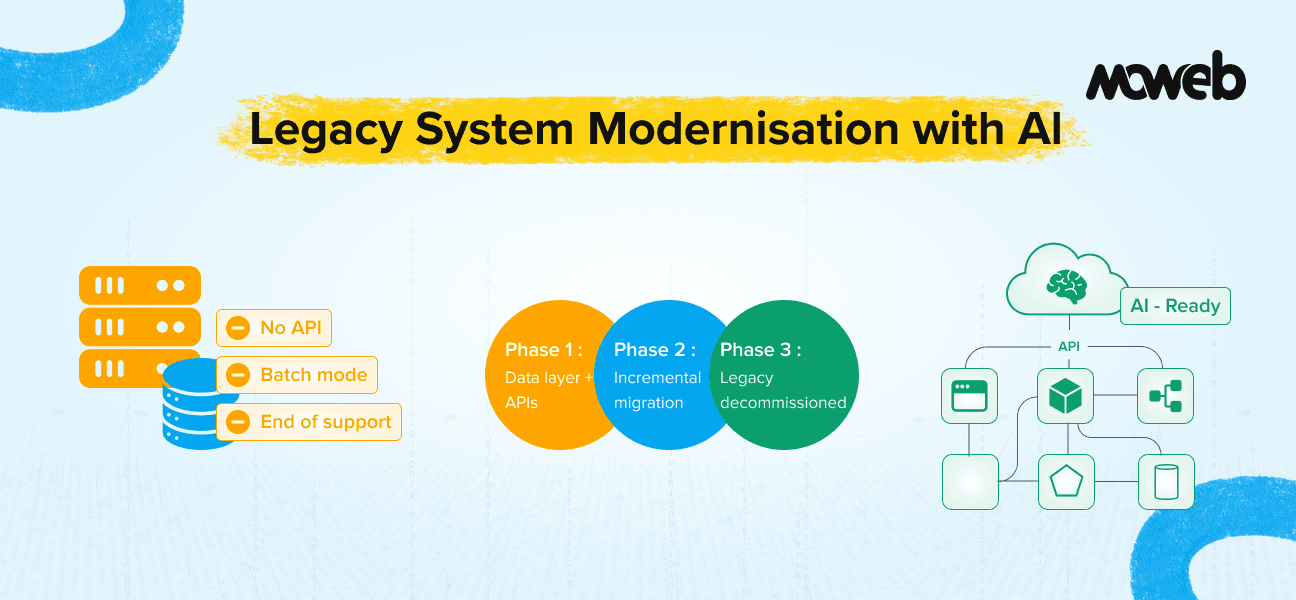
Wherever possible, change systems in slices rather than in one high-stakes cutover. Patterns such as running old and new side by side, or gradually redirecting traffic from the legacy system to its replacement, let you de-risk and roll back.
Protect data and continuity
Data migration is where modernization projects most often stumble. Plan validation, reconciliation, and fallback before moving a single record, and keep the business running throughout.
Decommission deliberately
A modernization is not finished until the old system is retired and its costs are actually removed. Systems left running "just in case" quietly recreate the debt you set out to clear.
Where AI fits
Modernization and AI reinforce each other. Legacy systems are frequently the reason an AI initiative stalls, because the data it needs is trapped in formats and silos that are hard to reach. Untangling those systems is often the prerequisite for any serious data or AI strategy, which is why modernization now sits at the center of digital transformation rather than off to the side of it.
Frequently asked questions
Is it cheaper to modernize or to keep maintaining a legacy system?
It depends on how much the system constrains the business, but maintenance costs rarely stay flat; they tend to rise as expertise leaves and dependencies age. The honest comparison is not modernization cost versus zero, but modernization cost versus the growing, compounding cost of standing still.
Should we lift and shift to the cloud first, or refactor?
Rehosting can reduce infrastructure risk quickly, but on its own it carries the application's problems to a new location. For systems that block the business, replatforming or refactoring delivers more of the value; for stable systems, a simple rehost may be all that is warranted.
How do we modernize without disrupting daily operations?
Through incremental patterns: running old and new in parallel, migrating in slices, and redirecting traffic gradually rather than in a single big cutover. Continuity planning and data validation matter as much as the code changes.
How long does modernization take?
There is no universal answer; it scales with the size and entanglement of the portfolio. This is precisely why sequencing matters, a well-chosen first project can deliver visible value in a single quarter while the larger program continues.
Modernizing with Moweb
Legacy modernization rewards enterprises that treat it as a portfolio strategy: retain what works, update what constrains you, and replace what is beyond repair, rather than as a single heroic rewrite. If you are weighing how to modernize a critical system without stalling the business, Moweb's digital transformation and enterprise software development teams help enterprises assess their portfolios and sequence the work. Start a conversation and a senior engineer will tell you what we would do, including where the right answer is to leave a system alone.