
Hotel Overbooking and Inventory Sync: The One Room Test for Your PMS and Channel Manager
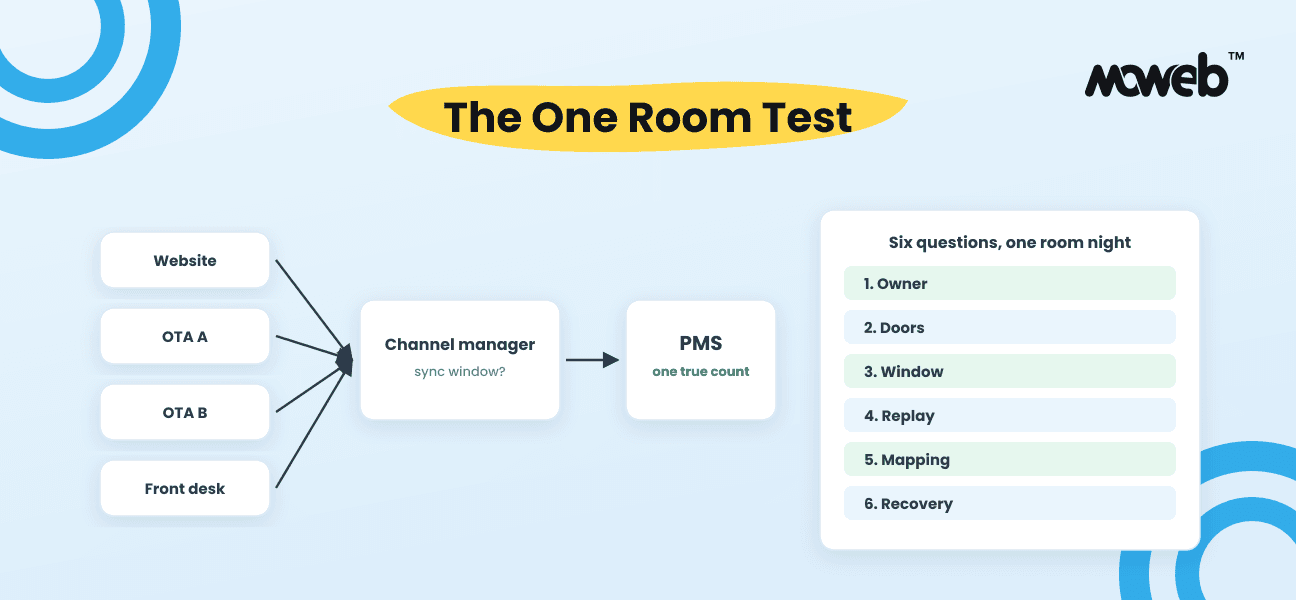
Overbookings are rarely bad luck. They come from how your PMS, channel manager and booking channels share one room. The One Room Test finds the gaps before a guest does.
A guest arrives at 11 at night with a confirmed booking and there is no room for them. The front desk walks them to another property, pays for the taxi and the night, and absorbs a review that will sit on the listing for years. The next morning the general manager asks how it happened, and the answer is usually some version of "the systems did not sync in time".
That answer is accurate and unhelpful. Overbooking caused by systems is not random. It comes from specific, findable gaps in how a property's inventory is shared between the property management system (PMS), the channel manager, the booking engine, online travel agencies and the front desk. Every gap has a mechanism, and every mechanism can be tested.
This guide is for hotel and resort owners, revenue managers and hospitality technology leads. It gives you a practical way to find those gaps: the One Room Test.
Why overbooking is a systems problem, not a front desk problem
A room night is a single unit of inventory being sold through many doors at once. Your website, two or three OTAs, a wholesaler, the phone, walk-ins and sometimes a group block all sell from the same pool. Every one of those doors needs to know, at the moment of sale, whether the unit is still available.
In practice that knowledge travels through a chain of systems, each with its own timing. A booking lands on one channel, is pulled or pushed to the channel manager, written to the PMS, and then an availability update goes back out to every other channel. Any delay, failure or mismatch along that chain opens a window in which the same room can be sold twice.
Booking.com's own connectivity documentation is candid about this. It lists the common causes of overbookings as system outages that stop availability being updated, incorrect auto-replenishment of cancelled reservations, late requests to close availability, non-XML rates and rates not correctly mapped for availability updates. It also recommends that connectivity partners increase the frequency of reservation pulls "to 30 seconds or less" to reduce the problem (Booking.com, Troubleshooting overbookings). Almost every item on that list is an integration design question, not a staff training question.
We have seen the same pattern first-hand. When we built an end-to-end resort management platform for Navdeep Resort, one of the documented problems was that the booking system did not sync information between the online and offline interfaces, which often resulted in overbooking. Fixing it meant treating inventory as one shared record rather than several copies kept roughly in step.
What an overbooking really costs
The visible cost is the relocation: the alternative room, the transport, perhaps a refund or a goodwill credit. That is the smallest part.
**The review outlives the night.** A guest who was walked writes about it, and that review sits beside your listing on the same channels that sent the booking. It keeps costing conversions long after the room night is forgotten.
**Channel standing can suffer.** OTAs track how reliably properties honour reservations. Repeated relocations on one channel can affect how a property is treated there, which is why their connectivity teams publish guidance on preventing them.
**Staff time goes to firefighting.** Every overbooking pulls the reservations team and the night manager into calls, apologies and manual reconciliation, usually at the busiest time of year.
**Revenue managers stop trusting the numbers.** Once teams have been burned, they start holding back inventory "just in case", closing channels early or keeping buffer rooms. That quietly costs occupancy on exactly the dates where every room should be selling.
That last cost is the one owners rarely see, and it is often larger than the relocations themselves. Fixing the systems is what lets the team sell the full house with confidence.
The One Room Test
The test asks six questions about a single room type on a single night. Pick a real one, ideally a high-demand date, and answer each question with evidence from your systems rather than from the vendor brochure.
Owner: which system holds the true count?
There must be exactly one system of record for availability. Usually it is the PMS; sometimes the channel manager holds the authoritative count and the PMS follows. Either can work. What fails is ambiguity, where the PMS, the channel manager and the booking engine each keep their own count and reconcile occasionally.
Ask your team which number wins when two systems disagree. If the answer is "whoever updated last", you do not have an owner.
Doors: how many places can sell this room, and do they all draw from the owner?
List every channel that can sell the room type: direct website, each OTA, wholesalers, GDS, the call centre, the front desk, group and corporate allocations. Then check that each one decrements the same inventory pool.
The usual leaks are manual ones. A sales manager holds rooms for a group in a spreadsheet. An OTA has a separate allotment set up years ago and never removed. A rate plan exists on a channel that is not connected through the channel manager at all, the "non-XML rate" Booking.com warns about. Each unconnected door is an overbooking waiting for a busy weekend.
Window: how long between a sale and every other door knowing?
Measure it. Make a test booking on one channel and time how long it takes for availability to change on each of the others. The gap between the booking and the last channel updating is your overbooking window.
The window is shaped by how reservations are retrieved (pushed instantly or pulled on a schedule), how quickly the PMS writes them, and how quickly availability updates go out. On a quiet Tuesday a long window costs nothing. On a sold-out festival weekend, when the last rooms are being booked minutes apart, it is the whole problem.
Replay: what happens when a message fails or arrives twice?
Integrations fail. A connection drops, an API times out, a message is delivered twice or out of order. The question is whether your systems recover correctly on their own.
A passing answer looks like this: every booking and availability message has a unique identifier, duplicates are recognised and ignored, failures are retried automatically, and anything that cannot be processed lands in a visible queue with an owner. A failing answer is "we check the error emails in the morning".
Mapping: does every room type and rate plan line up across systems?
Every room type and rate plan in the PMS has to be mapped to the matching product on each channel. A mapping error is invisible until it matters. A newly added rate that was never mapped sells without decrementing inventory. A room type mapped to the wrong code closes the wrong product. A cancellation on one channel can automatically reopen a room that the property had deliberately closed, which is the auto-replenishment issue in Booking.com's list.
Run a mapping audit whenever rooms, rates or channels change, not only at go-live.
Recovery: when an overbooking happens anyway, how fast is it caught?
Even a well-designed setup can occasionally oversell, for example when two bookings arrive within the same instant. The final question is whether you find out within minutes, with time to act, or at check-in.
A passing setup alerts on any night where confirmed bookings exceed sellable rooms, shows which booking arrived last and through which door, and gives the reservations team enough lead time to relocate a guest with dignity rather than at midnight.
Reading your results
Count the questions where you have a confident, evidenced answer.
- **Six:** your remaining overbooking risk is genuinely small. Keep auditing mapping whenever products change.
- **Four or five:** you probably oversell a few times a year, mostly on peak dates. Fix the failing questions before your next high season.
- **Three or fewer:** overbooking is built into your setup. Staff can manage it for a while, but it will get worse as you add channels.
The most common failures are Doors (an unconnected channel or manual allocation) and Window (scheduled pulls that are too slow on peak dates). Both are fixable without replacing your PMS.
Fix, integrate or rebuild?
The test also points to the right scale of fix.
**Configuration fixes** cover Mapping problems, closing unconnected doors and enabling faster retrieval where your existing channel manager supports it. These are days of work.
**Integration work** is needed when Window and Replay fail because the connection between your PMS and channel manager, or between your booking engine and the PMS, is built on slow polling or has no reliable retry and de-duplication. This is where custom middleware or a rebuilt connector usually pays for itself.
**A platform rebuild** makes sense when Owner fails at a fundamental level: inventory is split across systems that were never designed to share it, often alongside separate tools for billing, restaurant, events and accounting. That was the situation behind the resort platform mentioned above, where a single system for bookings, inventory, billing and reporting replaced several disconnected ones.
Our hospitality software development team works across all three, and our enterprise software development practice handles the integration layer. Where a property needs a new guest-facing booking experience, that sits with our web application development team.
Questions hoteliers ask about overbooking and inventory sync
Is some overbooking deliberate?
Some properties overbook on purpose to offset expected no-shows. That is a revenue management decision with a known risk. This test is about the overbooking nobody chose, caused by systems that disagree.
Will a new channel manager fix overbooking?
Only if your failures are in the channel manager itself. If the problem is an unconnected door, a mapping error or a manual allocation, a new channel manager inherits the same gaps.
How often should we run this test?
Before every high season, and whenever you add a channel, a room type or a rate plan. The Mapping and Doors questions drift the most over time.
Can small properties afford a custom integration?
Often the fix is not custom software at all but configuration and closing manual doors. Custom work is worth it when the measured window or failure handling is the problem and off-the-shelf connectors cannot close it.
What should we ask a software vendor before buying?
Ask them to answer the six questions for their own product: who owns the count, how retrieval works, what happens on a failed or duplicate message, and how overbookings are alerted. Vague answers to Replay and Recovery are the warning sign.
Run the One Room Test with our hospitality team
If overbookings keep landing on your front desk, pick your busiest room type and your next sold-out date, and we will run the One Room Test with you. A senior engineer will trace that room through every system and channel you use, measure the real sync window, and tell you whether the fix is configuration, integration or a new platform, along with what each would involve.
Book an inventory sync review. You can also read how we approached a full resort operation in our Navdeep Resort case study, or browse more of our work on the case studies page.