
Wealth Management Client Portal and App Development for RIAs: The Client Portal Test
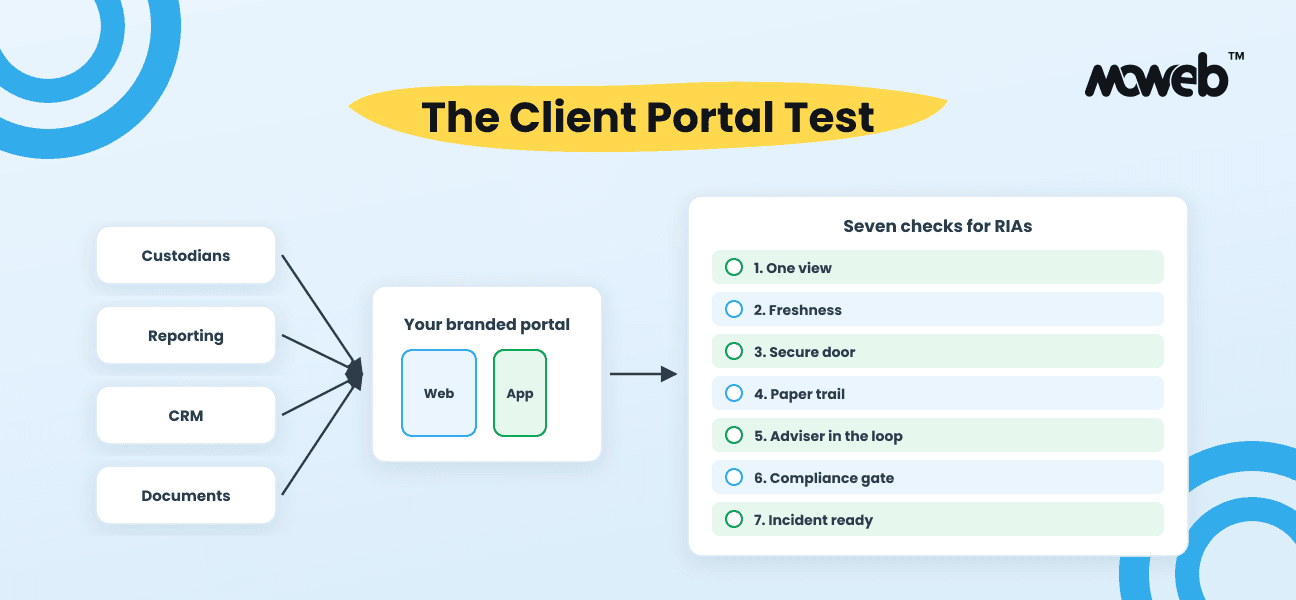
A practical guide for RIAs and family offices planning a branded client portal and mobile app: must-have features, integrations, SEC compliance, build vs buy, and the Client Portal Test.
A wealth management client portal is no longer a nice extra for a registered investment adviser. It is where clients check their progress, find their documents, message their adviser and decide, quietly, whether the firm feels modern enough to keep their family's money for another generation.
Most independent RIAs and multi-family offices still give clients a patchwork: a custodian login for statements, a separate reporting portal from the portfolio accounting vendor, a file-sharing link for tax documents, and email for everything else. Each piece works. Together they tell the client that the firm is assembled from other people's software.
This guide is for founders, partners and operations leads at advisory firms who are weighing a branded client portal and mobile app. It covers what the system must do, what it must connect to, where SEC rules shape the design, when to buy and when to build, and a checklist you can run on any proposal: the Client Portal Test.
What a wealth management client portal must do
Strip away vendor language and a client portal has five jobs.
**Show the whole picture.** Clients want one view of their household: accounts at each custodian, held-away assets, alternatives, trusts and entities, with performance and allocation that match what the adviser sees.
**Deliver documents with a trail.** Quarterly reports, statements, tax documents, signed agreements and meeting notes, each delivered once, stored securely and recorded as delivered.
**Keep the adviser close.** Secure messaging, meeting booking and task requests that land in the firm's CRM rather than in someone's personal inbox.
**Collect information without email.** Onboarding forms, account opening data, beneficiary updates and document uploads, captured in structured form instead of PDFs attached to emails.
**Reflect the firm.** The firm's brand, investment philosophy and voice, not a vendor's generic dashboard with a logo in the corner. For a fee-only fiduciary, the portal is part of the service clients are paying for.
Must-have features for an RIA client portal and app
Use this as a starting scope. Most firms need everything in the first two groups at launch.
| Area | Features | | --- | --- | | Household view | Consolidated balances, performance, allocation, held-away accounts, entity and trust structure | | Documents | Secure vault, statement and report delivery, tax document centre, e-signature, delivery receipts | | Communication | Secure messaging, meeting scheduling, notifications, adviser and team directory | | Onboarding | Digital forms, identity checks, account opening data capture, document upload | | Planning | Goals progress, cash flow and net worth views, links to planning software outputs | | Security | Multi-factor login, device management, role-based access for spouses, children, CPAs and attorneys | | Firm tools | Admin console, content publishing with compliance approval, usage reporting |
The mobile app does not need to replicate everything. Clients mostly use it to check balances, read a new document, approve something or message their adviser. Design the app around those moments and leave deep analysis to the web portal.
The integrations that make or break it
A client portal is mostly an integration project with a user interface on top. The data clients care about lives in systems the firm already pays for.
- **Custodians**, for positions, transactions and statements.
- **Portfolio accounting and performance reporting**, for reconciled performance and the reports clients already receive.
- **CRM**, so messages, requests and meetings are logged against the household.
- **Financial planning software**, for goals and projections.
- **Document management and e-signature**, for the vault and paperwork.
- **Identity and single sign-on**, so clients are not juggling passwords across systems.
The design question is not whether each connection exists but which system is the source of truth for each number. If the portal shows a performance figure that differs from the quarterly report by a few basis points, the client will notice, and the adviser will spend the next meeting explaining software instead of strategy. We cover the general method for pricing these connections in our guide to hidden integration scope.
Where SEC rules shape the design
Compliance is not a feature you add at the end. It decides how several parts of the portal are built.
**Customer data protection.** The SEC's amendments to Regulation S-P require covered firms, including registered investment advisers, to maintain a written incident response program, notify affected individuals within 30 days of discovering unauthorised access to sensitive customer information, and oversee service providers, who must notify the firm within 72 hours of certain incidents. Larger entities had to comply by 3 December 2025 and smaller entities by 3 June 2026 (Willkie Farr & Gallagher summary). A portal stores exactly the information those rules protect, and the firm's development partner becomes a service provider the firm must oversee. Logging, access controls and incident procedures belong in the specification.
**Marketing content.** The SEC's marketing rule, Rule 206(4)-1, covers communications that offer advisory services and prohibits untrue or unsubstantiated material claims, discussing benefits without fairly addressing risks, and testimonials without required disclosures (SEC small entity compliance guide). If the portal publishes insights, commentary or performance to clients, it needs an approval workflow so compliance can review content before it goes live.
**Records.** Messages, delivered documents and client instructions may need to be retained as firm records. Building retention and export into the messaging and document modules is far cheaper than retrofitting it before an examination.
Firms that work with a partner certified to ISO 27001, as Moweb is (our security approach), can map these obligations to controls that already exist rather than inventing them project by project.
The Client Portal Test
Run these seven checks against your current setup or against any vendor or development proposal. Each one should have a clear, written answer.
- **One view:** Can a client see every account in their household, including held-away assets, in one place, with numbers that reconcile to the custodian and the quarterly report?
- **Freshness:** Does every figure show how current it is, so a client never mistakes yesterday's value for today's?
- **Secure door:** Is there multi-factor login, device management and role-based access, so a spouse, adult child or CPA sees exactly what they should and nothing more?
- **Paper trail:** Is every delivered document, message and client instruction recorded with a timestamp and retained under the firm's record-keeping policy?
- **Adviser in the loop:** Does every client message, request and meeting land in the CRM against the right household, with an owner and a response time?
- **Compliance gate:** Does any content published to clients pass through a review and approval step that leaves a record?
- **Incident ready:** If client data were exposed, could the firm detect it, contain it and notify affected clients inside the Regulation S-P window, and is the development partner contractually bound to notify the firm promptly?
A proposal that answers all seven is a real plan. A proposal that answers three is a website with a login.
Buy, build or extend?
There are three honest paths, and the right one depends on the firm.
**Buy a packaged portal.** Many portfolio reporting and CRM platforms include a client portal. For a firm that is happy with that vendor's look, features and roadmap, this is the fastest and cheapest route. The trade-off is that every firm on the same platform offers clients broadly the same experience.
**Build a custom portal and app.** This suits firms whose client experience is part of their positioning, multi-family offices with complex entity structures, and firms that want to bring custodian data, planning, documents and communication into one branded product. It costs more up front and needs a partner who understands both the integrations and the compliance obligations.
**Extend what you have.** A middle path: keep the reporting engine and CRM, and build a branded web and mobile layer that pulls from them. This often delivers most of the value of a custom build with less risk, because the numbers still come from systems the firm already trusts.
We have worked on this kind of product. Moweb supported the development of a secure web and mobile wealth management platform for Endowment, a U.S. SEC-registered investment advisory firm, giving advisers and clients access to wealth management services through a compliant, easy-to-use digital experience, with secure access and structured information delivery designed in.
What drives cost and timeline
Firms usually ask for a number first. A fair estimate depends on a handful of drivers, so it is worth knowing them before you ask.
- **Number of data sources.** Each custodian, reporting system and CRM adds integration, mapping and reconciliation work.
- **Household complexity.** Trusts, entities, alternatives and held-away assets need richer data models than a list of brokerage accounts.
- **Web, mobile or both.** Native-quality iOS and Android apps add design, build, testing and app store work. Cross-platform frameworks can reduce this.
- **Onboarding depth.** Digital account opening with identity checks is a project in its own right.
- **Compliance workflows.** Content approval, retention and audit trails add modules that consumer apps do not need.
A sensible sequence is a short discovery to settle data sources and scope, a first release covering the household view, documents and messaging, and later releases for onboarding, planning and deeper analytics. Our web application and mobile app development teams usually work this way, with the integration layer handled by our enterprise software practice.
Questions advisory firms ask about client portals
Will a custom portal replace our portfolio reporting software?
Usually not. Most firms keep their reporting engine as the source of truth and build the client experience on top of it. Replacing reporting is a separate, larger decision.
Can clients sign documents and open accounts in the app?
Yes, through e-signature and digital onboarding integrations. Account opening also depends on what each custodian supports, which should be confirmed in discovery.
How do we keep client data secure with an outside developer?
Treat the developer as a service provider under your Regulation S-P programme: written security requirements, access limited to what the work needs, incident notification terms in the contract, and evidence of their own controls, such as ISO 27001 certification.
How long does a first release take?
It depends mainly on the number of integrations and whether mobile apps are in the first release. Discovery should produce a phased plan with a firm scope for release one.
Is this only for large RIAs?
No. Smaller firms often benefit most, because a polished portal lets a small team serve more households without adding staff. The scope simply starts smaller.
Run the Client Portal Test with us
If your clients are juggling custodian logins, PDF reports and email attachments, send us a short description of your current setup. A senior member of our fintech team will run the Client Portal Test with you in a free 30-minute session, show you where the gaps are, and tell you whether a packaged portal, a custom build or an extension of your current systems makes most sense for your firm.
Book your client portal review. You can see the wealth management platform we worked on in our Endowment portfolio entry, and more of our financial services work on our fintech software development page.