
Distribution Management Software: The Route-to-Cash Test for Choosing or Building a DMS
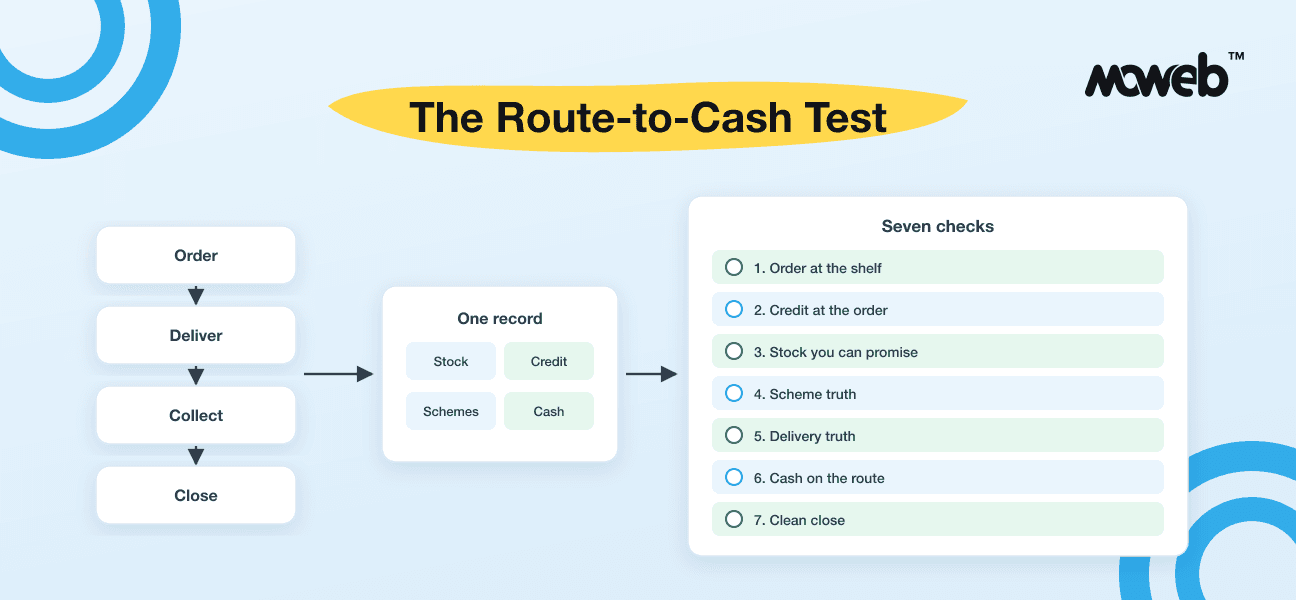
Distribution management software is judged by how cleanly an order becomes cash, not by its dashboards. Use the Route-to-Cash Test, seven checks scored pass, workaround or fail, to decide whether to buy, extend or build a custom DMS.
Every distribution business runs the same loop thousands of times a week. A salesperson takes an order at a shop counter, a depot picks it, a vehicle delivers it, someone collects payment, and finance closes the day. Distribution management software exists to make that loop reliable, yet most evaluations focus on what demos well: an outlet map, a sales dashboard, a catalogue on a tablet.
The loop breaks elsewhere: an order taken for stock already promised, credit extended to a customer who stopped paying last month, an app discount that does not match the invoice, route cash that takes days to reach the ledger. None of that shows up in a demo. All of it shows up in working capital.
This guide is for distributors, wholesalers, FMCG and food businesses, and manufacturers with their own distribution arm deciding whether to buy, extend or build a distribution management system (DMS). It gives you the **Route-to-Cash Test**, a checkable framework to run against a vendor shortlist or your current system.
Why distribution management software fails in the field
A DMS is a coordination system before it is a software product. Stock, credit and people move through depots and routes, each on its own clock. The failures we see are rarely missing screens; they are timing and ownership problems:
- **Orders are reconciled later.** An app that cannot validate stock or credit offline lets salespeople promise what the depot cannot deliver.
- **Credit is checked at invoicing.** By the time finance blocks a delinquent customer, the goods are loaded.
- **Schemes live in two places.** Promotions configured in the app and again in accounting drift until month-end becomes a dispute.
- **Returns are notes, not transactions.** A damaged crate is mentioned to the driver, never reversed in stock or on the invoice.
- **Route cash is a separate world.** Collections sit in a driver's bag and a paper book until someone reconciles them by hand.
Each of these is a design choice, which means each can be tested before you sign anything.
The Route-to-Cash Test
The Route-to-Cash Test is seven checks. Score each one **pass** (the system does it natively and you can watch it happen), **workaround** (possible with exports, spreadsheets or a phone call) or **fail** (not possible). Run it with your own outlets, products and schemes, not the vendor's sample data.
- **Order at the shelf:** an order or van sale can be captured offline and syncs without duplicates or lost lines.
- **Credit at the order:** credit limit and overdue status are checked when the order is taken, not when it is invoiced.
- **Stock you can promise:** the salesperson sees stock available to promise for that depot or vehicle, net of orders already taken.
- **Scheme truth:** discounts and promotions are calculated once, by one engine, and the app, invoice and claim all agree.
- **Delivery truth:** proof of delivery, short deliveries and returns post as transactions that correct stock and the invoice.
- **Cash on the route:** every collection is recorded against specific invoices, and vehicle cash is reconciled at day end.
- **Clean close:** tax documents are issued correctly and the day's sales, stock and cash post to the ledger without manual re-entry.
Two or more fails means the platform must be extended or replaced. Three or more workarounds means your back office is the integration layer, a cost no invoice shows.
Checks 1 to 3: order, credit and stock at the moment of sale
These three checks belong together because they all ask the same question: does the system know the truth at the moment a salesperson commits the business?
**Order at the shelf.** Field teams work where connectivity is poor, so the app must take orders offline. The hard part is syncing safely later: each order needs a client-generated identifier so a retry after a dropped connection does not create a duplicate, plus conflict rules for prices that changed while the device was offline. Ask the vendor to put a device in airplane mode, take three orders, edit one, reconnect twice, and show you the result.
**Credit at the order.** Credit control in distribution is a field decision. The device should carry each customer's limit, balance and overdue flag, and block or route an order for approval before it is confirmed, while saying plainly when its data is stale. If the only credit block happens at invoicing, score this a fail.
**Stock you can promise.** On-hand stock is not the number a salesperson needs. Available to promise is on-hand minus orders already accepted, per depot and per vehicle; for van sales, the vehicle is a warehouse with its own load-out and return-in. Without it, salespeople oversell the fast movers every week.
This is the core of the distribution management system Moweb has built and extended since 2022 for EA Foods, a food distributor operating across Tanzania: customer management with credit scoring and capping, central product and distribution management, and field sales with route planning and pre-orders. No volume or efficiency figures are published, so we cite it for scope, not results.
Checks 4 to 6: schemes, delivery and route cash
**Scheme truth.** Trade promotions are where distributors quietly lose margin: volume slabs, buy-X-get-Y, outlet-class pricing, and principal-funded discounts that must be claimed back from the brand. Configured separately in the field app, the ERP and a claims spreadsheet, the three will disagree, and the distributor absorbs the difference. The fix is one scheme engine every channel calls, with each invoice line recording which scheme produced its discount, so principal claims are generated rather than rebuilt. Ask the vendor to configure one of your real schemes live and show the order, invoice and claim line.
**Delivery truth.** The order and the delivery are different events. A delivery can be short, refused, partly returned as damaged, or changed at the door. Each case must be captured on the driver's device with a reason and proof (signature, photo or one-time code), and post as a transaction that corrects stock and adjusts the invoice or raises a credit note. A free-text remark fails. Route planning is its own constraint problem; our Feasible Day Test helps judge whether a routing engine respects your real constraints.
**Cash on the route.** Every collection, whether cash, cheque, mobile money or transfer, should be recorded against the specific invoices it settles, with a receipt issued on the spot. Each vehicle closes the day with a reconciliation: opening float plus collections minus deposits equals cash in hand. Unallocated "payments on account" are where disputes and leakage start. Ask how the system handles a round payment against three invoices, and who decides the allocation.
Check 7: a clean close, including tax
Distribution is transaction-heavy, which makes tax compliance a software problem. Rules differ by market, so a DMS must treat them as dated configuration.
In India, GSTN announced that taxpayers with aggregate annual turnover of ₹10 crore and above cannot report an e-invoice on the Invoice Registration Portal more than 30 days after the invoice date, effective 1 April 2025, and the restriction covers credit and debit notes as well (Taxmann summary of the GSTN advisory). A distributor that batches returns and credit notes at month end can find documents it can no longer register. In Tanzania, businesses above the turnover threshold and all VAT-registered taxpayers must issue a fiscal receipt or invoice from an electronic fiscal device for every transaction and send a daily Z-report (PKF Eastern Africa note on EFD obligations). Confirm the current rules for your markets with your tax advisers before configuring against them.
The implication is the same everywhere: generate tax documents from the transactions that move stock and cash, when they happen, with failures queued and visible. At day end, sales, returns, collections and stock movements post to the ledger automatically. If finance re-keys the route, the system fails check 7. For businesses where the DMS must sit inside a wider ERP, our ERP services team designs that boundary, and the Integration Surface Test shows where integration scope hides.
Must-have modules and integrations
A serious distribution management system needs these modules:
- **Outlet master:** outlet class, route, location and credit terms.
- **Field sales app:** offline orders, van sales, beat plans and photo audits.
- **Credit control:** limits, scoring, holds and approvals, visible on the device.
- **Inventory:** stock by depot and vehicle, transfers, batch and expiry.
- **Scheme and pricing engine:** price lists, promotions and principal claims from one source.
- **Delivery:** route plans, driver app, proof of delivery and returns with reasons.
- **Collections:** invoice-level allocation, receipts and vehicle reconciliation.
- **Reporting and audit:** secondary sales, outlet coverage and an event trail for every order.
Key integrations are your ERP, the principal's portal for secondary sales and claims, tax authority systems, payment and mobile money providers, and vehicle telematics. Our supply chain software development practice and its warehouse, inventory and distribution work cover this landscape end to end.
Off-the-shelf DMS, extension, or custom build
There are three honest options, and the Route-to-Cash Test tells you which fits.
- **Off-the-shelf distribution management software** wins when your schemes are simple, your tax rules are supported, and it passes checks 1, 2 and 7. Packaged products are usually thinnest on offline conflict handling and scheme-to-claim traceability.
- **Extending what you have** wins when your ERP handles finance and stock well but the field is weak. A purpose-built field app is often the fastest route; our mobile app development team builds these.
- **A custom distribution management system** wins when you fail several checks, operate across tax regimes, run van sales and pre-orders side by side, or compete on distribution itself. Our enterprise software development team builds these as owned platforms, so the rules, data and roadmap are yours. Clean order and payment data also makes forecasting and credit scoring realistic later, through our AI and ML development services.
Cost and timeline are driven by order types (pre-order, van sale, direct delivery), scheme complexity, offline needs, tax regimes, integrations and the state of your master data, so we do not quote before discovery. Where scope is clear, a fixed-cost engagement keeps the delivery risk with the builder. Moweb is ISO 27001 certified, and our security practices cover access control, encryption and audit logging for customer, credit and payment data.
FAQ: distribution management software
**What is the difference between a DMS and an ERP?** An ERP is the financial and inventory system of record. A DMS is built for the field: offline orders, van stock, proof of delivery and route cash. Most distributors need both, with a clean boundary.
**Should we build a custom distribution management system?** Build when you fail several Route-to-Cash checks, when your schemes or markets do not fit packaged software, or when distribution is how you compete. Otherwise buy, perhaps with a custom field app on top.
**How long does a DMS project take?** It depends on integrations, offline needs and data quality more than screens. A field app on an existing ERP is far shorter than a multi-country platform; we commit to a timeline after discovery.
Run the Route-to-Cash Test on your distribution operation
If month-end still means reconciling scheme claims, chasing route cash or explaining why the app promised stock the depot did not have, the fix is usually narrower than a full replacement. Book a free 30-minute review with Moweb's distribution engineers: we will take one real day of your orders, deliveries and collections, run the seven checks against your current system or vendor shortlist, score each one pass, workaround or fail, and tell you plainly whether you need a new DMS, a better field app or neither.
Talk to Moweb about your distribution system, or see how we built the EA Foods distribution management system first.