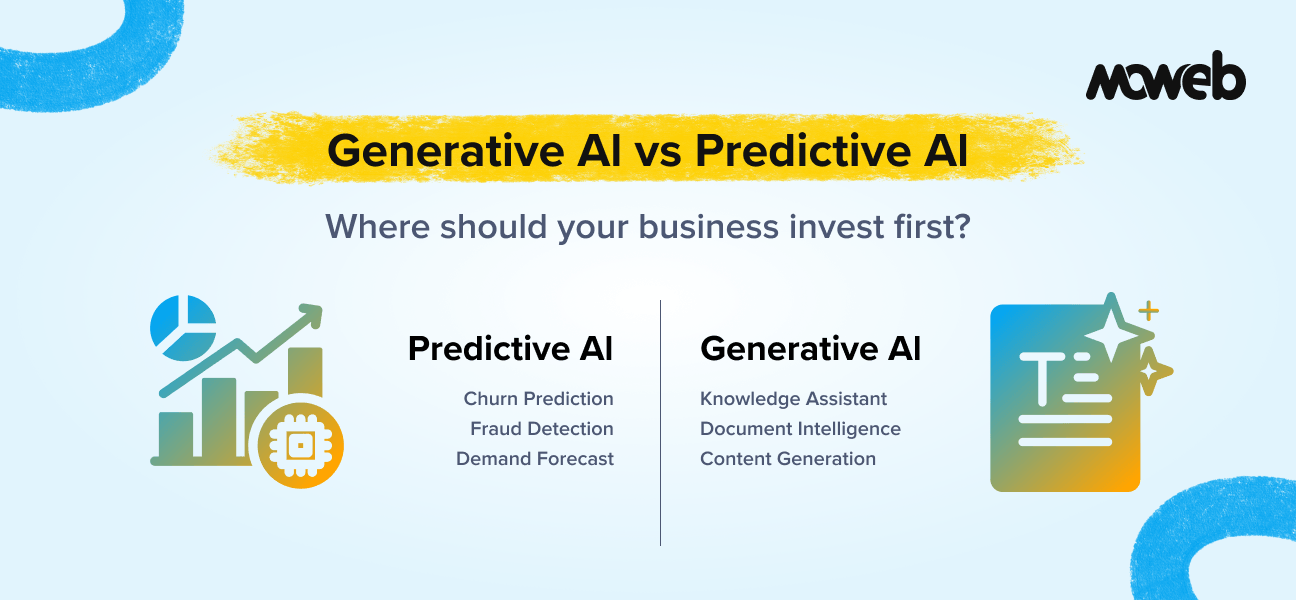
What is the difference between generative AI and predictive AI?Predictive AI uses historical data patterns to forecast future outcomes or classify inputs. It answers questions like: which customers are likely to churn, which transactions are likely fraudulent, which machines are likely to fail next week? Generative AI creates new content (text, images, code, structured data) in response to instructions or context. It answers requests like: write a summary of this document, answer this customer question using our knowledge base, and generate a product description from these specifications. Predictive AI is fundamentally about forecasting and classification. Generative AI is fundamentally about content creation and knowledge retrieval.
Should enterprises invest in generative AI or predictive AI first?The honest answer is: it depends on the problem you are trying to solve. If your most valuable AI use cases involve improving the accuracy of a forecast or classification that drives a high-value business decision (demand forecasting, credit risk scoring, fraud detection), predictive AI delivers direct ROI on that decision quality. If your most valuable use cases involve making your teams faster and more accurate with information-intensive work (drafting, researching, summarising, answering questions from documents), generative AI delivers ROI on productivity and response quality. Most enterprises will build both over time. The question of which comes first should be driven by which use case has the cleaner data, the clearer success criteria, and the greater near-term business value.
It is a good question. And it is one that the vendor community tends to answer with whatever they happen to sell. This guide tries to answer it honestly.
Generative AI and predictive AI are not competing technologies. The generative AI vs predictive AI investment decision is one of the most consequential choices enterprise AI teams make in 2026. They are different tools for different problems. Understanding precisely what each does, where each creates value, what each costs to implement and maintain, and what risks each entails will help you make a well-reasoned first investment decision rather than following the prevailing hype cycle.
What Predictive AI Actually Does
Enterprise AI budgets in 2026 face the same fundamental question they faced two years ago, now with more evidence and more urgency: if you can do one thing well before doing two things badly, should generative AI or predictive AI come first?
Predictive AI is the older, better-understood of the two capabilities. It uses patterns in historical data to make probabilistic forecasts or classifications about new inputs.
The core mechanic is always some variation of the same thing: a model is trained on labelled historical data, it learns the statistical relationships between input features and an output, and it then applies those learned relationships to new inputs it has never seen before. Most predictive AI applications in enterprise use supervised learning models trained on labelled historical data, though anomaly detection variants can operate on unlabelled data. If the training data is representative and the model is well-designed, the predictions on new data will be more accurate than a human baseline or a rule-based approach.
The business applications that predictive AI excels at have been refined over two decades of real enterprise deployment:
Demand forecasting – predicting future sales or demand based on historical patterns, seasonality, pricing data, and external signals. Used by retailers, manufacturers, and supply chain operations to optimise inventory and reduce waste.
Credit risk scoring and fraud detection – assessing the probability that a loan will default or a transaction is fraudulent, based on behavioural and transactional patterns. Core to financial services operations globally.
Customer churn prediction – identifying customers likely to cancel a subscription, reduce spending, or defect to a competitor, based on engagement signals, support history, and behavioural data. Used by SaaS, telecoms, and subscription businesses to prioritise retention efforts.
Predictive maintenance – forecasting equipment failure before it occurs based on sensor data, maintenance history, and operational patterns. Used in manufacturing, utilities, and logistics to reduce unplanned downtime.
Personalisation and recommendation – predicting which product, content, or offer a specific customer is most likely to engage with, based on their behaviour and the behaviour of similar customers. The backbone of e-commerce, media, and content platform revenue.
What all of these have in common is that they improve a decision – a specific, high-value business decision that was previously made with less information or less accuracy. The ROI from predictive AI is typically measured in decision quality improvement: reduced default rates, lower churn, fewer inventory shortfalls, and less unplanned downtime.
What Generative AI Actually Does
Generative AI produces new content in response to instructions or context. It does not primarily forecast outcomes or classify inputs. It creates: text, code, structured data, images, and increasingly audio and video.
The business applications of generative AI in enterprise contexts cluster around two themes: productivity acceleration and knowledge retrieval.
Productivity acceleration means making knowledge workers faster at information-intensive tasks. Drafting communications, summarising documents, generating first drafts of reports, writing and reviewing code, creating structured content from unstructured inputs – these are tasks that previously required significant human time, and that generative AI can compress dramatically. The ROI is measured in time saved per task, multiplied by the number of tasks executed per day across a team or organisation.
Knowledge retrieval means making organisational knowledge more accessible and usable. Enterprise chatbots and AI assistants built on RAG (Retrieval-Augmented Generation) systems allow employees to ask natural language questions and receive accurate, sourced answers from internal documents, policies, technical manuals, and knowledge bases. The ROI is measured in time saved on information search, reduction in errors from outdated information, and improved response quality in customer-facing interactions.
Beyond these two primary themes, generative AI is also used for personalised content generation at scale (product descriptions, marketing copy, personalised communications), code generation and review (significantly accelerating software development cycles), and data extraction from unstructured documents (pulling structured fields from contracts, invoices, forms).
What generative AI does not do well: make accurate quantitative predictions about future outcomes based on numerical patterns in data. Using a generative AI system to forecast sales or predict equipment failure will produce plausible-sounding outputs that are not statistically grounded. This is a fundamental architectural limitation, not a solvable engineering problem. Generative models are not trained to be calibrated forecasters. Predictive models are.
A Third Investment Category Emerging in 2026: Agentic AI
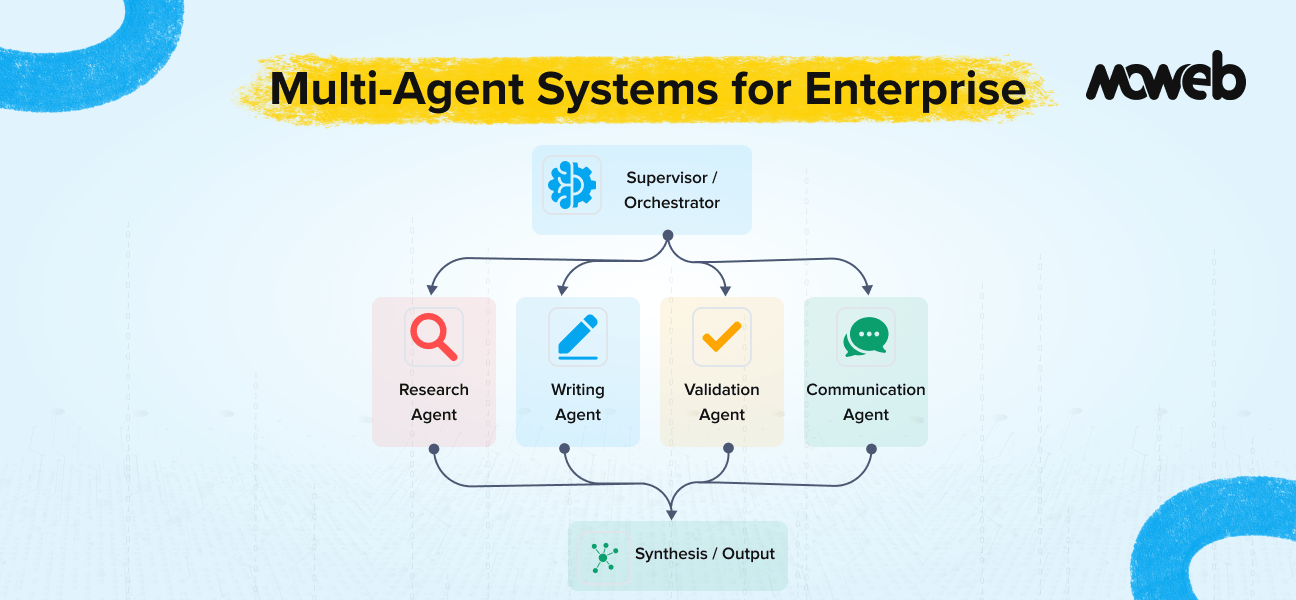
In 2026, a third investment category is entering enterprise AI conversations: agentic AI systems that combine generative and predictive components to plan and execute multi-step workflows autonomously (monitor → plan → act) with minimal human intervention. Gartner named agentic AI a top trend for 2026, and Deloitte predicts 50% of enterprises using generative AI will deploy autonomous agents by 2027. Agentic AI is not a replacement for either generative or predictive investment; it is built on top of both. Enterprises beginning their AI journey should understand this trajectory: the generative and predictive capabilities you build now become the building blocks of agentic systems you deploy in 12–24 months. For most enterprises in 2026, agentic AI is a planning context, not a first investment.
The Four Critical Differences That Drive the Investment Decision
When enterprise leaders are deciding which AI capability to invest in first, four dimensions consistently determine the right answer for their specific context.
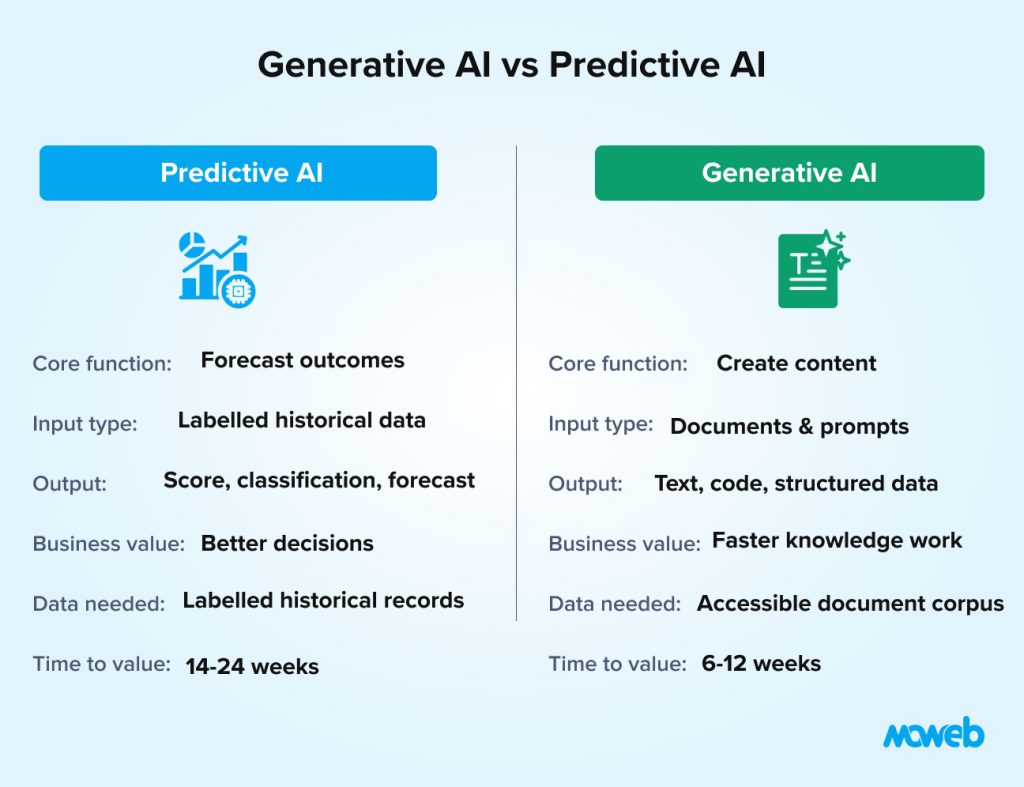
1. The Nature of the Business Problem
Predictive AI is the right choice when the value lies in making a specific recurring decision more accurately: should we approve this loan, how much inventory should we order, which maintenance task should be prioritised this week, which customers should the retention team contact?
Generative AI is the right choice when the value lies in making knowledge workers faster or more capable at information-intensive tasks, or in making organisational knowledge more accessible: how do we reduce the time our support team spends searching for policy answers, how do we generate first-draft customer communications faster, how do we help engineers find relevant documentation?
The test is simple: does your highest-value AI use case involve improving a specific recurring decision (predictive), or does it involve making information work faster and more accurately (generative)?
2. Data Requirements
Predictive AI requires labelled historical data that is representative of the decisions you want to improve. Quality matters enormously. A credit risk model trained on biased or unrepresentative historical data will make biased predictions. A demand forecasting model trained on data from an unusual historical period will produce poor forecasts. The data requirements for predictive AI are specific, technically demanding, and often take significant preparation time.
Generative AI (specifically RAG-based enterprise applications) requires a corpus of documents and knowledge content that is accessible, reasonably clean in format, and recent enough to be accurate. It does not require labelled training data in the way predictive AI does. If you have a usable document corpus, you can begin building. If you need labelled historical data for a predictive model, the labelling process itself can take weeks or months.
Implication for first investment: If your data is primarily in documents, emails, wikis, and PDFs rather than structured, labelled datasets, generative AI is probably the more data-ready starting point. If you have years of clean, labelled operational data for a specific decision domain, predictive AI can leverage that immediately.
3. Time to Value
Predictive AI projects typically follow a longer path from start to production value: data preparation (weeks to months), feature engineering (weeks), model training and evaluation (weeks), integration and deployment (weeks), and a period of monitoring before the model is trusted for high-stakes decisions. The full cycle from project start to production trust typically runs 14 to 24 weeks for a well-managed engagement.
Generative AI (RAG-based knowledge systems) can reach initial production value faster: corpus preparation, indexing, and pipeline setup can often be completed in 6 to 12 weeks for a production-grade enterprise deployment or 2 to 4 weeks for an internal prototype (enterprise security, identity integration, and access control configuration extend the timeline, and a knowledge assistant can begin providing value from its first day in production. The caveat is that “production value” for a knowledge assistant is a lower bar than production trust for a credit risk model – the stakes of an incorrect answer from a knowledge assistant are typically lower than the stakes of an incorrect risk score.
Implication for first investment: If your organisation needs to demonstrate AI value to leadership within a quarter, a well-scoped generative AI knowledge project is typically faster to achieve visible ROI than a predictive ML project. If your organisation is comfortable with a longer runway to higher-stakes ROI, predictive AI often delivers a larger per-decision impact.
4. Risk Profile and Failure Modes
Predictive AI fails in specific, quantifiable ways: the model’s predictions are less accurate than expected (precision/recall fall below target), the model becomes miscalibrated over time as the data distribution shifts (model drift), or the model produces biased outputs because the training data was not representative. These failures are measurable, and a well-governed predictive AI system has monitoring in place to detect them before they cause significant harm.
Generative AI fails in different ways: hallucination (producing confidently stated incorrect information), retrieval failure (failing to surface relevant documents when they exist), prompt injection (external content manipulating model behaviour), A fifth failure mode relevant in 2026: IP and copyright exposure generative AI outputs trained on internet-scale data may reproduce or closely paraphrase copyrighted material, creating legal risk in content generation use cases. and access control failure (surfacing documents the user should not see). These failures are harder to measure systematically and can be more subtle – a user who receives a plausible-sounding incorrect answer from a knowledge assistant may not know it is wrong.
Implication for first investment: Predictive AI failure modes are generally more measurable and more contained. Generative AI failure modes require more careful governance design, particularly for use cases where incorrect outputs could cause harm (medical information, financial guidance, compliance answers). Neither is inherently more risky, but the governance design requirements differ.
A Decision Framework: Which Should Come First for Your Business?
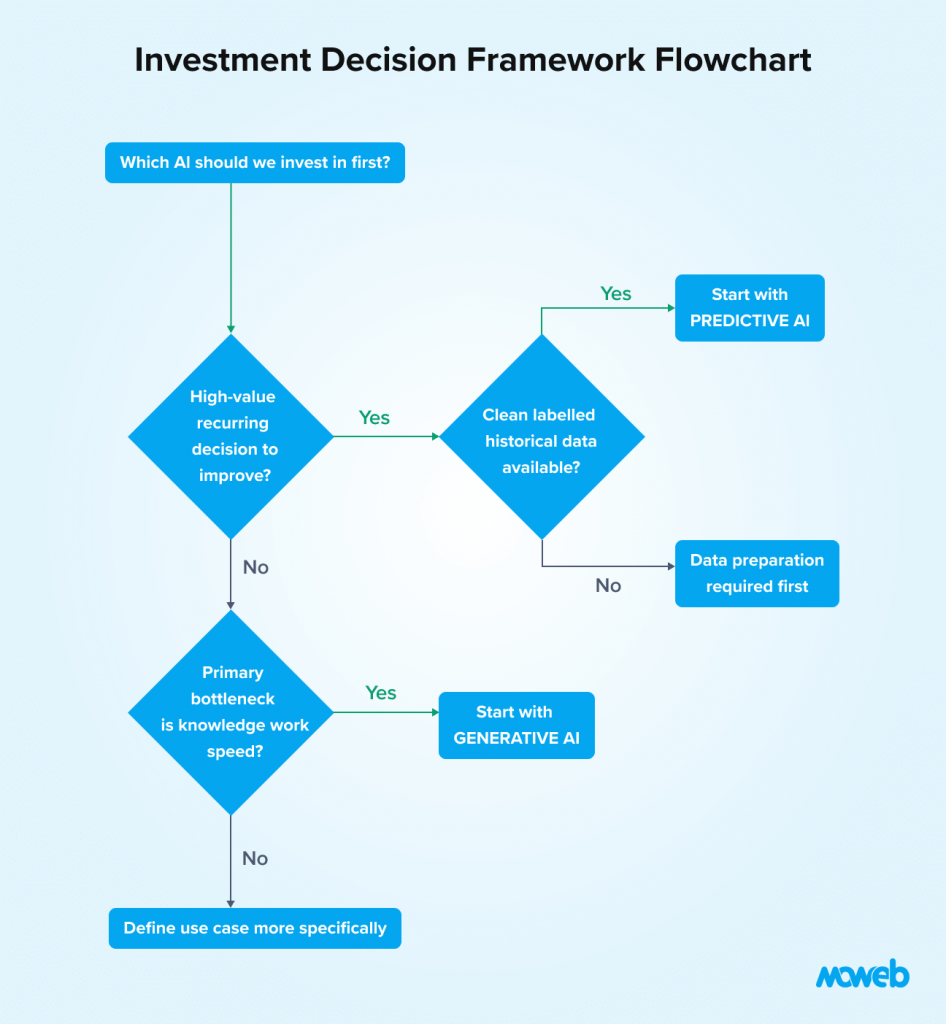
Invest in predictive AI first if:
- You have a specific, high-value recurring decision (churn, fraud, demand, risk, maintenance) where improving accuracy has a direct, measurable financial impact
- You have clean labelled historical data for that decision domain, or the data preparation investment is clearly justified by the decision’s economic value
- Your organisation is comfortable with a 16 to 24 week path to production and has the governance maturity to trust model outputs in high-stakes decisions
- You are in financial services, supply chain, manufacturing, or telecoms, where predictive AI use cases are mature, and the ROI evidence is well established
Invest in generative AI first if:
- Your biggest productivity bottleneck is information-intensive work: your teams spend significant time searching for information, drafting communications, or answering repetitive questions from documents
- You have a usable document corpus, but limited labelled historical data for predictive modelling
- You want to demonstrate AI value to leadership within a quarter
- You are in professional services, legal, healthcare operations, HR, or any knowledge-intensive function where document intelligence and knowledge retrieval are the primary AI opportunity
- You want to build internal AI confidence and capability before tackling more complex predictive use cases
Invest in both in parallel if:
- You have clearly defined use cases for both capabilities, with separate teams to execute them
- Your organisation has the governance and technical capacity to manage two AI initiatives simultaneously without quality degradation on either
- The predictive and generative use cases are in different parts of the organisation and do not compete for the same internal resources or attention
The most important principle is this: the first AI investment should be the one where your data is cleanest, your use case is clearest, and your success criteria are most specific – regardless of which capability category it falls into.
What Each Looks Like in Practice: Side-by-Side Examples
It helps to see these distinctions in concrete terms. Here are two enterprise scenarios showing what each AI type delivers in the same organisation:
Scenario A: A mid-sized insurance company
Predictive AI use case: A churn prediction model trained on policy renewal history, claims frequency, customer service interactions, and payment patterns. The model produces a churn probability score for each policyholder 60 days before renewal. The retention team uses these scores to prioritise outbound contact. Success metric: increase 12-month retention rate by 4 percentage points.
Generative AI use case: A RAG-powered knowledge assistant for claims handlers, trained on the company’s 2,400-page policy documentation, claims handling guidelines, and regulatory compliance library. Claims handlers ask natural language questions during calls and receive accurate, sourced answers in seconds rather than searching manually. Success metric: Reduce average handling time per complex claim by 35%.
Both are valuable. Both are independently justified. The question of which comes first depends on where the data is cleaner, where the internal champion is stronger, and where the near-term financial impact is larger.
Scenario B: A B2B software company
Predictive AI use case: A product usage-based churn scoring model trained on feature adoption patterns, login frequency, support ticket history, and contract value. Used by customer success managers to identify at-risk accounts 90 days before renewal.
Generative AI use case: An AI sales assistant that helps account executives research prospect companies, surface relevant case studies from a knowledge base, draft personalised outreach emails, and prepare for renewal meetings.
Again, both are valuable. The generative AI use case is probably faster to deploy (documentation and case studies likely exist in reasonable quality). The predictive AI use case probably has a higher per-decision impact (a retained enterprise contract has more value than time saved on one outreach email).
Frequently Asked Questions About Generative AI vs Predictive AI
Can generative AI do what predictive AI does? No. Generative AI and predictive AI are architecturally different and suited to different tasks. Generative models can describe a prediction in natural language, but they are not statistically calibrated forecasters. Using a generative AI system for demand forecasting or credit scoring will produce text that sounds like a forecast but lacks the statistical grounding that makes a predictive model accurate. For decisions where accuracy is quantifiable and high-stakes, predictive AI is the right tool.
Can predictive AI do what generative AI does? No. Predictive AI models are trained to produce specific output types (a classification label, a probability score, a numerical forecast). They cannot generate natural language responses, summarise documents, or answer questions from a knowledge base. The two capabilities are complementary, not interchangeable.
Is generative AI more expensive than predictive AI? Not necessarily. Costs depend heavily on scale and infrastructure choices. A RAG-based knowledge system for an internal team has modest ongoing costs (LLM API fees, vector database hosting) that scale with query volume. A large-scale predictive ML system with real-time inference, continuous retraining, and monitoring infrastructure can have significant ongoing compute costs. See the indicative cost comparison table in the Decision Framework section above for a side-by-side breakdown. A custom-trained large generative model is more expensive than either. In general, initial deployment costs for a focused RAG system are comparable to a focused ML deployment. The total cost of ownership (TCO) for both depends more on ongoing data maintenance, monitoring, and retraining needs than on the initial build cost. Ongoing costs depend more on usage patterns and scale than on capability type.
How do generative AI and predictive AI work together? Many mature enterprise AI systems combine both. A financial services firm might use predictive AI to score transaction risk and generative AI to produce a natural language explanation of the risk score for compliance review. A healthcare provider might use predictive AI to flag high-risk patient records and generative AI to summarise the relevant clinical context for a care manager. A retailer might use predictive AI for demand forecasting and generative AI for automated buyer reports that narrate the forecast. In 2026, combining both is also the foundation for agentic AI systems, where a predictive component identifies the situation and a generative component drafts the response or action. The two capabilities are complementary across the full decision-support and knowledge-work spectrum.
Which type of AI is more mature and lower risk for a first enterprise deployment? Predictive ML applications in established domains (fraud detection, churn prediction, demand forecasting) are extremely mature with well-established evaluation frameworks and extensive production deployment evidence. RAG-based generative AI knowledge systems are newer but have reached production maturity rapidly and are now deployed at scale in regulated industries, including financial services and healthcare. According to IDC, global enterprise AI investment reached $307 billion in 2025, split across both capability types, indicating broad production deployment of both. The risk profile of each depends more on the quality of the implementation and governance than on the fundamental capability maturity.
What data do we need before starting a generative AI project? For a RAG-based enterprise knowledge system, you need a corpus of internal documents that covers the questions users will ask – typically policies, procedures, product documentation, FAQs, and relevant reference materials. The corpus should be accessible in a format that can be ingested (PDFs, HTML, Word documents, database exports) and recent enough that the information in it is accurate. You do not need labelled training data. A corpus of 200 to 5,000 documents is sufficient for most first deployments.
What data do we need before starting a predictive AI project? For a supervised predictive ML project, you need labelled historical data where the outcome you want to predict is recorded alongside the input features available at the time of the decision. The minimum volume varies by use case, but 1,000 to 10,000 labelled examples is a typical threshold for viable initial modelling. The data needs to be representative of the decisions you will make in the future – training data from an unusual historical period (a crisis, a market anomaly) will produce poorly calibrated models.
Conclusion: The Best First Investment Is the One You Can Execute Well
The generative AI vs. predictive AI debate is ultimately a distraction from the more important question: which AI use case can your organisation execute reliably right now, given the data you have, the team you have, and the governance you have?
A well-executed predictive AI project on clean labelled data creates measurable, compounding value. A well-executed generative AI knowledge project creates immediate productivity gains and builds internal confidence in AI. Both are worth doing. Neither is always the right starting point.
The Moweb AI-First Investment Matrix in this guide gives you the tools to make that decision based on your specific situation, not the prevailing narrative in your industry or vendor ecosystem.
If you would like help applying this framework to your specific use cases and building an investment sequence that matches your data reality, Moweb’s AI Strategy & Consulting team facilitates exactly this kind of structured decision-making as part of enterprise AI planning engagements. Our Machine Learning & MLOps and Generative AI & LLM development practices cover both capability areas with production delivery experience across both. Talk to us about where to start.
Found this post insightful? Don’t forget to share it with your network!





 India
India USA
USA