
Hospital Management System Development: The Patient Journey Test for Choosing or Building an HMS
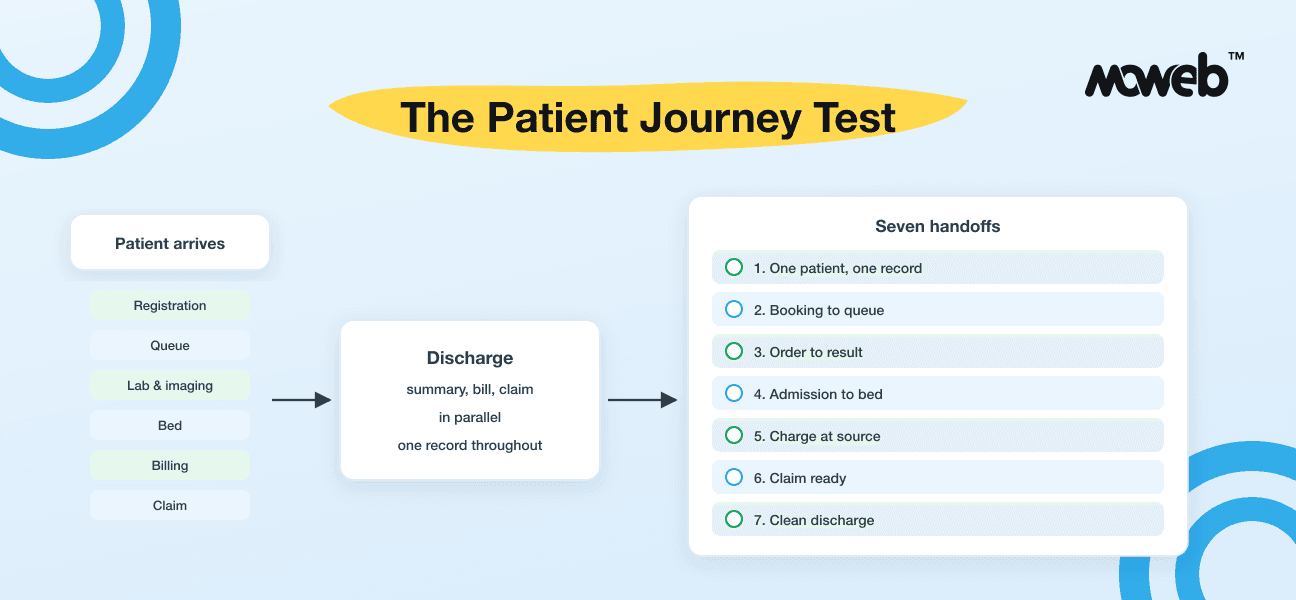
A hospital management system is judged by how cleanly one patient moves from registration to discharge, not by its module list. Use the Patient Journey Test, seven handoffs scored pass, workaround or fail, to decide whether to buy, extend or build a custom HMS.
Every hospital management system brochure lists the same modules: OPD, IPD, pharmacy, laboratory, radiology, billing, inventory, MIS. Every vendor ticks every box. Yet hospitals still run a parallel world of registers and spreadsheets, because the modules exist but the handoffs between them do not.
A patient does not experience modules. A patient experiences a journey: registration, a queue, a consultation, a test, perhaps an admission, a bill, an insurance claim and a discharge. Each step belongs to a different team, and the hospital loses time, revenue and trust at every handoff.
This guide is for hospital owners, clinic chains, medical directors and administrators deciding whether to buy, extend or build a hospital management system (HMS). It gives you the **Patient Journey Test**, a checkable framework you can run against a vendor shortlist or the system you already have.
Why hospital management systems fail on the floor
Most HMS failures are not missing features. They are handoff failures, and they follow a few recognisable patterns:
- **The patient is registered twice.** A walk-in at the front desk and a booking from the app create two records, and the lab report attaches to the wrong one.
- **Orders travel on paper.** The doctor prescribes a test in the system, but the lab works from a printed slip, so results arrive late and unlinked.
- **Charges are captured at the end.** Consumables, bedside procedures and visiting consultant fees are added at discharge from memory, and some never make it to the bill.
- **Insurance is a separate desk.** Pre-authorisation, enhancements and final claims are assembled by hand from documents scattered across modules.
- **Discharge is a negotiation.** The patient is medically fit at noon and walks out in the evening, because the summary, the final bill and the insurer's approval are three separate chases.
Each is a design decision you can test before you sign.
The Patient Journey Test
The Patient Journey Test follows one real patient through seven handoffs. Score each one **pass** (the system does it natively and you can watch it happen), **workaround** (possible with a phone call, a printout or a spreadsheet) or **fail** (not possible). Use your own tariffs and payers, never the vendor's demo hospital.
- **One patient, one record:** every channel (front desk, app, call centre, emergency) finds or creates the same patient, with duplicates detected and merged under audit.
- **Booking to queue:** an appointment becomes a live queue position, and the patient and doctor both see real waiting status.
- **Order to result:** a test or imaging order reaches the lab or radiology system electronically, and the result returns to the same encounter.
- **Admission to bed:** bed availability, transfers and housekeeping status are live, so admission does not depend on calling the ward.
- **Charge at source:** every service, drug and consumable is charged where it is delivered, against the right tariff for that payer.
- **Claim ready:** pre-authorisation, enhancements and the final claim are built from data already in the system, with status visible to the billing team.
- **Clean discharge:** the discharge summary, final bill and payer approval move in parallel, and records can be shared with the patient's consent.
Two or more fails means the platform must be extended or replaced. Three or more workarounds means your staff are the integration layer, a cost no invoice shows.
Handoffs 1 and 2: registration and the queue
**One patient, one record.** Identity is the foundation everything else rests on. A good HMS searches before it creates, using name, phone, date of birth and any national health identifier, and flags likely duplicates for a supervisor to merge with a full audit trail. Ask the vendor to register one patient from the desk and the app with a different spelling, then show you where a lab result lands.
In India, this handoff now has a national dimension. Under the Ayushman Bharat Digital Mission (ABDM), integration milestone M1 lets a facility's software create and verify a patient's ABHA number or address during registration (ABDM integration documentation). If the identity layer is weak, ABHA linking only spreads the duplicate further.
**Booking to queue.** An appointment is a promise; a queue is reality. A confirmed booking should become a token on arrival, doctors should see who is waiting, and walk-ins and emergencies should fit in without breaking the order. Score this a workaround if the queue lives on a token machine that knows nothing about appointments.
Handoffs 3 and 4: orders, results and beds
**Order to result.** An ordered test should reach the lab or radiology system electronically, generate a barcoded sample label, and return its result to the same encounter, with critical values alerting the doctor. Ask to see the whole loop without anyone retyping a patient name.
Most hospitals already run analysers or a PACS from other vendors, so this is an integration problem: HL7 or FHIR interfaces with message logs that show what failed. Our Integration Surface Test shows how to scope these connections before they become hidden cost.
**Admission to bed.** The HMS should show which beds are occupied, reserved, being cleaned or blocked, updating the moment a patient moves. Bed category drives tariff, so a transfer to a private room must change charges from the right time. If admission still means phoning the ward, score this a fail.
Handoffs 5 and 6: charge capture and the claim-ready record
Charge at the source
Hospital revenue leaks through charges never captured, not wrong prices: a bedside dressing, an extra consultant visit, an implant used in theatre. Recorded hours later, some are missed and others disputed.
Capture each charge where the service happens and price it from that patient's tariff: cash, corporate, a government scheme or an insurer's package. Ask the vendor to admit a patient on a surgical package, add an out-of-package test, and show the interim bill.
Ward stock issued to a patient should reduce inventory and add to the bill in one transaction. This is where an HMS meets an ERP: our ERP services team designs that boundary so stores, purchase and finance stay clean without slowing the ward.
Insurance and the claim-ready record
For many private hospitals, insurance and TPA claims decide cash flow. A claim-ready HMS keeps every document on the encounter, tracks pre-authorisation and enhancements, and generates the claim from the record instead of a fresh form.
India is moving claims onto shared rails. The National Health Claims Exchange (NHCX) carries claims between providers and payers in a standard digital format, and IRDAI's circular of 8 June 2023 advised insurers and TPAs to test and adopt the exchange's specifications; that guidance is advisory rather than a legal mandate for hospitals (Nirmitee summary of IRDAI and NHA requirements). Structured claim data can connect to the exchange later; scanned PDFs cannot. Confirm current requirements with your insurers and advisers.
Handoff 7: discharge, consent and data protection
**Clean discharge.** Summary, final bill and final claim should run in parallel, with each discharge's status visible in one place while a delay can still be fixed.
**Consent-based sharing.** ABDM milestone M2 makes a facility a Health Information Provider, linking its records to the patient's ABHA for consent-based sharing, and M3 lets it request records from other providers once the patient authorises access (ABDM integration documentation). Both depend on records being structured at the moment they are created.
**Data protection.** Health records are personal data, and India's privacy regime now has dates. The Digital Personal Data Protection Rules were notified on 13 November 2025, and the obligations on data fiduciaries, including notice and consent, security safeguards and breach reporting, apply from 13 May 2027 (Bar and Bench analysis of the DPDP Rules). Build role-based access, consent records and audit logs in now. Hospitals serving US patients face HIPAA as well; our guide to HIPAA-compliant healthcare software covers that regime. Moweb is ISO 27001 certified, and our security practices cover access control, encryption and audit logging for sensitive records.
What a hospital management system must include
Must-have modules and integrations
- **Patient master** with duplicate merge and ABHA linking.
- **Appointments and queue** across every booking channel.
- **OPD and EMR** with structured notes and orders.
- **IPD and bed management** with live housekeeping status.
- **Laboratory and radiology** interfaces to analysers and PACS.
- **Pharmacy and stores** with batch and expiry.
- **Billing** with payer tariffs, packages and interim bills.
- **Insurance desk** for pre-authorisation and claims.
- **Patient app** for bookings, reports and payments.
Key integrations: lab and imaging equipment, ABDM, insurers or the claims exchange, payments and accounting. Our healthcare software development practice designs this landscape around your clinical workflows, with clinicians testing each sprint.
Off-the-shelf HMS, extension, or custom build
There are three honest options, and the Patient Journey Test tells you which fits.
- **Off-the-shelf hospital management software** wins for single-site clinics and small hospitals with standard workflows, if it passes handoffs 1, 5 and 6 with your tariffs and payers.
- **Extending what you have** wins when your core HMS handles billing and records well but patients and doctors are underserved. A patient app or doctor app on top is often the fastest route; our mobile app development and web application development teams build these.
- **A custom hospital management system** wins when you fail several handoffs, run a multi-specialty or multi-site chain, operate across regulatory regimes, or treat patient experience as a competitive edge. Our enterprise software development team builds these as owned platforms, so the workflows, data and roadmap are yours. Structured records also make later AI and ML work realistic, from document intelligence to bed demand forecasting.
Cost and timeline depend on departments, sites, payer complexity, integrations and data migration, so we do not quote before discovery. Where scope is clear, a fixed-cost engagement keeps the delivery risk with the builder.
FAQ: hospital management system development
**What is the difference between an HMS and an EMR?** An EMR holds the clinical record: notes, orders, results and prescriptions. A hospital management system runs the whole operation around that record, including registration, beds, pharmacy, billing and insurance. Many hospitals need both, either in one platform or with a clean integration.
**Should a hospital build a custom HMS?** Build when you fail several Patient Journey handoffs, when your payers, packages or sites do not fit packaged software, or when the patient experience is how you compete. Otherwise buy, perhaps with custom apps or integrations on top.
**Does a hospital management system in India need ABDM integration?** ABDM integration through the M1, M2 and M3 milestones is what lets your software create ABHA identities, share records with patient consent and receive records from other providers. Check current requirements for any government scheme or insurer you work with before deciding scope.
Run the Patient Journey Test on your hospital
If discharges take hours, billing chases wards for missed charges, or claims are rebuilt by hand, the fix is often narrower than a full replacement. Book a free 30-minute review with Moweb's healthcare engineers: we will walk one real patient journey through your current system or vendor shortlist, score all seven handoffs pass, workaround or fail, and tell you plainly whether you need a new HMS, a targeted integration or a better patient app.
Talk to Moweb about your hospital management system, or see how we approach healthcare software development first.