
How to Choose an Enterprise AI Development Company in the USA
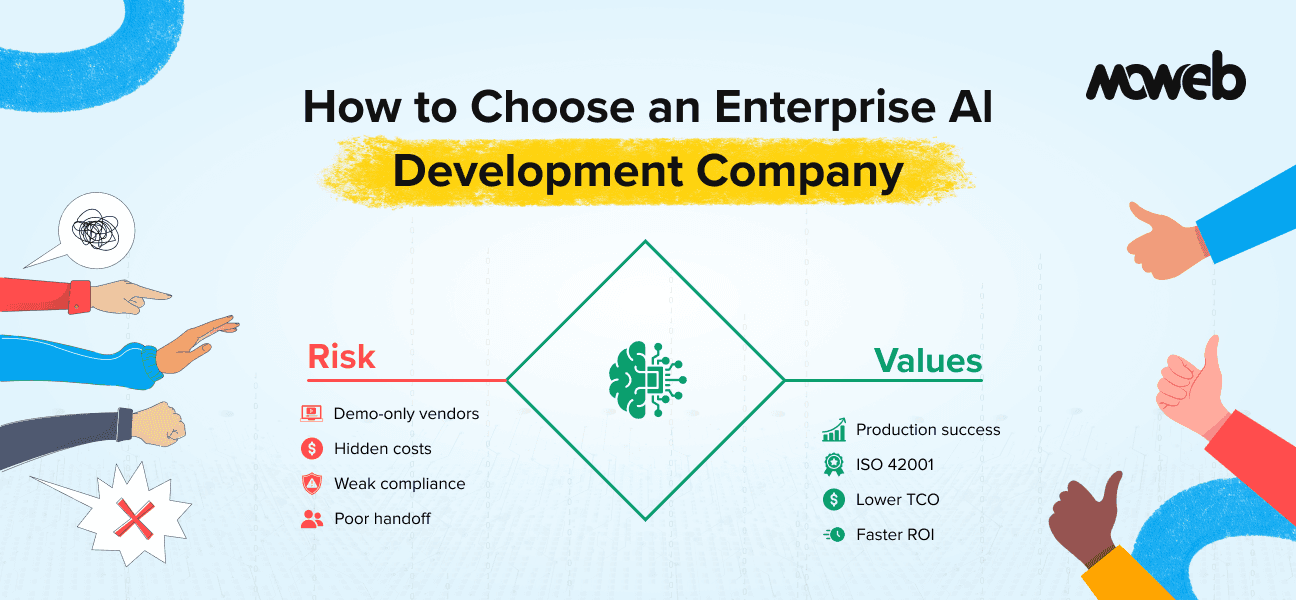
A structured checklist for US enterprises evaluating AI development company partners in 2026. Covers production track record, compliance credentials, integration depth, data sovereignty, total cost of ownership, and the eight questions that separate credible partners from demo ve
What should US enterprises look for when choosing an AI development company? US enterprises evaluating AI development companies in 2026 should assess eight dimensions in sequence: production deployment track record (not demo capability), compliance and security credentials relevant to their industry, data handling and sovereignty practices, integration depth with existing enterprise systems, total cost of ownership across the full engagement lifecycle, implementation methodology and quality standards, post-deployment support model, and knowledge transfer approach. The most common and expensive mistake is evaluating vendors primarily on model sophistication or feature demonstrations rather than on the dimensions that determine whether a system will actually reach production and perform reliably over 12 months.Enterprise AI procurement in 2026 requires cross-functional evaluation committees not informal demos. Technical, security, compliance, and business stakeholders must all participate before a vendor is selected. How Moweb scopes and staffs this work is set out on our AI/ML development services page.
How has the AI development company evaluation process changed in 2026? The evaluation process has changed fundamentally. In 2023, the primary evaluation criterion was technical capability: does this team understand the technology? In 2026, that question is table stakes. Organisations achieving AI success are 3x more likely to have set outcome-based objectives tied to business KPIs.
A VP of Engineering at a mid-market US financial services firm spent $2.1 million and fourteen months on an AI programme that produced no deployable system. The development company they hired had an impressive portfolio, articulate leadership, and a confident technical team. The demos worked beautifully. The production system never did.
This story is not unusual. The AI development company landscape in 2026 is crowded with firms that can demonstrate AI capability in controlled conditions and substantially fewer that can deliver systems that perform reliably in production, survive a compliance review, and continue to function correctly six months after the engagement closes. Enterprise AI procurement in 2026 demands cross-functional evaluation committees with technical, security, compliance, and business stakeholders, rather than relying on persuasive demonstrations alone (AI Vendor Evaluation Framework, February 2026). Average hidden costs add to stated vendor pricing when integration, training, change management, and ongoing maintenance are factored in (AI Agent Square, 2026). The checklist that used to begin and end with “does the team understand the technology” now runs across eight distinct dimensions, most of which have nothing to do with the model and everything to do with what happens after it is deployed.
This guide gives US enterprise buyers the structured checklist to evaluate AI development companies correctly – covering the eight dimensions that determine production success, the specific questions to ask at each stage, and the red flags that should end the evaluation early.
Why Choosing the Wrong AI Development Company Is Expensive
Before the checklist, it is worth being precise about what goes wrong when enterprises choose the wrong AI development partner, because the failure modes are specific and consistently identifiable.
Prototype vendors with no production experience. Many firms that entered the AI development market in 2023-2024 have built impressive demos but have never operated an AI system through the full lifecycle: data quality discovery, architecture design, integration engineering, governance documentation, production deployment, monitoring, and model maintenance. They can build what they show you. They cannot build what you need.
Compliance gaps that surface after deployment. An AI development company that does not understand HIPAA, SOC 2, CCPA, or the specific regulatory context of your industry will build a system that works technically but cannot be deployed because it fails the compliance review. Retrofitting compliance controls onto a completed system is expensive, time-consuming, and frequently incomplete.
Data handling that creates legal exposure. Some development firms access client data with insufficient governance: no data processing agreements, broad access grants rather than minimum necessary access, no documented data deletion procedures. For US enterprises in regulated industries, this is not just a security risk – it is a legal liability. Starting security and compliance review after commercial commitment is signed causes costly re-negotiation or project abandonment post-contract a failure pattern that experienced enterprise buyers now specifically prevent by making compliance documentation a pre-signature requirement.
Integration gaps that block production. The AI system works in isolation but cannot connect reliably to the enterprise systems it needs to access: the CRM, the ERP, the data warehouse, the identity management platform. Integration complexity was underestimated at proposal stage. The engagement extends, the budget overruns, and the system either misses its go-live date or goes live degraded.
Knowledge transfer failure. The engagement ends, the development team moves on, and the enterprise has a working system but no ability to maintain, modify, or extend it. The first model degradation event produces a support crisis because the institutional knowledge needed to diagnose it is left with the vendor.
Understanding these failure modes shapes every criterion in the checklist that follows.
The Eight-Dimension Evaluation Checklist
Dimension 1: Production Deployment Track Record
The first and most important question is not “what can you build?” but “what have you deployed, and what does it look like now?”
A vendor with genuine production experience will be able to walk you through a specific deployment in technical detail: the architecture decisions made and why, the data quality problems encountered and how they were resolved, the evaluation methodology used to validate the system before launch, the integration approach for connecting to enterprise systems, and what the system’s performance metrics look like 6-12 months after go-live.
Questions to ask:
• Describe a production AI deployment for a company similar to ours in size and industry. Not a pilot – a system that is running in production today.
• What were the accuracy or quality metrics at launch? What are they now?
• What went wrong during the engagement and how did you resolve it?
• Can we speak directly with someone at that client – not a reference you have pre-selected and briefed?
• What does your MLOps infrastructure look like for monitoring deployed models? Specifically, how do you detect and respond to model drift and output quality degradation?
Red flag: The vendor can only show demos and proof-of-concept results. They describe past work in capability terms (“we built a RAG system for a financial services client”) rather than outcome terms (“we deployed a document intelligence system that processes 2,400 lease abstractions per month at 93% field-level accuracy”). A credible vendor describes outcomes, not technology. Vendors who restrict customer testing, withhold production telemetry, or cannot provide granular metrics over meaningful time periods are signalling immaturity in their production monitoring posture (F5/NSS Labs, 2026). For regulated industries, compliance credentials are not a nice-to-have – they are a deployment prerequisite.
ISO 27001:2022 is the international information security management standard and the baseline credential for enterprise AI vendors in 2026. It demonstrates that the vendor has an audited, maintained information security management system covering the policies, processes, and controls that protect client data during and after an engagement.
ISO/IEC 42001:2023 is the international AI Management System (AIMS) standard, the AI-specific credential that now sits alongside ISO 27001 as a requirement for enterprise AI vendors. It covers 38 controls across AI policy, system impact assessment, data management, lifecycle management, transparency, and third-party AI components. Critically, it is the fastest, most credible documentation framework for demonstrating compliance with EU AI Act obligations for high-risk AI systems, and it maps directly to NIST AI RMF 1.1. Ask for certification documentation or a credible implementation roadmap with a target date.
SOC 2 Type II is the US-specific security audit standard. Type II verification means the vendor’s security controls have been independently tested and validated over an extended period, not just designed on paper. For US financial services, healthcare, and technology enterprise clients, SOC 2 Type II is the standard expectation.
CMMI Level 3 compliance signals that the vendor follows audited, standardised delivery processes across the full software development lifecycle. It is particularly relevant for US government, defence, and large enterprise procurement where process maturity is a contract requirement.
NIST AI Risk Management Framework (AI RMF) alignment is the US-specific AI governance framework not a certification but a structured methodology covering four functions: Govern, Map, Measure, and Manage. For US enterprise buyers who want a domestic governance reference alongside the international ISO stack, requiring that vendors demonstrate NIST AI RMF alignment is increasingly standard in regulated sector procurement. NIST AI RMF subcategories map directly to ISO 42001 clauses, meaning ISO 42001-certified vendors already satisfy most NIST AI RMF requirements.
Industry-specific certifications: Healthcare engagements require the ability to sign a HIPAA Business Associate Agreement. Financial services may require demonstrated familiarity with SOX, PCI-DSS, or SEC data governance requirements. Government contracts may require FedRAMP-aligned practices. Colorado SB 205 (2026), the first US state-level AI governance law covering high-risk AI systems used in consequential decisions, now applies to vendors serving Colorado residents, making state-level AI law compliance a new procurement dimension for US enterprise buyers.
Questions to ask:
• Which security certifications do you hold? Can you provide current certification documentation?
• Can you sign a HIPAA BAA for this engagement?
• How do you handle data access during an engagement – what is the minimum necessary access principle in practice?
• What is your data deletion procedure at engagement end?
• How does your AI governance framework address model risk, explainability, and human oversight requirements for our specific use case?
Red flag: The vendor claims compliance credentials they cannot document, or deflects compliance questions to a “we can discuss that later” position. Later means after you have signed. Equally: a vendor who holds ISO 27001 but has no ISO 42001 certification or roadmap in 2026 has not invested in AI-specific governance infrastructure a meaningful gap for buyers in regulated industries or those with EU exposure.
Dimension 3: Data Handling and Sovereignty
For US enterprises processing regulated, sensitive, or competitively proprietary data, understanding exactly how an AI development company handles your data is a non-negotiable evaluation requirement.
The specific questions cover three areas.
Data processing location: Where is your data processed during the engagement? For some US enterprises, sending data to offshore processing infrastructure creates regulatory issues (ITAR, certain HIPAA interpretations, financial data residency requirements for specific instrument types). For others, it creates competitive sensitivity risk. Know the answer before you contract.
Training data usage: Will any of your data be used to train or fine-tune models that serve other clients? The answer should be an unequivocal no, documented in the contract. Some vendors – particularly those using shared fine-tuning pipelines across clients – have less clear answers to this question than they initially suggest.
Data access governance during the engagement: How are individual team members authorised to access client data? Is access logged? Is access limited to the minimum required for the specific task? A development firm where all team members have broad access to all client data on all active engagements is a data governance risk, regardless of their certification status. Require written documentation of access control procedures before contract signature, not as a due diligence exercise after the engagement begins.
For a deeper examination of what data sovereignty means for AI systems and when on-premises deployment is the right answer, our guide to what is sovereign AI and why enterprises are running models locally covers this dimension in full.
Dimension 4: Integration Depth and Technical Architecture
An AI system that performs well in isolation but cannot connect to the enterprise systems where data lives, and decisions are made is not an enterprise AI system – it is a prototype. Integration depth is one of the most commonly underestimated evaluation dimensions and one of the most consequential for production success.
Questions to ask:
• How do you approach integrating AI systems with existing enterprise platforms – CRM, ERP, HRIS, data warehouses?
• What is your experience with legacy system integration? Have you built API wrappers or middleware for systems without native integration capability?
• How do you handle IAM integration – specifically, how does the AI system inherit user-level permissions rather than operating with broad service account access?
• What monitoring and observability infrastructure do you deploy alongside the AI system?
• What is your approach to MCP-based tool integration for agentic AI systems that need to connect to multiple enterprise systems?
A vendor with genuine integration experience will answer these questions specifically, naming the integration patterns, tools, and challenges they have encountered. A vendor without it will answer in generalities.
Dimension 5: Total Cost of Ownership
The proposal price is not the total cost of the engagement. Understanding the full cost picture before signing is the difference between a budget that works and a budget that requires emergency approval three months in.
Initial development cost is the number on the proposal. It covers discovery, architecture, development, and deployment. For a focused first production deployment, this typically runs $80,000 to $200,000 with a specialist firm and $300,000 to $1.5 million with a global consulting firm.
Ongoing infrastructure costs are frequently absent from proposals but are real and recurring: LLM API costs (typically $0.50 to $3.00 per 1,000 tokens at enterprise pricing tiers), vector database hosting ($500 to $2,000 per month for mid-market scale deployments), monitoring tooling, and cloud compute for any self-hosted components. Hidden costs: integration work, data quality remediation, change management, and ongoing maintenance add an average of to stated vendor pricing (AI Agent Square, 2026). Budget this overhead explicitly, not as a contingency.
Post-engagement support costs cover the operational support after the development engagement closes: incident response, model quality maintenance, knowledge base updates for RAG systems, and enhancement work. These are typically priced as a monthly retainer ($5,000 to $25,000 per month depending on complexity and SLA requirements).
Hidden costs that frequently surface mid-engagement: data quality remediation when source data proves messier than assumed, additional integration work when legacy system complexity exceeds the proposal estimate, compliance documentation work when regulatory requirements are more demanding than initially scoped. Build the TCO model before signing, not after the first invoice surprises arrive.
Questions to ask:
• What are the ongoing monthly infrastructure costs for a deployment at our scale?
• What is your standard post-engagement support model and what does it cost?
• How do you handle scope changes that arise from data quality problems discovered mid-engagement?
• Can you provide itemised cost estimates rather than a single project price?
• What is the all-in 12-month cost of ownership, including infrastructure, support retainer, and your team’s estimate of integration and data quality work?
Dimension 6: Implementation Methodology and Quality Standards
How a vendor structures their delivery process is a reliable signal of their production experience. Vendors with genuine production track records have developed systematic approaches to the recurring challenges of enterprise AI delivery: data quality assessment, evaluation framework design, governance documentation, integration testing, and production readiness review.
Questions to ask:
• What does your discovery phase cover, and what are the deliverables?
• How do you define and agree quality thresholds before development begins?
• What evaluation methodology do you use – specifically, what metrics and at what thresholds?
• How do you handle the transition from staging to production? What is your production readiness checklist?
• What does your change management and adoption support look like?
• How do you handle MLOps specifically, model versioning, monitoring, and lifecycle management in production?
A vendor with a systematic methodology can answer each of these questions with specificity. Absence of formal MLOps processes, model versioning, monitoring, and lifecycle management signals poor production readiness even when the development phase looks strong (AI Vendor Evaluation, 2026). They have faced these challenges repeatedly and have developed consistent approaches. A vendor without it improvises on each engagement.
For the full engagement structure that a credible AI consulting engagement should follow, our guide to enterprise AI consulting services: what to expect from an engagement documents the four phases, milestone deliverables, and accountability structure in detail.
Dimension 7: Post-Deployment Support Model
AI systems require ongoing operational support in a way that traditional software does not. Models drift. Knowledge bases become stale. New attack patterns emerge for prompt injection defences. Usage patterns reveal failure modes that testing did not surface. A vendor who considers their obligations complete at go-live is selling you an asset with a built-in degradation problem. Observability platforms that track drift, bias, latency, cost, and hallucination rates and connect detection to governance controls rather than treating it as an isolated ops alert are now the standard for credible post-deployment support (Modulos AI, 2026).
Questions to ask:
• What SLAs do you offer for production incident response?
• How do you monitor for model quality degradation and output drift post-deployment?
• What triggers a model update or retraining cycle, and who initiates it?
• What does a 90-day post-launch support engagement look like?
• What is the escalation path for a P1 incident outside business hours?
• Does your monitoring infrastructure connect quality alerts to governance controls so a drift event automatically triggers a compliance review, not just an ops notification?
The presence of specific, documented answers to these questions signals that the vendor has operated systems through the post-launch period. The absence of specific answers signals they have not.
Dimension 8: Knowledge Transfer and Independence
The final evaluation dimension is one that US enterprises consistently underweight in initial vendor selection and consistently regret overlooking: does the engagement end with your team able to operate the system independently?
A development firm that builds institutional knowledge into its own team rather than into your organisation creates a dependency relationship that benefits the vendor and costs you. The first maintenance issue, the first compliance question, the first requirement change – all require returning to the vendor at their billing rate rather than being handled by your internal team.
Questions to ask:
• What technical documentation is included as a standard deliverable?
• What training sessions do you provide for our engineering team, our operations team, and our business stakeholders?
• At engagement end, what should our team be able to do independently that they cannot do today?
• What is covered by your post-engagement support versus what our team should handle independently?
• How do you document AI-specific operational requirements, model drift thresholds, re-indexing triggers, and governance escalation procedures in your runbooks?
Moweb’s standard knowledge transfer package includes complete architecture documentation, operational runbooks, monitoring setup guides, and live training sessions covering system operation for the internal team. Our goal at engagement close is that your team can operate, monitor, and extend the system without requiring our involvement for routine operations. We offer structured post-engagement support for incident response and enhancements, not as a dependency relationship but as a partnership.
The Reference Check: How to Validate What Vendors Tell You
The reference check is the most underused tool in enterprise AI vendor evaluation. Vendors naturally provide references who will speak positively. The value of a reference call depends entirely on the questions you ask.
Questions for reference clients that reveal the truth:
• What were the quality metrics at launch? What are they now, 6-12 months later?
• What went wrong during the engagement that was not in the original proposal?
• How did the vendor respond when problems arose – did they communicate proactively or did you discover issues yourself?
• Is your team able to operate the system independently, or do you still rely on the vendor for routine maintenance?
• If you were making this decision again today, would you choose the same vendor?
• Would you be comfortable introducing us to someone on your engineering team who worked with their delivery team day-to-day?
• What would you have required contractually that you did not require the first time?
The last question is particularly revealing. A vendor whose reference clients will allow a conversation with their engineering team has confident, consistent quality. A vendor whose references are exclusively C-suite is managing what you can discover. The new final question What would you have required contractually that you did not the first time surfaces the specific contractual gaps that experienced buyers discover too late: IP ownership clarity, data deletion timelines, scope change provisions, and post-deployment SLA definitions.
Why US Enterprises Are Increasingly Choosing Specialist AI Firms Over Global Consultancies
The enterprise AI vendor landscape divides into three categories that serve different needs at different price points, as explored in our guide to what to expect from an enterprise AI consulting engagement. Their limitations are minimum engagement sizes of $500,000 or more, delivery teams that may be less experienced than the partner who won the engagement, and billing rates of $300–$900 (up to $900/hour for AI engineering specialists, Fortune 2025) per hour that make iterative post-launch optimisation prohibitively expensive.
Specialist AI engineering firms combine strategic advisory with hands-on engineering delivery. They build production systems, not strategy decks. Their billing rates ($150-300 per hour) allow iterative post-launch work without budget crisis. Their delivery teams – the people who actually build the system – are the same people who sold the engagement. For mid-market US enterprises with specific production AI requirements, specialist firms consistently outperform global consultancies on speed, cost, and production quality.
Offshore development teams combine strategic advisory with hands-on engineering delivery. They build production systems, not strategy decks. Their billing rates ($100–$300 per hour) allow iterative post-launch work without budget crisis. Their delivery teams, the people who actually build the system, are the same people who sold the engagement. For mid-market US enterprises with specific production AI requirements, specialist firms consistently outperform global consultancies on speed, cost, and production quality.
Offshore development teams provide engineering execution at lowest cost, appropriate when requirements are precisely defined, and the buyer has the internal technical capability to direct and quality-check the work. For first-generation enterprise AI deployments where advisory capability and architectural judgment are required alongside engineering execution, pure offshore teams without strategic advisory capability are a risky choice.
Moweb operates as a specialist AI firm with genuine US market presence: our office is in Secaucus, New Jersey, we work in Eastern, Central, and Pacific time zones, and our leadership is physically present for US client meetings. We hold ISO 27001:2022 certification and follow CMMI Level 3 appraised processes. We are on an active ISO/IEC 42001 implementation roadmap with a target certification date and a commitment to the AI-specific governance standard that enterprise buyers are now rightly requiring. For US enterprises evaluating offshore-headquartered AI firms, our guide to what American buyers expect from an enterprise AI partner covers the specific expectations and evaluation criteria that experienced US buyers apply.
The Buyer’s Checklist: Summary Reference
Use this as a one-page evaluation framework when shortlisting AI development companies.
Production Track Record • Specific production deployments with named outcomes • Quality metrics at launch and at 6-12 months post-launch • Direct reference calls with engineering-level contacts • Honest description of problems encountered and resolved • MLOps infrastructure for monitoring: model versioning, drift detection, telemetry Compliance and Security • ISO 27001:2022 certification (documented) • ISO/IEC 42001:2023 certification or roadmap with target date (AI Management System) • SOC 2 Type II (for US enterprise clients) • CMMI Level 3 compliance (for process-sensitive clients) • NIST AI RMF alignment (for US regulated sector clients) • HIPAA BAA capability (for healthcare clients) • Colorado SB 205 compliance awareness (for clients serving Colorado residents) • Documented data access and deletion procedures Data Handling • Clear answer on data processing location • Contractual commitment: no training on client data • Minimum necessary access with access logging • Data deletion procedures at engagement end • Written access control documentation provided pre-signature Integration Depth • Legacy system integration experience • IAM integration and user-level permission inheritance • Named integration patterns and tools • Monitoring and observability as standard delivery • MCP-based tool integration experience for agentic AI systems Total Cost of Ownership • Itemised ongoing infrastructure costs • Post-engagement support model and pricing • Scope change provisions for data quality surprises • All-in 12-month TCO model (60–120% hidden cost overhead factored in) Methodology • Defined discovery phase with specific deliverables • Pre-agreed quality thresholds before development begins • Production readiness checklist and staging-to-production process • Change management and adoption support • Formal MLOps process: versioning, monitoring lifecycle, rollback capability Post-Deployment Support • Defined SLAs for incident response • Model quality monitoring and drift detection • Documented escalation path for P1 incidents • Post-launch support contract terms • Drift alerts connected to governance controls, not just ops notification.
Knowledge Transfer
• Architecture documentation as standard deliverable
• Operational runbooks for internal team
• Training sessions for engineering and operations
• Clear definition of what your team can do independently at engagement close
• AI-specific runbook entries: model drift thresholds, re-indexing triggers, governance escalation.
Frequently Asked Questions About Choosing an Enterprise AI Development Company
What is the most important criterion when choosing an enterprise AI development company? Production deployment track record is the most important criterion – specifically, the ability to describe specific deployments in technical detail, provide quality metrics at launch and at 6-12 months post-launch, and connect you directly with engineering-level contacts at reference clients. Every other criterion builds on this foundation. A vendor with deep compliance credentials, excellent methodology, and strong post-deployment support but no genuine production experience is still a prototype vendor with premium packaging.
What certifications should a US enterprise require from an AI development partner? At minimum: ISO 27001:2022 for information security management, ISO/IEC 42001:2023 (or a documented roadmap to it) for AI management system governance, and CMMI Level 3 compliance for process maturity. For healthcare clients: HIPAA BAA capability. For financial services: demonstrated familiarity with SOC 2, SOX, and relevant sector-specific requirements. For US regulated sector clients: NIST AI RMF alignment. For government: FedRAMP-aligned practices. All should be independently verifiable from documentation, not self-reported.
How has enterprise AI vendor evaluation changed in 2026? Fundamentally. In 2023, the primary criterion was technical capability. In 2026, that is table stakes. Second, enterprise AI procurement now demands cross-functional evaluation committees: technical, security, compliance, and business stakeholders rather than demo-based selection. Third, hidden costs add to stated vendor pricing on average; TCO modelling before signature is now standard practice for experienced buyers.
What should a proposal from an enterprise AI development company include? A credible proposal includes: a use case definition developed from a real discovery conversation (not copied from your RFP), specific quality thresholds the system will be evaluated against (defined before development begins), an itemised cost estimate with separate lines for development, infrastructure, and post-engagement support, a named delivery team with specific backgrounds (not generic team descriptions), IP ownership terms assigning all deliverables to the client, and a defined post-deployment support arrangement. Proposals missing any of these elements should prompt specific follow-up questions before signing. Also require: explicit data processing location, a contractual no-training-on-client-data commitment, and documentation of the post-engagement support SLA terms.
How should US enterprises evaluate offshore AI development firms? Evaluate on the same eight dimensions as domestic firms, with three additional considerations: US market fluency (do they understand the specific regulatory, competitive, and cultural context of US enterprise operations?), time-zone coverage (are there structured overlap hours for real-time collaboration, and is there a US-based point of contact for escalations?), and US client references (have they successfully delivered for US enterprise clients in your sector, and can you speak with those clients directly?). The detailed framework for evaluating offshore AI partners is covered in our guide to AI consulting engagement models for US companies working with offshore teams.
What is the difference between an AI consulting engagement and an AI development engagement? An AI consulting engagement focuses on strategy: use case identification, readiness assessment, architecture recommendation, and roadmap development. An AI development engagement focuses on building and deploying a specific system to production. The most effective partners do both: a discovery and advisory phase that defines what to build, followed by engineering execution that builds and deploys it. Vendors who only offer one of these two capabilities are either strategy-only firms (who cannot build) or engineering-only firms (who cannot advise on what to build). For the full structure of an effective engagement, see our guide to enterprise AI consulting services: what to expect.
What is the typical cost of engaging an enterprise AI development company in the USA? Specialist AI engineering firms typically charge $100–$300 per hour, with first production deployments running $80,000 to $200,000. Global consultancies charge $300–$900 per hour (AI engineering specialists at Fortune 500 firms up to $900/hour, Fortune 2025), with minimum engagements of $500,000 to $5,000,000. Ongoing infrastructure and support retainer typically add $5,000 to $20,000 per month. Critically: hidden costs integration work, data remediation, change management, ongoing maintenance add an average of to stated vendor pricing (AI Agent Square, 2026). Model full 12-month TCO before signing. Organisations that do this are 2.8x more likely to remain within budget.
What questions should I ask at a reference call with an AI development company’s past client? Ask: what were the quality metrics at launch and at 6–12 months post-launch? What went wrong that was not in the original proposal and how did the vendor respond? Is your team able to operate the system independently or do you still rely on the vendor? Would you choose the same vendor again? Can we speak with someone from your engineering team who worked with their delivery team day-to-day? And: what would you have required contractually that you did not require the first time? The last question surfaces the specific contractual gaps experienced buyers discover after the fact.
Conclusion: The Checklist Is a Conversation Guide, Not a Filter
The eight-dimension checklist in this guide is not designed to be applied as a pass/fail filter that eliminates most vendors. It is designed to generate the specific conversations that reveal which vendors have the production experience, compliance credentials, and delivery discipline your enterprise needs.
The vendors worth working with will welcome these questions. They will answer each one specifically, provide documentation where documentation exists, connect you with reference clients at the engineering level, and have clear, documented answers to every post-deployment support and knowledge transfer question.
The vendors not worth working with will deflect, generalise, or redirect. They will produce impressive demos and vague proposals. They will suggest that compliance and governance details are best discussed after you have signed the initial agreement.
The checklist protects you from the second group by ensuring the first group is the only one that makes it to the contract stage.
Moweb works with US enterprise and mid-market clients across financial services, healthcare, manufacturing, and technology. We welcome every question on this checklist because we have specific answers to all of them. Our New Jersey office, ISO 27001:2022 certification, CMMI Level 3 appraised processes, and production deployments across multiple sectors mean we are evaluated regularly by US buyers using exactly this framework. Start the conversation with our team.
Found this post insightful? Don’t forget to share it with your network!