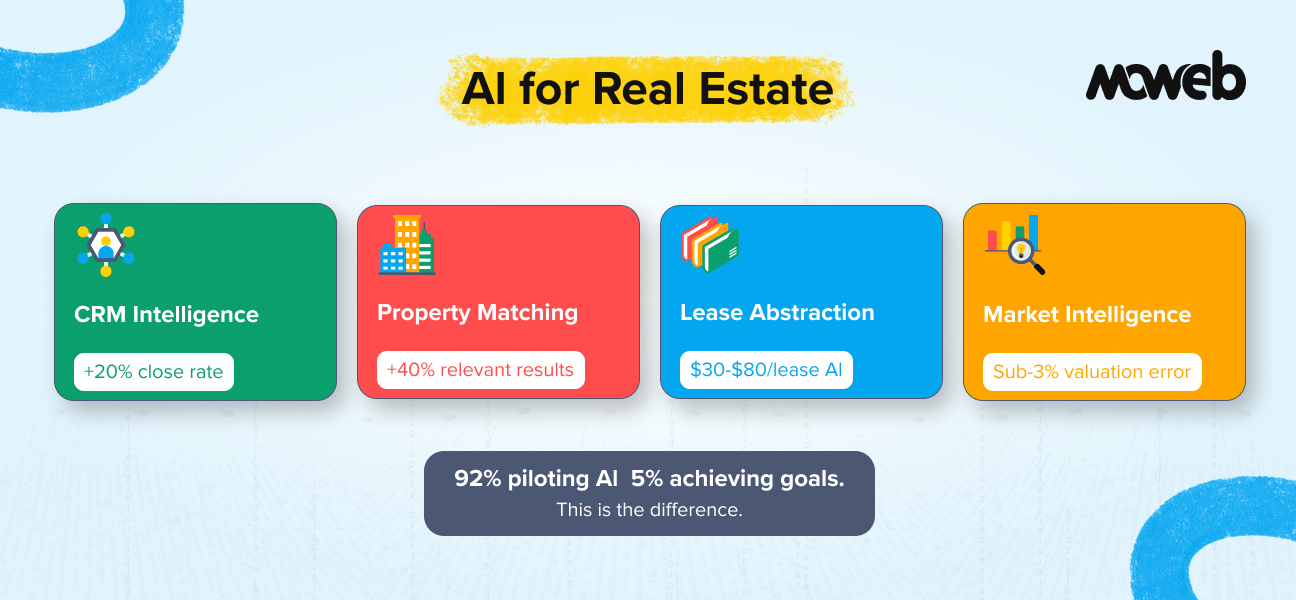
What is AI used for in real estate in 2026? AI in real estate is applied across four primary operational areas: CRM intelligence (scoring leads, predicting which contacts are most likely to transact, automating follow-up sequences, and surfacing relationship insights from communication history), semantic property matching (using vector search and natural language understanding to match buyer or tenant requirements to available inventory with far greater accuracy than keyword-based search), document automation (extracting key terms from leases and contracts using AI, automating data entry into property management systems, and generating compliance-ready document summaries), and market intelligence (aggregating listing data, comparable transactions, and economic signals to generate property valuations, market reports, and investment screening analyses). The global AI in real estate market grew from $222.65 billion in 2024 to $301.58 billion in 2025, and is projected to reach $404.9 billion in 2026 at a 34.3% CAGR, growing to $1.3 trillion by 2030 (Business Research Company, 2026). Morgan Stanley estimates AI could automate up to 37% of real estate operations, saving the industry roughly $34 billion in efficiency gains over the next five years.
Why are only 5% of real estate AI programmes achieving their goals? According to JLL’s 2025 research, 92% of CRE teams have started piloting AI but only 5% report achieving most of their programme goals. The gap is almost never a technology problem. It is consistently one of three execution problems: using the wrong AI tool for the specific workflow bottleneck (general-purpose AI tools applied to specialised CRE data structures), failing to integrate AI outputs into the actual workflows where decisions are made (AI that produces insights in a separate dashboard nobody checks), or piloting in isolation without the data infrastructure to support production deployment at scale.
Real estate is one of the most data-intensive industries in the world and one of the least automated. A commercial property transaction generates hundreds of documents. A residential brokerage manages thousands of client relationships simultaneously. A REIT administers portfolios of leases, each with unique terms, renewal clauses, rent escalation provisions, and compliance obligations that must be tracked across every property in the portfolio.
The gap between the data volume real estate organisations handle and their capacity to process it intelligently has been widening for decades. AI is the first technology capable of closing it at scale.
The global AI in real estate market reflects this opportunity: it grew from $222.65 billion in 2024 to $301.58 billion in 2025, reaching $404.9 billion in 2026 at a 34.3% CAGR, and is projected to reach $1.3 trillion by 2030 (Business Research Company, 2026). The proptech market separately hit $47 billion in 2025 and is projected to reach $185 billion by 2034 (Precedence Research). 75% of US real estate companies are already using some form of AI, with 89% of top-producing agents expected to use AI-enhanced tools by the end of 2026. McKinsey estimates AI could generate $110 to $180 billion in value for the real estate sector; Morgan Stanley puts the efficiency savings potential at $34 billion from automating up to 37% of real estate operations over the next five years.
But the execution gap is stark. JLL’s 2025 research found that 92% of CRE teams have started piloting AI, yet only 5% report achieving most of their programme goals. Understanding why the majority stall – and what the 5% do differently – is the practical foundation of any real estate AI strategy.
This guide covers the four AI capabilities delivering consistent, measurable value in real estate operations in 2026, the data and integration requirements that make them work, and a realistic implementation roadmap for property firms, developers, and institutional investors at different scales.
Why Real Estate AI Programmes Stall: The Three Execution Gaps
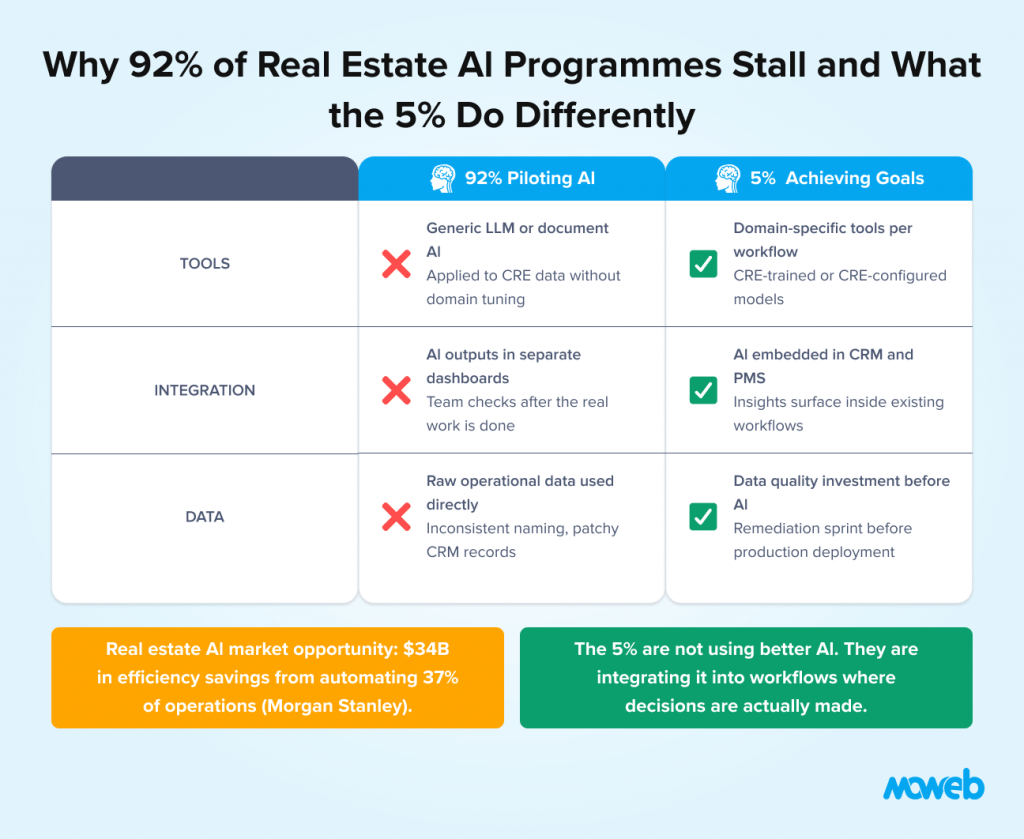
Before examining specific capabilities, it is worth understanding precisely why 92% of real estate teams piloting AI are not achieving their goals. The Deloitte 2026 CRE Outlook, which found 76% of CRE firms exploring or implementing AI, identified the same pattern across failed deployments.
Gap 1: Wrong tool for the specific workflow. Real estate data has structural characteristics that general-purpose AI tools handle poorly. Lease data has non-standard schema across every document. Property descriptions use inconsistent terminology across markets and time periods. Transaction records are distributed across multiple systems with no unified identifier. A general-purpose LLM or a generic document processor applied to CRE data without domain-specific training or prompt engineering produces results too inconsistent for production use. The deployments that work use AI specifically configured for the workflow, not the most capable general model applied generically.
Gap 2: AI outputs not integrated into decision workflows. The most consistent failure mode is AI that produces genuinely useful insights in a separate interface that nobody checks because the actual work happens in the CRM, the property management system, or email. A property matching AI that surfaces recommendations in a standalone dashboard gets ignored after two weeks. A document extraction AI that outputs to a spreadsheet rather than directly updating the lease management system creates more work, not less. AI value in real estate comes from integration into the workflows where decisions are made, not from adjacent insights that require an additional step to act on.
Gap 3: Insufficient data infrastructure for production scale. Pilots work on curated data. Production systems encounter the full messiness of real estate data: inconsistent naming conventions across markets, documents in multiple formats and languages, CRM records with years of patchy data entry, and property databases with overlapping and conflicting entries. The organisations that scale successfully invest in data quality and integration infrastructure before expecting AI to perform at production standard on raw operational data.
Capability 1: CRM Intelligence and Lead Prioritisation
Real estate CRM is one of the highest-ROI AI applications in the sector because it operates on data that already exists (contact records, communication history, transaction records) and addresses a problem with clear financial consequences (missed follow-ups, poorly timed outreach, time wasted on low-probability leads).
AI-powered CRM intelligence adds three specific capabilities beyond what traditional CRM systems provide.
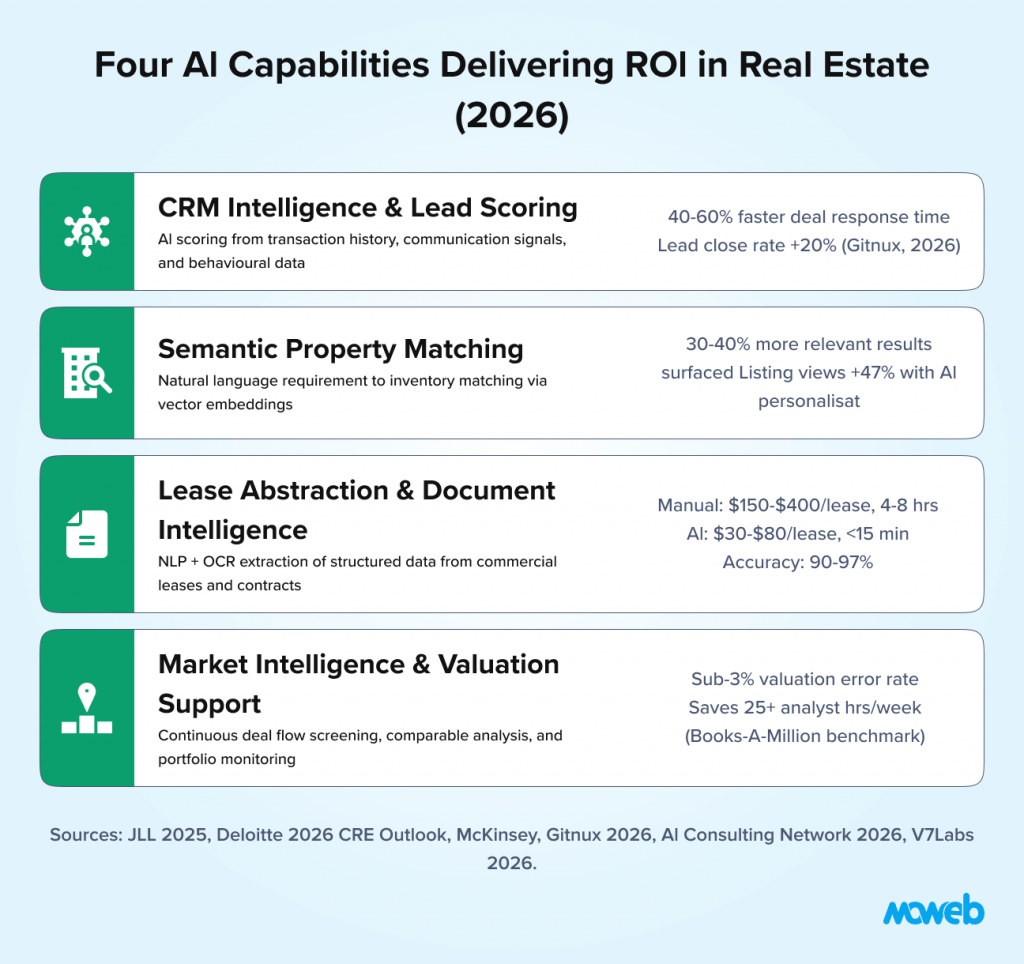
Lead scoring and transaction prediction. AI models trained on historical transaction data can score each contact in the CRM by their predicted likelihood to transact in the next 30, 60, or 90 days, based on behavioural signals: email open rates, portal search activity, communication frequency, time since last transaction, and life event signals where available. The commercial benefit is straightforward: a brokerage with 5,000 contacts in its CRM cannot meaningfully engage all 5,000 with the same intensity. AI scoring identifies the 200 most likely to transact in the next quarter and concentrates follow-up resources accordingly. CRM AI now predicts client churn at 85% accuracy and improves predictive lead scoring close rates by 20% (Gitnux, 2026). Chatbots embedded in CRM workflows convert 30% more leads than standard web forms.
AI-powered CRMs reduce deal response time by 40–60% through automated broker follow-ups, intelligent deal scoring, and prioritised pipeline management that surfaces the most promising opportunities. For commercial real estate, where a single deal can represent millions in commission and the difference between winning and losing often comes down to speed of response, this prioritisation effect is commercially significant. EliseAI, valued at $2.2 billion after raising $250 million in August 2025 manages leasing communications for roughly 10% of the US apartment market, with clients including Greystar, AvalonBay, Brookfield, and Equity Residential. Their ARR crossed $100 million in 2025, illustrating the commercial scale these CRM AI deployments can reach.
Communication intelligence and relationship context. AI analysis of email and call communication history surfaces relationship insights that are invisible in a standard CRM record: which contacts respond fastest to which communication types, which relationships have gone cold, which conversations contain buying signals that were not captured as CRM activities, and which contacts are connected to other high-value relationships in the network. This relationship intelligence layer transforms the CRM from a contact database into a genuinely intelligent relationship management tool.
Automated follow-up and drip sequence management. AI-driven action plans generate personalised follow-up sequences based on contact behaviour and transaction stage, ensuring consistent long-term follow-up for leads that are not ready to transact immediately. For residential brokerages managing large buyer and seller pipelines, this automation eliminates the manual overhead of maintaining consistent engagement across hundreds of active relationships simultaneously.
The integration requirement for CRM intelligence AI is direct access to the existing CRM platform. For enterprises on Salesforce, HubSpot, or dedicated real estate CRM platforms, this typically means an API integration that allows the AI system to read communication history, write lead scores, and trigger automated actions within the CRM interface the team already uses.
Capability 2: Semantic Property Matching
Property search and matching is where the gap between AI capability and current practice is widest, and the opportunity is most significant.
Traditional property search is keyword-based: a buyer or tenant submits requirements as structured filters (location, size, price range, property type), and the system returns listings that match those exact parameters. This approach fails systematically for several reasons: buyers often cannot articulate their requirements precisely in structured filter terms, property descriptions use inconsistent terminology that keyword matching misses, and the most relevant properties are frequently described differently from how the buyer describes their needs.
Semantic property matching uses vector embeddings to convert both property listings and buyer requirements into numerical representations of meaning, then matches on semantic similarity rather than keyword overlap. The buyer can describe what they need in natural language (“a modern office space with good natural light, close to public transport, with room to expand within 18 months”), and the system retrieves the properties whose characteristics most closely match that intent – including properties described in entirely different terms.
For residential real estate, semantic matching has been demonstrated to surface relevant properties that traditional filter-based search misses for 30-40% of searches. For commercial real estate, where requirements are more complex and the language used to describe properties varies considerably across markets, the improvement is even more pronounced.. AI personalisation at the listing level boosts listing views by 47% and personalised video tour AI increases conversions by 18% (Gitnux, 2026) improvements that compound the underlying semantic matching capability with individualised presentation
The technology underpinning semantic property matching is the same RAG and vector database architecture used for enterprise knowledge management. Property listings are chunked, embedded using a property-domain embedding model, and indexed in a vector database. At query time, the buyer’s requirements are embedded and matched against the property index using approximate nearest neighbour search. For a full explanation of how this architecture works, our guide to RAG development for enterprise knowledge systems and our overview of vector databases for business leaders cover the foundational technology in detail.
For Indian real estate specifically, Moweb’s existing work on RAG and vector search for Indian real estate demonstrates how this architecture applies to the specific characteristics of Indian property markets, including multilingual requirements and the informal property description conventions common in emerging market listings.
Capability 3: Lease Abstraction and Document Intelligence
Lease abstraction is the most mature AI use case in commercial real estate and the one with the clearest, most immediately quantifiable ROI.
A commercial lease is a complex legal document, typically 50 to 200 pages, containing dozens of commercially critical data points: rent commencement date, base rent and escalation schedule, expiry and renewal option dates, permitted use clauses, assignment and subletting provisions, service charge caps, break clauses, dilapidations obligations, and HVAC and utilities responsibilities. A portfolio of 100 leases contains thousands of these data points. Manually abstracting them is time-consuming, error-prone, and must be repeated whenever a document is updated or a renewal is negotiated.
AI document intelligence for lease abstraction extracts these structured data points from the raw lease document using a combination of NLP, OCR (for scanned documents), and domain-specific extraction models trained on commercial lease corpora. The extracted data is validated against defined rules and populated directly into the lease management or property management system.
The operational benefit is substantial. The true cost picture in 2026 is more granular than a single range. In-house manual abstraction by a junior analyst runs $90 to $250 per lease in fully burdened labour cost (4 to 8 hours per standard lease). Outsourced offshore abstraction runs $150 to $400 per lease with a 2 to 4 week turnaround, too slow for due diligence timelines of 30 to 60 days. AI-assisted abstraction compresses this to under 15 minutes per lease at $30 to $80 per lease for standard commercial leases, with leading platforms achieving 90 to 97% accuracy at field level (AI Lease Abstraction Software 2026 comparison, theaiconsultingnetwork.com). A critical practical nuance: the 90–97% accuracy figure applies to standard commercial lease terms. Non-standard clauses, complex rent escalation formulas, and cross-referenced exhibits remain the accuracy weak spots; human review of these sections is standard practice at every enterprise-grade platform. Additionally, a commercial lease is not one document it is a base agreement plus years of amendments, side letters, and notices. The abstraction system must consolidate these into one current lease position rather than abstracting the base lease in isolation.
For a portfolio of 500 leases, the shift from outsourced to AI-assisted abstraction represents a saving of $60,000 to $185,000 on initial abstraction alone, with the additional benefit of a 2- to 4-week turnaround reduced to hours before accounting for the ongoing benefit of automated updates when leases are amended. Cushman and Wakefield’s 2026 AI Impact Barometer cites lease intelligence as one of the top 5 CRE use cases driving measurable ROI in 2026, consistent with Deloitte’s observation that 75–76% of US CRE firms have begun implementing or exploring AI, with lease abstraction and AP automation leading adoption.
Beyond cost savings, AI lease abstraction enables portfolio-level analytics that are practically impossible with manually maintained data: expiry date clustering analysis (identifying concentration risk in renewal obligations), rent escalation forecasting, break clause calendar management, and automated covenant compliance monitoring. A 500-lease portfolio with a 2% critical date miss rate generates 10 missed opportunities per year, potentially hundreds of thousands in preventable costs. AI-maintained lease data eliminates this exposure systematically.
The document intelligence capability extends beyond leases to the full range of real estate documents: purchase agreements, planning applications, development agreements, title documents, survey reports, and environmental assessments. AI extraction models for each document type can be configured to extract the specific data points relevant to the organisation’s operational needs.
Capability 4: Market Intelligence and Property Valuation
Market intelligence AI aggregates data from multiple sources – listing portals, transaction registries, planning databases, economic indicators, demographic data, and transport network data – to generate property valuations, investment screening analyses, and market reports that would take days of analyst time to produce manually.
For acquisition teams at REITs, property developers, and institutional investors, AI market intelligence has two primary applications.
Automated deal flow screening. AI algorithms monitor listing sites and public records continuously for properties matching preset investment criteria (location, size, yield, planning status, tenure type), generating prioritised deal lists for acquisition team review. The commercial benefit is coverage: a human acquisition team can monitor a finite number of sources and geographies. An AI screening system monitors comprehensively and never misses a qualifying opportunity because a team member was on holiday.
Comparable transaction analysis and valuation support. AI valuation models trained on recent comparable transactions provide indicative valuations for properties under consideration, incorporating location, property characteristics, lease terms (for income-producing assets), and current market conditions. Leading AI valuation systems are achieving sub-3% error rates on standard residential and commercial properties (V7Labs, 2026). These are not replacement valuations; formal RICS or MAI appraisals remain necessary for transaction purposes, but they are valuable for rapid initial screening, portfolio monitoring, and identifying assets trading at significant premiums or discounts to intrinsic value. A manually produced CMA report now takes AI systems ten seconds; previously this required 30 to 60 minutes of analyst time.
The data infrastructure requirement for market intelligence AI is more demanding than for CRM or document automation: it requires reliable data feeds from listing platforms, transaction registries, and economic data sources. Building and maintaining these feeds is the primary technical challenge for organisations deploying market intelligence AI independently rather than using specialist data platform providers.
A practical 2026 benchmark: Placer.ai provides foot traffic analytics for retail site selection; GrowthFactor offers the complete CRE evaluation workflow from site scoring through deal close. Books-A-Million deployed site analysis AI and now saves 25 hours per analyst per week. These are the kind of concrete productivity benchmarks acquisition teams should demand from any market intelligence AI vendor before committing.
The Operations Layer: Where 2026 Budget Is Actually Moving
Beyond the four AI capabilities above, there is a fifth area seeing significant adoption in 2026 that sits below the strategic visibility of market intelligence and above the tactical focus of lease abstraction: the operations layer.
The operations layer covers the back-office workflows that determine whether a property portfolio runs efficiently: accounts payable automation (processing supplier invoices against budgets and approvals), three-way matching on capital expenditure (matching purchase orders, delivery receipts, and invoices), rent roll exception handling (identifying anomalies in rental income against expected schedules), vendor master maintenance, and SOX-ready audit trails for REIT and institutional fund compliance.
Deloitte’s 2026 CRE Outlook notes this is where procurement budgets are quietly moving, because the ROI is clearer and faster than strategic AI applications. Single-workflow deployments – AP automation for one property type, lease abstraction for a specific portfolio – typically run 6-12 weeks from contract to production. Multi-workflow programmes across larger portfolios run 6-12 months for full deployment. Kognitos’ 2026 analysis of real estate AI automation identifies AP and vendor invoice automation as the highest-leverage entry point, followed by lease abstraction and three-way match in that order based on volume, consistency, and speed of ROI realisation.
The most successful 2026 deployments follow a phased approach: start with one high-volume workflow (typically AP or lease abstraction), demonstrate ROI within 90 days, then expand to adjacent workflows (three-way match, rent roll, compliance monitoring) using the data and integration infrastructure established in Phase 1.
Implementation Roadmap for Real Estate Organisations
The phased approach to real estate AI mirrors the pattern that works across all industries: start where the data is cleanest, the process is most defined, and the ROI is most measurable.
Phase 1 (Weeks 1-8): Document intelligence and data foundation. Lease abstraction is the right starting point for most real estate organisations. The ROI calculation is immediate and specific. The data exists (the lease documents). The success metric is clear (abstraction accuracy against a validation set of manually abstracted leases). And the output – clean, structured lease data – becomes the foundation for every subsequent AI application. A practical data prerequisite: confirm whether your lease documents exist in searchable PDF format or as scanned images. Scanned documents require OCR pre-processing that adds to timeline and cost. For a portfolio of 500+ leases, OCR remediation is typically a Phase 1 prerequisite in its own right.
Alongside lease abstraction, this phase establishes the data infrastructure: a clean property and lease database, CRM data quality remediation, and the API integrations between the property management system, lease management system, and CRM that subsequent AI capabilities depend on.
Phase 2 (Weeks 8-16): CRM intelligence and property matching. With clean data infrastructure in place, Phase 2 adds the AI layers that affect front-office performance. CRM lead scoring and communication intelligence improve sales team productivity. Semantic property matching improves conversion rates on buyer and tenant enquiries. These capabilities compound the data quality investment from Phase 1. The minimum CRM data requirement for reliable lead scoring is 12–24 months of contact history including communication records and transaction outcomes. Teams with CRM data quality gaps should plan a data remediation sprint as the first four weeks of Phase 2.
Phase 3 (Months 4-9): Market intelligence and portfolio analytics. With document intelligence and CRM intelligence operational, Phase 3 adds the market intelligence layer: deal flow screening, valuation support, and portfolio analytics. This phase typically requires the most data engineering work – building the external data feeds and integration pipelines that market intelligence depends on.
Phase 4 (Months 9+): Operations automation and portfolio-scale deployment: AP automation, three-way matching, compliance monitoring, and full portfolio-scale deployment of all capabilities across all property types and geographies. By Phase 4, the data infrastructure, integration patterns, and governance framework are established, making each additional deployment significantly faster than the one before. For a structured approach to assessing which phase your organisation is ready for, our AI readiness assessment checklist covers data quality, infrastructure, and process definition as the three core readiness dimensions.
Frequently Asked Questions About AI in Real Estate
Why are so few real estate AI programmes achieving their goals? JLL’s research found 92% of CRE teams piloting AI but only 5% achieving programme goals. Three execution gaps account for the majority of failures: using the wrong tool for the specific workflow bottleneck (general AI tools applied to specialised CRE data), failing to integrate AI outputs into actual decision workflows rather than separate dashboards, and insufficient data infrastructure for production scale. The organisations achieving their goals invest in these three areas before expecting AI to perform at production standard.
What is lease abstraction AI and how accurate is it? Lease abstraction AI uses NLP, OCR, and LLMs to extract structured data points from commercial lease documents: rent commencement, base rent, escalation schedules, expiry and renewal dates, break clauses, and similar terms. Leading platforms achieve 90 to 97% accuracy at field level on standard commercial leases (AI Consulting Network, 2026), with lower accuracy for non-standard clauses, complex rent escalation formulas, and cross-referenced exhibits. Human review of these exception sections remains standard practice. A 2026 practical benchmark: leading tools complete a standard commercial lease in under 15 minutes versus 4 to 8 hours manually. One important technical requirement: the system must consolidate the base lease and all amendments, side letters, and notices into a single current lease position, not just abstract the base lease in isolation.
How does AI property matching differ from traditional property search? Traditional search matches buyer requirements as structured filters against property attributes in the same terms. AI semantic matching converts both requirements and property descriptions into vector embeddings representing meaning, then matches on semantic similarity. This means the buyer can describe needs in natural language, and the system retrieves relevant properties regardless of whether the listing uses the same terminology. AI matching consistently surfaces relevant properties that structured filter search misses, particularly for complex or non-standard requirements.
What data do real estate organisations need before deploying AI? For lease abstraction: the lease documents themselves in accessible format (searchable PDF preferred; scanned images require OCR pre-processing). For CRM intelligence: at least 12–24 months of CRM contact history including communication records and transaction outcomes. Teams with data quality gaps should plan a remediation sprint before AI deployment. For semantic property matching: a structured property database with consistent attribute recording and rich property descriptions. For market intelligence: access to listing portal data feeds and transaction registry data for the relevant markets. A 2025 MIT Sloan study found 61% of enterprise AI projects were approved on projected value that was never formally measured after deployment, often because data quality issues discovered mid-project invalidated the original business case. Data assessment before commitment is not optional diligence; it is the primary determinant of whether the AI programme pays back within the first year.
Is AI in real estate relevant for residential as well as commercial property? Yes, though the specific applications differ. Commercial real estate AI concentrates on lease abstraction, portfolio management, deal flow screening, and institutional investor CRM. Residential real estate AI concentrates on buyer and seller lead scoring, property matching for buyer requirements, automated valuation models, and marketing automation. The underlying technology is similar; the domain-specific training data and workflow integration requirements differ significantly between the two segments.
What is the ROI timeline for real estate AI investments? Lease abstraction generates positive ROI within the first portfolio processed. The shift from outsourced abstraction ($150–$400/lease, 2–4 week turnaround) to AI-assisted abstraction ($30–$80/lease, under 15 minutes) is immediately quantifiable. A 500-lease portfolio generates $60,000 to $185,000 in savings on initial abstraction alone. CRM intelligence ROI manifests over 60–90 days as improved lead conversion rates; predictive lead scoring improves close rates by 20%, and chatbot-assisted CRM converts 30% more leads than forms (Gitnux, 2026). Market intelligence ROI is longer-term and harder to isolate, accruing through acquisition decisions made with better information and opportunities captured that would otherwise have been missed, with AI valuation systems now achieving sub-3% error rates on standard property types.
Conclusion: The 5% Are Not Doing More AI – They Are Doing It Differently
The lesson from the 92% versus 5% gap in real estate AI is not that the technology is immature or the ROI is unclear. The technology works. The ROI is well-documented. The gap is execution.
The organisations achieving their AI programme goals in real estate are doing three things the majority are not: they are using AI tools specifically configured for real estate workflows rather than generic AI applied generically, they are integrating AI outputs into the systems and workflows where decisions are actually made, and they are investing in data infrastructure before expecting AI to perform at production standard.
These are not secret insights. They are the straightforward requirements for production AI deployment in any data-intensive industry. Real estate happens to be an industry where the gap between what AI can do and what most organisations have deployed is unusually wide – which means the opportunity for organisations that execute well is unusually significant. Morgan Stanley’s estimate of $34 billion in efficiency savings from automating 37% of real estate operations over five years is not a theoretical ceiling. It is the size of the value that the 5% are beginning to capture and the 92% are leaving on the table.
Moweb’s AI & ML development and Generative AI & LLM development practices work with real estate enterprises, REITs, and property technology companies to design and build AI systems integrated directly into property management, lease administration, and CRM workflows. Our Data Engineering & Foundations practice handles the data infrastructure that production real estate AI depends on. Talk to us about your real estate AI programme.
Found this post insightful? Don’t forget to share it with your network!





 India
India USA
USA