
AI in Supply Chain and Logistics
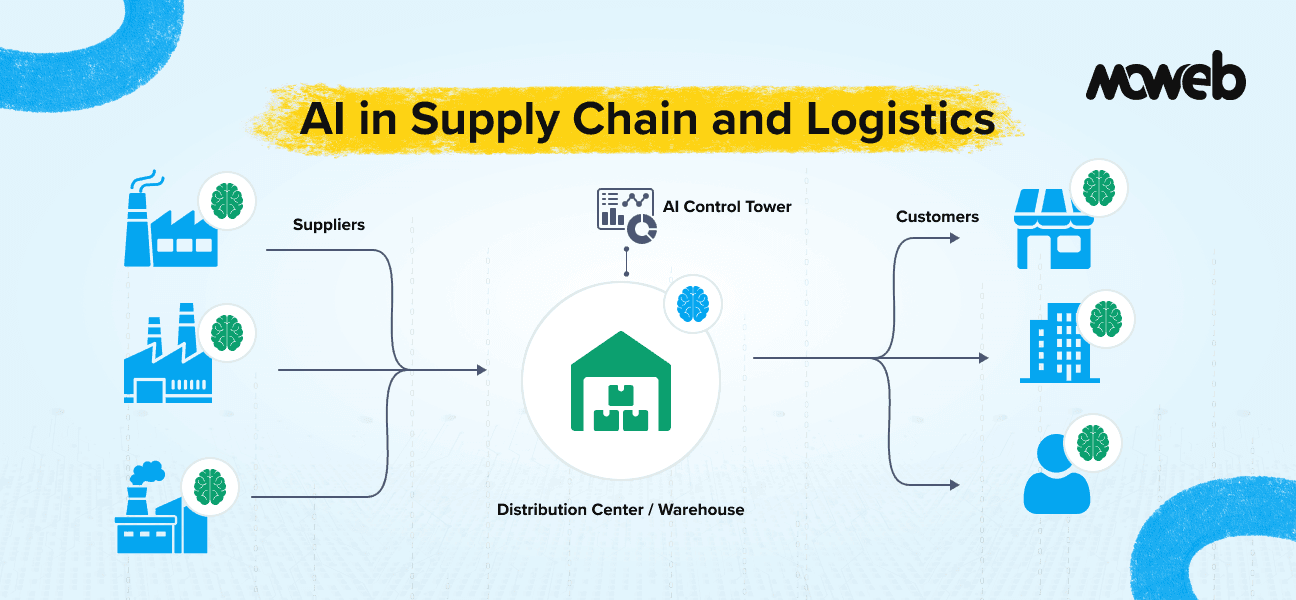
A practical guide to AI in supply chain and logistics for 2026. Covers demand sensing, route optimization, warehouse intelligence, disruption prediction, and AI control towers - with real ROI benchmarks and an implementation roadmap.
What is AI used for in supply chain and logistics? AI in supply chain and logistics is used across five interconnected capability areas: demand sensing (predicting what customers will want with greater accuracy than historical averaging), supplier intelligence (scoring and monitoring supplier risk in real time), route optimisation (dynamically routing vehicles based on live traffic, weather, fuel, and capacity data), warehouse automation and slotting intelligence (optimising how goods are stored and picked), and disruption prediction (identifying supply chain risks 2 to 4 weeks before they materialise using external signal monitoring). In 2026, a sixth capability is emerging at scale: agentic AI operations, autonomous AI agents that do not just recommend actions but execute them, rerouting shipments, issuing purchase orders, and managing exceptions without human prompting. Each capability delivers independent value, but the compounding effect of implementing multiple capabilities on shared data infrastructure produces an ROI that significantly exceeds the sum of individual business cases.
The supply chain that performed reliably in 2020 has a structural vulnerability in 2026: it was designed for a world where demand was predictable, suppliers were stable, and disruptions were rare. None of those assumptions hold. The organisations absorbing 2026 volatility without operational crisis are not doing it with more analysts or more safety stock. They are doing it with AI systems that see disruptions coming, route around them automatically, and reposition inventory before the demand signal reaches the planning team. Climate events, geopolitical tensions, port congestion, and supplier financial instability create a continuous stream of disruptions that traditional supply chain management – built around assumptions of stable demand and reliable supply – cannot absorb. At the same time, customer expectations for delivery speed, accuracy, and visibility have permanently shifted. What was premium service three years ago is now a baseline expectation.
The supply chains keeping up with these demands are not doing it with more analysts, more safety stock, or more manual coordination. They are doing it with AI: systems that sense demand changes before they hit the order book, route vehicles dynamically around live disruptions, position inventory ahead of demand shifts, and identify supplier risks weeks before they become operational crises.
This guide covers the six AI capabilities that are producing documented ROI in supply chain and logistics operations in 2026, the data and integration requirements that make them work, and a realistic roadmap for moving from isolated experiments to enterprise-scale deployment.
For manufacturers specifically, our guide to AI in manufacturing: pilot to plant-wide deployment covers the factory floor dimension of this transformation.
The Supply Chain AI Landscape in 2026: Where Things Actually Stand
Before getting into specific capabilities, it is worth being honest about where the industry stands, because the gap between what is technically possible and what is operationally deployed is significant.
The reason for this gap is not the AI technology. The reason is that supply chain AI deployments fail for three consistently identifiable reasons:
Data quality and accessibility. Supply chain data is notoriously fragmented across TMS, WMS, ERP, and supplier systems that were not designed to share information. A demand forecasting model that cannot access real-time inventory positions, current order book, and live supplier lead times is working with a materially incomplete picture. Building the data infrastructure to make these sources accessible and consistently formatted is the foundational investment that most organisations underestimate before starting.
Legacy system integration complexity. Most mid-market supply chain organisations operate TMS and WMS systems that are 5 to 15 years old. These systems were not designed with AI integration in mind. Connecting modern AI applications to legacy operational systems requires integration middleware, data transformation pipelines, and in some cases, API development that adds significant time and cost to what looks, in a demo, like a straightforward plug-in.
Workforce readiness and change management. A route optimisation system that dispatchers do not trust will not change how routes are actually executed. A demand forecast that planners override because it does not match their intuition delivers no operational value. Building the workflow integration and human trust that makes AI outputs actionable is as important as building the AI system itself.
Understanding these three barriers upfront shapes both the architecture and the implementation approach for supply chain AI that actually scales.
Before launching a supply chain AI programme, a structured AI readiness assessment helps identify which of these three barriers is most likely to affect your organisation.
Capability 1: Demand Sensing and AI-Driven Forecasting
Traditional demand planning uses historical sales data, seasonal indices, and manual sales input to produce forecasts that are already outdated by the time they reach the planning team. The problem is not the methodology – it is the data. Historical patterns alone cannot capture the demand signals that matter most: a competitor’s product launch, a social media trend, an unexpected weather event, a logistics disruption at a key port.
AI-driven demand sensing integrates a fundamentally broader signal set. Beyond historical sales, modern demand sensing models incorporate:
• Point-of-sale data from retail partners is updated daily or in real time
• External market signals: economic indicators, social media sentiment, search trend data, competitor pricing movements
• Promotional calendars and marketing spend data
• Weather forecasts and seasonal patterns
• Current order book and in-transit inventory positions
• Supplier lead time signals from procurement systems
The accuracy improvement from this broader signal integration is substantial. Accuracy benchmarks vary by industry, and evaluation methodologies ask vendors to specify the metric and baseline when reviewing their claims.
The implementation path for demand sensing starts with data integration, not model building. The first eight to twelve weeks of a demand sensing implementation should be spent connecting the data sources (POS, ERP, external signals), standardising their formats, and establishing the pipeline that keeps them current. Only then does the model development phase produce meaningful results, because demand sensing is only as good as the breadth and freshness of the signals it can access.
Demand sensing is a predictive AI application. For supply chain leaders deciding where to invest first between predictive and generative AI capabilities, see our decision framework on generative AI vs predictive AI.
Capability 2: Dynamic Route Optimisation
Route optimisation is one of the most mature and best-evidenced AI applications in logistics, and it is also one of the most actively evolving. The gap between first-generation static optimisation (optimise a route once, at the start of the day) and 2026 dynamic optimisation (continuously re-optimise routes based on live conditions throughout execution) is a qualitative difference in operational capability, not just an incremental improvement.
Static optimisation tools have been available for decades. They take a set of delivery stops, a vehicle fleet, and time window constraints, and produce an optimised sequence. Their limitation is that the optimised route is calculated against conditions at the time of planning, which often diverge significantly from conditions during execution: traffic incidents, weather changes, late customer requests, vehicle breakdowns, and delivery exceptions.
Dynamic route optimisation systems monitor execution in real time and continuously recalculate optimal routing based on live conditions. When a traffic incident adds 40 minutes to a route segment, the system does not wait for the driver to detect and report the delay – it identifies the deviation, calculates the network-wide impact on all active routes, and recommends or automatically implements the resequencing that minimises total network disruption. The implementation spanned 18 months across the full network but generated positive ROI after just 4 months in the first deployment region.
For mid-market logistics operations, the proportional impact is comparable. Documented mid-market implementations consistently show fuel cost reduction, reduction in kilometres driven, and improvement in on-time delivery performance. The data requirements are accessible: vehicle telemetry, delivery manifests, time window constraints, and live traffic feeds are the core inputs.
Capability 3: Warehouse Intelligence and Slotting Optimisation
The warehouse is where supply chain AI delivers some of its fastest and most measurable ROI, because warehouse operations are data-rich, highly repetitive, and directly tied to quantifiable metrics (picks per hour, order accuracy rate, travel time per pick).
Three AI applications within the warehouse are producing consistent ROI in 2026:
AI-driven slotting optimisation continuously analyses order patterns, product velocity, and warehouse layout to recommend the optimal storage location for each SKU. Traditional slotting is done periodically (quarterly or annually) based on historical velocity data. AI-driven slotting adapts continuously, identifying when a product’s pick frequency has changed and recommending relocation before the mismatch between location and velocity compounds into material travel time waste. Slotting optimisation models that continuously adapt to order patterns reduce picker travel time in a warehouse – a significant gain in operations where picking labour represents of total warehouse operating cost.
Warehouse AI control towers provide real-time visibility across inbound receipts, storage, picking, packing, and outbound shipments. The AI layer monitors against expected throughput, flags bottlenecks before they create downstream delays, and surfaces actionable recommendations (shift labour allocation, replenish a pick face, open a second packing station) to warehouse managers in real time rather than after the fact. In 2026, IoT sensor integration is enhancing control tower capability significantly: RFID, weight sensors, and computer vision systems feed real-time inventory position and movement data to the AI layer, reducing the manual data entry that has historically degraded warehouse data quality.
AI-powered picking path optimisation takes the output of slotting optimisation and applies it in real time to individual pick lists, sequencing picks to minimise travel distance for each order while accommodating zone constraints, weight sequencing rules, and multi-order batch picking requirements. Combined with slotting optimisation, picking path optimisation consistently delivers improvement in picks per hour.
AI-driven picking optimisation increases warehouse throughput across documented implementations. For operations running thin margins and under constant labour cost pressure, these throughput improvements are strategically significant.
Capability 4: Supply Chain Disruption Prediction
The traditional approach to supply chain disruption is reactive: a disruption occurs, the team scrambles to identify alternatives, expedite shipments, and manage customer impact. The cost of this reactive cycle in a complex supply chain – expediting fees, air freight premiums, production line stoppages, customer penalties – consistently runs 10 to 15 times the cost of proactive disruption management.
AI-driven disruption prediction changes this calculus by monitoring external signals continuously and identifying disruption precursors before the disruption materialises in the supply chain.
Modern disruption prediction systems monitor a broad signal set, including:
• Port congestion data and vessel tracking across global shipping lanes
• Weather patterns and climate event forecasting across key logistics routes
• Supplier financial health indicators (credit ratings, payment delay patterns, news sentiment)
• Geopolitical risk signals for key sourcing regions
• Logistics network capacity signals (carrier availability, fuel price movements, driver shortage indicators)
The predictive power of these systems has improved substantially since 2023.
For supply chain leaders who have lived through the past four years of supply chain volatility, the ability to see a disruption coming with two to three weeks of lead time rather than responding to a fait accompli is transformative. It converts a cost of disruption problem into a cost of prevention problem, and prevention is almost always cheaper.
Capability 5: Supplier Intelligence and Risk Scoring
Supplier risk management has traditionally been a periodic, manual process: annual reviews, questionnaire-based assessments, and reactive credit checks when problems surface. This approach systematically misses the dynamic, high-frequency risk signals that precede most supplier failures.
AI-driven supplier intelligence monitors suppliers continuously across financial, operational, and reputational dimensions:
• Financial health signals: credit rating changes, payment delays to other customers, publicly available financial distress indicators
• Operational signals: delivery performance trends, quality defect patterns, capacity utilisation signals from industry sources
• Reputational signals: news sentiment monitoring, regulatory action tracking, labour dispute alerts
• Geopolitical and climate exposure scoring: how exposed is each supplier to the specific geopolitical and climate risks most relevant to your sourcing geography?
The system produces a continuously updated risk score for each supplier, alerts the procurement team when a supplier’s risk profile crosses a defined threshold, and in more advanced implementations, suggests alternative sourcing options ranked by availability, lead time, and cost impact.
This is one of the supply chain AI capabilities where the ROI case is most compelling but hardest to quantify precisely – because the value is in disruptions avoided rather than costs directly measured. The proxy metric most procurement organisations use is the reduction in emergency supplier switches and expedited sourcing events, which in complex supply chains represent high unplanned cost in both direct spend and team time.
Capability 6: Agentic AI and Autonomous Supply Chain Operations
The five capabilities above represent the 2024–2025 state of supply chain AI: intelligent systems that sense, predict, and recommend. In 2026, the landscape has shifted to a fundamentally different capability: AI agents that do not just recommend actions but autonomously execute them.
Agentic AI in supply chain refers to autonomous AI systems that can reason across multiple steps, use approved tools, access external systems, and complete multi-step operational tasks with defined human oversight checkpoints. The defining characteristic, as described by supply chain AI researchers, is proactive autonomy: the agent continuously monitors conditions, detects a disruption, traces it to specific materials or carriers, identifies alternatives, and takes action without waiting for a human prompt.
What agentic supply chain operations look like in practice:
• A procurement agent detects a supplier’s deteriorating risk score, identifies three alternative suppliers with available inventory at comparable cost, and drafts a purchase order for procurement team approval all within minutes of the risk threshold being crossed
• A logistics agent continuously monitors active shipments and, when a weather event is detected on a key route, automatically evaluates re-routing options, calculates cost and time trade-offs, and either implements the reroute within pre-approved parameters or escalates for approval above those parameters
• A demand agent detects an unexpected POS spike for a specific SKU, calculates the inventory shortfall risk, and triggers a replenishment order through the procurement system before the next planning cycle runs
The market scale of this shift is significant.
SAP demonstrated agentic supply chain capabilities at Hannover Messe 2026. Microsoft’s internal supply chain team is targeting over 100 active supply chain agents by end of 2026.
For supply chain leaders evaluating AI programmes in 2026, the question is no longer only which AI capabilities to deploy but which workflows are ready for autonomous execution and what governance framework ensures human oversight at the right decision thresholds.
The Data Foundation: Why Supply Chain AI Fails Without It
All five AI capabilities above share a common dependency: a data foundation that makes relevant, current, consistent data accessible to the AI systems that need it.
Supply chain environments are typically the most data-fragmented in any enterprise. A mid-market manufacturer or distributor might have customer order data in the ERP, inventory positions in a separate WMS, transport data in a TMS, supplier data in a procurement system, and quality data in yet another application – none of them designed to share information in real time.
Building the data foundation for supply chain AI is a distinct engineering project that should precede AI application development, not run concurrently with it. The core components:
A supply chain data platform or data lake that consolidates data from ERP, WMS, TMS, procurement, and external data sources into a single accessible layer. Modern cloud data warehouses (Snowflake, Databricks, AWS Redshift, Google BigQuery, Azure Synapse Analytics) with connector libraries for common supply chain systems are the most practical implementation path for mid-market organisations.
Real-time data pipelines that keep the platform current. Batch updates (nightly ERP exports) are insufficient for AI applications that need to sense demand changes, route around disruptions, or flag supplier risk in real time. The pipeline architecture must support near-real-time data ingestion from operational systems.
Data quality management that identifies and flags inconsistent, missing, or erroneous data before it reaches the AI models. In supply chain environments where data comes from many systems and many partners, data quality governance is an ongoing operational discipline, not a one-time cleansing project. For the foundational data engineering work that supply chain AI requires, our guide to data engineering for AI: building the foundations your models actually need covers the architecture and implementation approach in detail. Moweb’s Data Engineering & Foundations practice handles this layer as a dedicated engagement phase for supply chain AI programmes. Before launching a supply chain AI programme, a structured AI readiness assessment helps identify which of these three barriers is most likely to affect your organisation.
Implementation Roadmap: From Pilot to Portfolio
The most effective supply chain AI programmes follow a portfolio approach rather than a single-use-case focus. The data infrastructure built for demand sensing also serves route optimisation and disruption prediction. Each additional use case deployed on the shared foundation is faster and cheaper than the one before it.
A realistic implementation sequence for a mid-market supply chain organisation:
Phase 1 (Months 1 to 4): Data foundation and first use case. Build the supply chain data platform and first integration pipeline. Launch a focused pilot on the highest-ROI use case for your specific operation (demand sensing if inventory carrying cost is your primary pain, route optimisation if logistics cost or delivery performance is the priority). Establish the measurement framework and baseline metrics before the pilot starts.
Phase 2 (Months 4 to 9): Validate, expand, and add a second capability. Validate Phase 1 ROI over a full operating cycle (at least 90 days). Use lessons from Phase 1 to refine the data platform and deployment playbook. Launch the second AI capability on the existing data infrastructure. Begin building operator training and workflow integration for both capabilities.
Phase 3 (Months 9 to 18): Portfolio deployment and AI control tower. Deploy remaining AI capabilities from the portfolio. Implement an AI control tower that provides unified visibility across all active supply chain AI systems. Establish ongoing model monitoring, drift detection, and retraining cadences. For organisations with mature Phase 1 and 2 deployments, Phase 3 is also the appropriate stage to evaluate agentic AI workflows, identifying which decision processes are sufficiently governed and data-rich to support autonomous execution within defined boundaries. Measure portfolio ROI as a consolidated business case.
Full ROI across a multi-capability supply chain AI programme typically materialises within 9 to 12 months from first deployment, with individual capability ROI visible considerably sooner: demand sensing improvements within 30 to 60 days, transportation cost reductions within 60 to 90 days, and inventory reductions over 3 to 6 months.
Frequently Asked Questions About AI in Supply Chain and Logistics
What is the difference between demand sensing and demand forecasting? Demand forecasting uses historical data and known patterns to project future demand, typically at weekly or monthly granularity. Demand sensing uses a much broader set of real-time signals (POS data, weather, social media, competitor activity, economic indicators) to detect demand shifts as they happen or immediately before they materialise, operating at daily or even hourly granularity. Demand sensing does not replace demand forecasting – it provides a higher-frequency signal layer that improves the accuracy of near-term forecasts and triggers faster planning responses to demand changes.
How does AI route optimisation differ from traditional TMS routing? Traditional TMS routing optimises routes at the start of each day based on the order book and static constraints (time windows, vehicle capacity, driver hours). It does not adapt to conditions that change during execution. AI-driven dynamic route optimisation continuously monitors execution against live conditions (traffic, weather, delivery exceptions, new orders) and recalculates optimal routing in real time throughout the day. The difference is the shift from plan-and-execute to plan-and-continuously-adapt, which produces consistent efficiency gains in environments where operational conditions deviate regularly from the plan.
What data does an AI supply chain system need to function effectively? At minimum: historical sales data at sufficient granularity (SKU level, daily frequency, at least 2 years), current inventory positions updated in near-real-time, current order book, supplier lead times and reliability history, and, for logistics applications, vehicle and route data. More advanced capabilities (disruption prediction, demand sensing) additionally require external data feeds: weather forecasts, port congestion data, supplier financial signals, and market intelligence. The quality and freshness of this data are the primary determinants of AI system performance.
How long does it take to see ROI from supply chain AI? ROI timeline varies by use case. Demand sensing improvements are visible within 30 to 60 days as forecast accuracy metrics improve. Transportation cost reductions from route optimisation appear within 60 to 90 days as optimised routes are implemented across the fleet. Inventory reductions take 3 to 6 months as safety stock levels are recalibrated and excess stock is worked through. Full portfolio ROI across multiple capabilities typically materialises within 9 to 12 months.
What is an AI supply chain control tower? An AI supply chain control tower is a centralised visibility and decision-support platform that monitors all supply chain AI systems – demand sensing, route optimisation, warehouse intelligence, disruption prediction – in a unified dashboard. It aggregates alerts, performance metrics, and exception flags from all operational systems and surfaces them to planning and operations teams in a single interface.
Should mid-market supply chain companies build custom AI or buy a supply chain AI platform? The practical guidance: use a supply chain AI platform (Kinaxis, Blue Yonder, o9 Solutions,SAP Integrated Business Planning, or Oracle Fusion SCM) if your supply chain is relatively standard and your IT team is small. Build custom AI solutions on top of your ERP if you have unique supply chain characteristics – custom manufacturing processes, complex multi-tier supplier networks, specialised logistics requirements – that platforms do not adequately address. Many mid-market businesses start with platform components for standard capabilities and add custom AI models for their most critical competitive differentiators. The build vs buy decision should be use-case-specific, not a blanket policy. For the full decision framework, see our guide to build vs buy AI for US businesses in 2026.
What is agentic AI in supply chain, and how is it different from traditional supply chain AI? Traditional supply chain AI produces recommendations that humans act on. Agentic AI in supply chain refers to autonomous AI systems that execute actions directly rerouting a shipment, issuing a purchase order, reallocating warehouse labour within pre-defined governance boundaries, without requiring a human to approve each step. The shift from recommendation to autonomous execution is the defining characteristic of agentic supply chain AI in 2026. Organisations evaluating supply chain AI partners should ask specifically about the vendor’s experience deploying agentic workflows and their governance framework for autonomous decision execution.
Conclusion: Supply Chain AI Is a Competitive Differentiator, Not a Cost-Saving Exercise
The supply chain leaders who are winning in 2026 have reframed the AI question. They are not asking “how much can we save?” They are asking, “How much faster can we sense, decide, and act than our competitors?”
The organisations that sense demand shifts two weeks before they hit the order book, reroute disrupted shipments automatically, and identify supplier risks before they materialise have a structural advantage that compounds over time. Each AI capability deployed makes the data foundation more valuable because additional use cases can be built on shared infrastructure. Each operational cycle generates more data, which makes the models more accurate. Each accurate prediction builds operator trust, which makes the AI outputs more consistently acted upon.
In 2026, the frontier of this advantage is agentic AI: supply chains where autonomous agents do not just surface the right decision but execute it within defined boundaries, compressing the time from signal to action from hours to seconds. The organisations building this capability now are not just ahead of the current competitive curve they are building an operational infrastructure that will be structurally difficult for laggards to close.
This compounding dynamic is why the gap between AI leaders and AI laggards in logistics is widening faster than in almost any other sector. The leaders are not just ahead – they are pulling further ahead with each operating cycle.Moweb’s AI & ML development and Data Engineering & Foundations practices work with supply chain and logistics organisations to build both the data foundation and the AI application layer. If you are planning a supply chain AI programme or want to assess why a current initiative is not scaling, talk to our team.
Found this post insightful? Don’t forget to share it with your network!