
Family Office Software: The One View Test for Consolidated Reporting Across Entities, Custodians and Private Assets
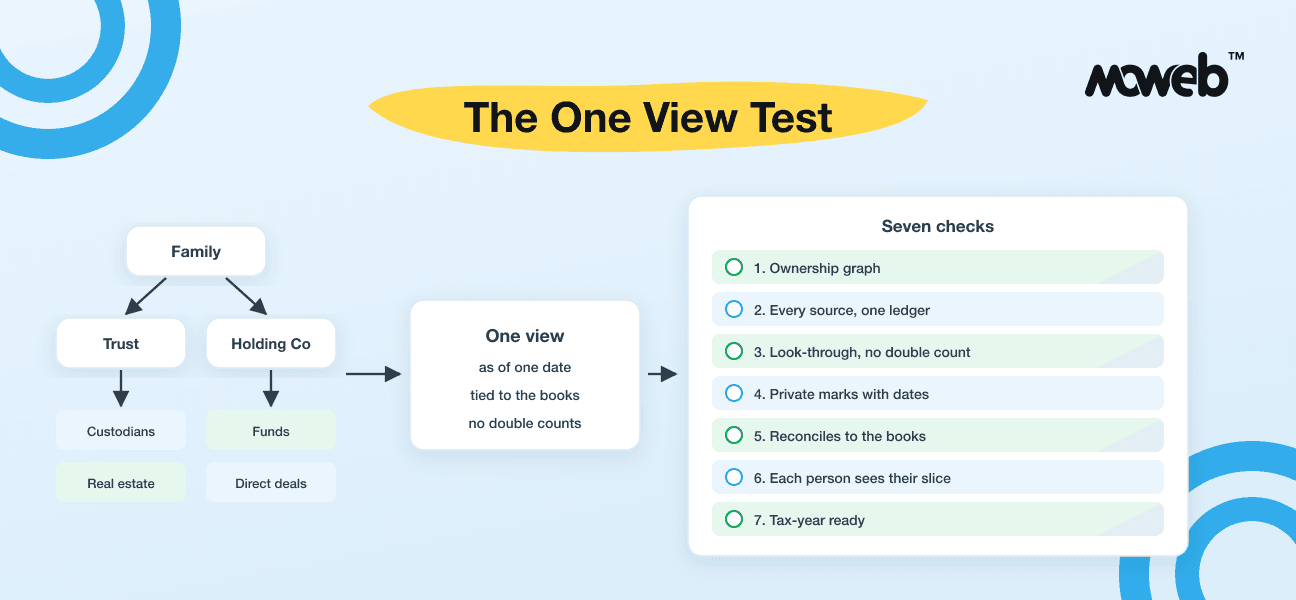
Family office software is judged by whether one number holds up across every entity, custodian and private fund. Use the One View Test, seven checks scored pass, workaround or fail, to decide whether to buy, extend or build a custom family office platform.
Ask a family office principal what the family is worth and you will usually get one of two answers. The first is a number, followed by a pause while someone checks the spreadsheet it came from. The second is "as of when?", the more honest answer, because the number depends on which feeds arrived, which fund marks are stale, and whether an intercompany loan was counted twice.
Family office software exists to make that question boring. Most evaluations focus on what demos well, an allocation chart or a polished PDF, while the hard part sits underneath: who owns what, through which entity, valued as of which date.
This guide is for principals, chief financial officers and operations heads at single family offices and multi-family offices deciding whether to buy, extend or build family office software. It gives you the **One View Test**, a checkable framework to run against a vendor shortlist or the stack you already have.
Why family offices outgrow spreadsheets and portals
A family office is a small finance department wrapped around a complicated legal structure: trusts, a family limited partnership, a holding company, an operating business, a foundation and special purpose vehicles for direct deals, each with its own books, owners and tax obligations.
The tooling usually grows by accretion:
- **Custodian portals** show liquid holdings, one institution at a time.
- **Fund statements** arrive as PDFs, weeks after quarter end.
- **The general ledger** holds entity accounting, often in software built for operating companies.
- **A master spreadsheet** stitches it together, maintained by one person.
Each piece is correct on its own terms. The failure is in the joins: applying the right ownership percentage at each entity layer, on the right date, without counting intercompany balances twice. When the spreadsheet's owner is on holiday, the family's view of its own wealth goes on holiday too.
What family office software actually has to model
If a platform cannot model these five things natively, no amount of reporting polish will fix it.
**The ownership graph.** People own entities, entities own other entities and accounts, and percentages change through gifts, sales and trust distributions. Every edge needs an effective date.
**Every asset class in one ledger.** Securities, cash, fund interests, direct deals, real estate, intercompany loans and collectibles, each with its own sources and valuation conventions, in one data model.
**Commitments, not just holdings.** A fund interest has a commitment, contributions, distributions, an unfunded balance and a reported value. Liquidity planning depends on the unfunded side.
**Dates on everything.** Mixing trade dates, valuation dates and period ends silently is how a statement blends last night's equities with a fund mark from two quarters ago.
**People and permissions.** Family members, trustees, advisers and accountants each need a different slice that follows the ownership graph.
The One View Test
The One View Test is seven checks. Score each one **pass** (the system does it natively and you can watch it happen with your own data), **workaround** (possible with exports, spreadsheets or a call to support) or **fail** (not possible). Run it with a real slice of your structure, not the vendor's sample household.
- **Ownership graph:** every asset rolls up through trusts and entities using effective-dated ownership percentages, and a change in ownership restates history correctly.
- **Every source, one ledger:** custodian feeds, fund statements, real estate, direct deals and bank accounts land in one data model, and every figure can be traced back to its source document or feed.
- **Look-through without double counting:** the system can show an entity's view and the family's look-through view, and eliminates intercompany loans and cross-holdings in consolidation.
- **Private marks with dates:** every private asset shows its valuation date and source, alongside commitment, contributed, distributed and unfunded amounts.
- **Reconciles to the books:** positions and cash reconcile to custodians on a schedule, and investment records tie to each entity's general ledger without manual re-keying.
- **Each person sees their slice:** permissions follow the ownership graph, so a branch, trustee or accountant sees exactly the entities they should.
- **Tax-year ready:** cost basis by lot, entity-level income reporting and a tracker for every expected Schedule K-1, with what has arrived and what is still outstanding.
Two or more fails means the platform must be extended or replaced. Three or more workarounds means your team is the integration layer, which is a cost that never appears on a software invoice.
Checks 1 to 3: structure, sources and consolidation
These three checks decide whether the "one view" is real or decorative.
**Ownership graph.** Ask the vendor to model your real structure live, two or three layers deep. Then transfer part of one entity to a new trust, effective last quarter, and rerun the prior quarter report. If history changes when it should not, or stays put when it should move, score this a fail.
**Every source, one ledger.** Liquid assets arrive through custodian feeds; private assets arrive as documents such as capital call notices and quarterly statements. A serious platform extracts the figures, stores the original against the transaction, and links every reported number back to its source. Document extraction is a good place for applied AI, provided a person approves the values before they post. Our AI and ML development services team builds this kind of review-first extraction.
**Look-through without double counting.** If the holding company lends to the operating business, the family owns both the receivable and the debt. The family view should eliminate that loan; the entity view should show it. Ask for both views side by side.
Checks 4 to 7: private assets, reconciliation, access and tax
**Private marks with dates.** Private fund data quality depends on general partners. The Institutional Limited Partners Association released an updated Reporting Template and a new Performance Template in 2025, and refreshed its Capital Call and Distribution Template later the same year to standardise the accounting detail in call and distribution notices (ILPA templates hub). Software that maps those fields cleanly spends less effort per statement, and every private value must display its as-of date.
**Reconciles to the books.** Investment reporting and entity accounting drift apart when they are kept in separate systems with no tie-out. Pick one entity and one month and ask the system to reconcile investment activity to that entity's ledger. A pass explains the differences; a fail exports two reports and leaves the work to you.
**Each person sees their slice.** Permissioning by account number breaks the first time a new account opens under an existing entity. Ask what an adult child in one branch sees, what a trustee of one trust sees, and what the outside accountant sees, and check every answer against the structure chart.
**Tax-year ready.** For partnership interests, the K-1 is the critical document, and its timing is outside the family's control. A calendar-year partnership's return is due by the 15th day of the third month after year end, and extensions push it later (IRS Instructions for Form 1065). A system that lists every expected K-1, by entity and fund, with its status, turns tax season from a chase into a checklist.
Regulation shapes the design more than most buyers expect
Whether the office is regulated changes several design decisions.
A single family office that meets the SEC's family office rule, Rule 202(a)(11)(G)-1, is excluded from the Investment Advisers Act. To qualify, it must advise only family clients, be wholly owned by family clients and controlled by family members or family entities, and not hold itself out to the public as an investment adviser (SEC small entity compliance guide). A multi-family office serving unrelated families generally falls outside that exclusion and operates as a registered investment adviser, with the record-keeping, marketing and customer data obligations that come with it.
So a multi-family office needs audit trails, report retention and client-data incident response from day one. We covered the client-facing side of those obligations in our guide to the Client Portal Test for RIAs. Moweb is ISO 27001 certified, and our security practices cover access control, encryption and audit logging for exactly this kind of data.
Off-the-shelf, extension or custom family office software
There are three honest options, and the One View Test tells you which one fits.
- **Packaged family office software** wins when your structure is conventional, most assets are liquid and custodied, and the product passes checks 1, 3 and 5 with your data.
- **Extending what you have** wins when your accounting and reporting engines are sound but the joins are manual. A data layer that pulls feeds, fund documents and ledger entries into one model, with a branded front end on top, often delivers most of the value. Our data engineering and web application teams build this layer.
- **Custom family office software** wins when you fail several checks, hold a large share of private and direct assets, run a multi-family office where the client experience is part of the offer, or need the platform, data and roadmap to be yours. Our enterprise software development practice builds these as owned platforms.
We have worked in this space. Moweb supported the development of a secure web and mobile platform enabling digital wealth management for U.S. advisory firms and their clients for Endowment, designed with regulatory considerations in mind and supporting secure access and structured information delivery.
**What drives cost and timeline.** The drivers are entities and ownership layers, custodians and fund administrators, the share of private assets arriving as documents, whether the ledger is integrated or replaced, and web or mobile access. Each data source carries its own mapping and reconciliation work, which we unpack in the Integration Surface Test. We do not quote before discovery, and where scope is clear, a fixed-cost engagement keeps delivery risk with the builder.
FAQ: family office software
**What is the difference between family office software and wealth management software?** Wealth management software is built for advisers serving many households. Family office software must also model entities, trusts, private investments and entity accounting, where the legal structure matters as much as the portfolio.
**How do private fund statements get into the system?** Through document capture: figures are extracted from notices and statements, a person approves them, and the original stays linked to each transaction.
**Should a single family office build custom software?** Build when you fail several One View checks, hold complex direct investments, or want full ownership of your data and roadmap. Otherwise buy, and consider a custom data layer or portal on top.
**How long does a family office software project take?** It depends on entities, data sources and private assets more than screens. We commit to a timeline after discovery.
Run the One View Test on your family's structure
If the family's net worth still depends on one spreadsheet and the person who maintains it, the fix may be narrower than a new platform. Send us your structure chart, with names removed if you prefer, and a list of the systems you use today. In a free 30-minute session, a senior member of our fintech team will walk your structure through all seven checks, score each one pass, workaround or fail, and tell you plainly whether you need packaged software, a data layer over what you have, or a custom family office platform.
Book your One View review with Moweb. You can see the wealth management platform we worked on in our Endowment portfolio entry, and more of our financial services work on our fintech software development page.