
AI in Agriculture: Vision and Forecasting
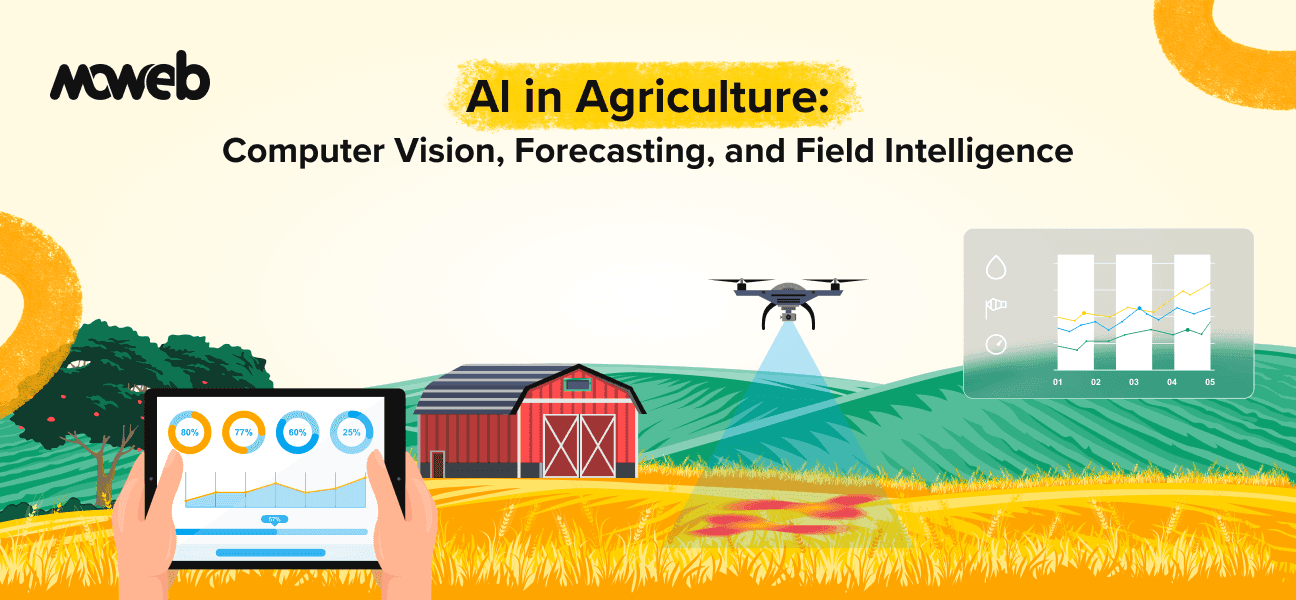
A data-backed guide to AI in agriculture for 2026. Covers computer vision crop monitoring, AI yield forecasting, precision irrigation, pest and disease prediction, agricultural digital twins, and a three-phase implementation roadmap for agribusinesses and farming enterprises incl
What is AI used for in agriculture? In 2026, agricultural digital twins virtual replicas of individual fields continuously updated with real-time sensor and satellite data are emerging as the integration layer that connects all five capabilities into a unified operational model.
What ROI can agribusinesses expect from AI in agriculture? Precision irrigation AI reduces water consumption a critical ROI driver in water-scarce regions. Most agribusinesses achieve full ROI within 12–24 months of AI deployment. The most important shift in 2026 is that agricultural AI is no longer evaluated on potential it is evaluated on payback. The question has moved from “what can this technology do?” to “how does this pay off this season?”
Agriculture has always been a data-driven business. Weather patterns, soil conditions, crop cycles, and market prices have guided farming decisions for centuries. What has changed in 2026 is the scale, speed, and intelligence with which that data can be collected, processed, and acted on. But market size tells only part of the story. The more significant shift is in how the agricultural sector is thinking about AI. The conversation has moved from “what can this technology do?” to “how does this pay off today?” and “will this crop survive the summer?” Labour shortages are making automation a survival mechanism rather than a luxury for many farming operations. Climate volatility is making precision more valuable – because the margin for error in input use, water management, and harvest timing has narrowed significantly.
This guide covers the five AI capabilities producing documented value for agribusinesses and farming enterprises in 2026, the data infrastructure that makes them work in the challenging connectivity and terrain conditions of real agricultural environments, and a practical roadmap for agricultural organisations at different scales and technology maturity levels.
This blog also has particular relevance for agricultural enterprises in East Africa and Tanzania, where Moweb has client relationships and where the combination of labour constraints, variable rainfall, and subsistence-to-commercial scale transition creates specific AI opportunities that differ from European or North American agricultural contexts. We address those differences explicitly.
Why Agricultural AI Is Different from Other Industry AI
Before getting into specific applications, it is worth understanding why agricultural AI deployments face a distinct set of challenges that shape every implementation decision.
Field environments are hostile to technology. Sensors, cameras, and connected devices operating in the field face conditions that enterprise server rooms do not: dust, humidity, temperature extremes, vibration from equipment, and physical damage from field operations. Agricultural AI systems must be designed for operational resilience in real field conditions, not just for performance in controlled environments.
Connectivity is unreliable or absent in many agricultural contexts. Cloud-dependent AI architectures that assume reliable internet connectivity fail in the field environments where much of the world’s food is grown. Agricultural AI must frequently operate on edge computing infrastructure – processing data locally on field devices and syncing to the cloud when connectivity is available, rather than relying on continuous real-time cloud connection.
Seasonal and biological variability create model drift challenges unique to agriculture. A crop disease detection model trained on data from one season’s pathogen population may underperform against evolved pathogen strains the following season. A yield forecasting model trained on historical weather-yield relationships may require recalibration as climate patterns shift. Agricultural AI requires more frequent model validation and updating cycles than most enterprise AI applications.
Scale varies enormously – and so do the relevant solutions. The AI tools appropriate for a 50,000-hectare commercial grain operation in Tanzania are not the same as those appropriate for a 5-hectare smallholder operation, even if the underlying technology is similar. Agricultural AI implementation must be scaled to the operational reality and capital availability of the specific farming enterprise.
Understanding these four differences shapes the architecture choices, the connectivity strategy, the model maintenance approach, and the deployment timeline for agricultural AI that actually works in the field.
Capability 1: Computer Vision for Crop Health Monitoring
Before getting into specific applications, it is worth understanding why agricultural AI deployments face a distinct set of challenges that shape every implementation decision.
Field environments are hostile to technology. Sensors, cameras, and connected devices operating in the field face conditions that enterprise server rooms do not: dust, humidity, temperature extremes, vibration from equipment, and physical damage from field operations. Agricultural AI systems must be designed for operational resilience in real field conditions, not just for performance in controlled environments.
Connectivity is unreliable or absent in many agricultural contexts. Cloud-dependent AI architectures that assume reliable internet connectivity fail in the field environments where much of the world’s food is grown. Agricultural AI must frequently operate on edge computing infrastructure, processing data locally on field devices and syncing to the cloud when connectivity is available, rather than relying on a continuous real-time cloud connection. In Sub-Saharan Africa, this is not a marginal concern: World Bank research confirms that limited internet connectivity and high digital infrastructure costs remain primary barriers to AI adoption among smallholder farmers across the region.
Seasonal and biological variability create model drift challenges unique to agriculture. A crop disease detection model trained on data from one season’s pathogen population may underperform against evolved pathogen strains the following season. A yield forecasting model trained on historical weather-yield relationships may require recalibration as climate patterns shift. Agricultural AI requires more frequent model validation and updating cycles than most enterprise AI applications.
Scale varies enormously and so do the relevant solutions. The AI tools appropriate for a 50,000-hectare commercial grain operation in Tanzania are not the same as those appropriate for a 5-hectare smallholder operation, even if the underlying technology is similar. Agricultural AI implementation must be scaled to the operational reality and capital availability of the specific farming enterprise.Understanding these four differences shapes the architecture choices, the connectivity strategy, the model maintenance approach, and the deployment timeline for agricultural AI that actually works in the field. For the edge computing and data pipeline architecture that these connectivity constraints require, see our future guide to data engineering for AI: building the foundations your models actually need.
Computer vision quality inspection in post-harvest processing facilities shares architectural patterns with manufacturing AI. For that cross-over context, see our guide to AI in manufacturing: pilot to plant-wide deployment.
Capability 2: Yield Forecasting and Predictive Analytics
Yield forecasting is the agricultural AI application with the broadest impact across the value chain, from the individual farm’s harvest planning to the agribusiness’s procurement strategy to the commodity trader’s market position.
Traditional yield forecasting relies on historical averages, agronomist experience, and periodic field assessments. The limitation is that historical patterns are increasingly unreliable as climate variability increases, and field assessments provide point-in-time snapshots that may not reflect the dynamic conditions affecting yield throughout the growing season.
AI yield forecasting integrates a fundamentally richer signal set: satellite vegetation indices (NDVI, EVI) tracked weekly throughout the growing season, weather station data including temperature, rainfall, and humidity at the field level, soil moisture sensor readings, historical yield records at the field and sub-field level, and, in advanced implementations, commodity market signals that contextualise yield forecasting within supply and demand dynamics.
The accuracy improvement from AI yield forecasting is substantial.
For agribusiness enterprises managing large cropping programs, yield forecasting AI drives material business value: more accurate procurement planning, reduced waste from over-purchasing inputs for lower-yield seasons, improved cash flow management from better harvest timing decisions, and stronger contract fulfilment capability from earlier and more accurate yield commitments to buyers.
For smallholder and mid-scale farmers, accessible yield forecasting via mobile-first platforms has democratised a capability that was previously available only to large commercial operations with in-house agronomic teams.
Yield forecasting and precision irrigation are predictive AI applications. For the broader decision of where to invest between predictive and generative AI capabilities, our framework on generative AI vs predictive AI is a useful starting point.
Capability 3: Precision Irrigation and Water Management
Water is agriculture’s most constrained resource in most growing regions globally. Overuse depletes aquifers and raises production costs. Underuse stresses crops at critical growth stages, reducing yield and quality. The precision of irrigation management has a direct impact on both yield and sustainability outcomes.
AI-driven precision irrigation determines irrigation requirements at the field zone level rather than the whole-field level, using inputs from soil moisture sensors, weather forecasts, crop evapotranspiration models, and satellite crop stress data. The system calculates the water deficit in each field zone and schedules irrigation to meet that deficit precisely, rather than applying a uniform rate across the entire field.
The measurable outcomes are consistent. AI precision irrigation reduces water consumption compared to conventional scheduled irrigation while maintaining or improving yield outcomes. In regions facing water allocation restrictions, this efficiency gain is commercially significant, allowing more area to be irrigated within the same allocation, or reducing the water cost per unit of production in volumetrically priced water supply systems.
For agricultural enterprises in water-scarce regions of East Africa, the Middle East, parts of South Asia, and increasingly parts of Southern Europe and North America, as climate patterns shift, precision irrigation AI is transitioning from a competitive advantage to an operational necessity. Operations that cannot demonstrate water use efficiency face growing regulatory pressure, market access barriers from sustainability certification requirements, and physical supply constraints. Europe’s Green Deal and Canada’s 2030 Emission Reduction Plan both explicitly target reductions in agricultural input use and are accelerating the adoption of precision irrigation and farm management AI as compliance tools, not just productivity tools.
The connectivity requirement for precision irrigation AI is worth noting. Real-time soil moisture sensing and dynamic irrigation scheduling require either continuous connectivity or edge computing capability at the field level. For agricultural operations in areas with unreliable connectivity, the architecture must incorporate local data processing and scheduled sync rather than assuming always-on cloud connectivity.
Capability 4: Pest and Disease Prediction
Pest and disease outbreaks are among the highest-impact risk events in agricultural production. A late blight outbreak in potato, fall armyworm incursion in maize, or locust swarm in East Africa can devastate entire harvests with little warning under traditional monitoring approaches.
AI-driven pest and disease prediction shifts the posture from reactive monitoring to predictive early warning. The models integrate weather pattern analysis (specific temperature, humidity, and wind conditions that favour pest movement or disease spread), crop stress signals from satellite and sensor monitoring (stressed crops are more susceptible to both), historical incidence maps (where previous outbreaks occurred and the conditions that preceded them), and in some implementations, community reporting networks where farmers report sightings through mobile apps that feed into regional prediction models.
The practical capability of these systems has advanced significantly since 2023. Disruption prediction models for key pest species, fall armyworm in sub-Saharan Africa, aphids and whitefly in European vegetable production, and brown planthopper in Asian rice systems, can now provide 1 to 3 weeks of advance warning for outbreak risk at the regional level with accuracy. This advanced window is sufficient for preventive intervention: targeted application of biopesticides or chemical controls before populations reach economically damaging thresholds, at significantly lower cost than remedial treatment of established infestations. Multi-agent AI frameworks such as AgroAskAI (AAAI, 2026) are now being deployed specifically for smallholder advisory services in vulnerable communities, providing contextualised, crop-specific pest and weather risk guidance adapted to local conditions a capability that did not exist at this level of accessibility two years ago.
For East African and Tanzanian agricultural enterprises, pest and disease prediction AI has particular strategic value. Fall armyworm, which devastated maize crops across sub-Saharan Africa after its 2016 arrival, remains a significant production risk. Striga weed infestation, aflatoxin risk in groundnuts and maize, and East Coast Fever in dairy cattle are all prediction targets where AI early warning systems are delivering documented value in regional deployments. iSDA’s Virtual Agronomist, launched in 2024 by Rothamsted Research, ICRAF, and IITA, has already provided agronomic advisories for over 200,000 smallholder plots across seven African countries and 17 crops, demonstrating the scale at which AI advisory systems can operate when designed for low-bandwidth, mobile-first access.
Post-harvest loss reduction and agricultural supply chain optimisation extend the value of field intelligence into the logistics and distribution chain. Our guide to AI in supply chain and logistics covers those downstream applications.
Capability 5: Farm Management Intelligence and Decision Support
The four capabilities above – computer vision monitoring, yield forecasting, precision irrigation, and pest prediction – generate enormous volumes of data. Farm management intelligence systems integrate this data into actionable decision support: not just “here is what is happening” but “here is what you should do about it, and here is why.”
The shift from data to decision is where agricultural AI delivers its most practical value to farming enterprises. A satellite image showing nitrogen deficiency in the eastern section of Field 7 is information. A recommendation to apply 45 kg/ha of urea to that specific zone during the next suitable application window, based on current growth stage, weather forecast, and soil uptake rate, is a decision support.
Modern farm management intelligence platforms combine data aggregation (satellite imagery, weather, sensor data, market prices), AI analysis (anomaly detection, prediction, recommendation), and mobile-first delivery (recommendations available on a smartphone in the field, not just on a desktop in an office). The mobile delivery dimension is particularly important for agricultural contexts where the people making and executing decisions are in the field, not behind a desk.
Agricultural digital twins are the emerging frontier in farm management intelligence. A digital twin is a virtual replica of an individual field or farming operation, continuously updated with real-time sensor and satellite data, that enables simulation-based decision support: testing how different irrigation schedules, planting densities, or fertilisation strategies would perform before committing to them in the real field. Research published in Agriculture (MDPI, 2025) identifies sensor fusion, edge AI, and multi-agent systems as the three enabling technologies that will bring digital twin systems to commercial scale, including scalable frameworks specifically designed for smallholder operations. The ESA’s DT4CMI project is actively developing Digital Twin as a Service specifically for African agricultural contexts, targeting smallholder farmers in climate-vulnerable regions.
For enterprise agribusinesses managing complex multi-crop, multi-site operations, farm management intelligence also provides portfolio-level optimisation: allocating resources (labour, irrigation water, agronomic expertise) across the full farm portfolio based on where marginal investment has the highest expected return in the current season.
Agriculture AI in East Africa and Tanzania: Specific Considerations
The agricultural AI opportunity in East Africa and Tanzania has distinct characteristics that standard global agriculture AI frameworks do not fully address. Understanding these differences matters for organisations operating in or evaluating the East African agricultural market.
The smallholder context. The majority of agricultural production in Tanzania and East Africa is smallholder farming – operations of 1 to 5 hectares, with limited capital for technology investment and limited technical literacy for complex platform interfaces. Agricultural AI that requires expensive hardware, a complex setup, or continuous internet connectivity does not reach this market. The AI applications with the most impact in this context are those delivered via mobile SMS or USSD interfaces, requiring no smartphone, and priced on a per-season or per-query basis accessible to smallholder budgets. The World Bank confirms that private agri-food tech investment in Sub-Saharan Africa grew from less than $10 million in 2014 to approximately $600 million in 2022, with mobile-first AI advisory platforms now serving millions of smallholder farmers at scale. AI platforms in Tanzania are already connecting farmers directly with buyers, eliminating middlemen and improving price realisation, as documented in World Bank research as a tangible livelihood improvement.
The commercial agribusiness context. Alongside the smallholder sector, Tanzania and East Africa have a growing commercial agribusiness sector – larger farming operations, export-oriented horticulture, tea, coffee, and flower production, and agricultural processing enterprises. This segment has the capital and operational scale to deploy precision agriculture AI comparable to what is used in European and North American commercial farming. The specific priorities differ from global averages: water management (seasonal rainfall variability), fall armyworm and other invasive pest management, and post-harvest loss reduction are top operational AI priorities.
Connectivity architecture matters more. Rural agricultural areas in Tanzania have lower mobile data connectivity than comparable agricultural regions in Europe or North America. Edge computing – processing AI analysis locally on field devices rather than requiring continuous cloud connectivity – is not an optional architecture consideration; it is a deployment requirement for reliable field operations. The Digital Frontiers Institute’s 2026 analysis of AI adoption across Africa identifies this infrastructure gap as the defining constraint and the defining opportunity for AI vendors building for African agricultural markets: those who solve the connectivity and edge architecture challenge unlock a market that cloud-first competitors cannot reach.
Government and development finance alignment. Agricultural digitalisation in Tanzania is supported by both the Tanzanian government’s agricultural development agenda and by international development finance institutions investing in agricultural productivity and food security. Agricultural AI implementations in this context often benefit from structured financing, co-investment, and subsidy frameworks that reduce the direct cost to farmers. Understanding this funding landscape is part of the commercial context for AI vendors operating in this market. The African Union’s CAADP Strategy and Action Plan (2026–2035) explicitly sets targets for digital agriculture adoption, creating a multi-year policy tailwind for agricultural AI investment across the continent. GIZ’s Agriculture Information Exchange Platform is actively testing inclusive AI solutions for agricultural advisory services across multiple African markets, representing both a co-investment opportunity and a deployment model for reaching smallholder farmers at scale.
Moweb’s presence and client relationships in Tanzania give us direct operational familiarity with these specific considerations. If you are an agricultural enterprise or agtech organisation operating in East Africa and evaluating AI implementation, we understand the local context – connectivity constraints, funding landscape, regulatory environment, and the specific crop production systems relevant to the region.
Implementation Roadmap for Agricultural Organisations
Agricultural AI implementation success follows the same principle as every other sector: start with the use case where the data is most accessible, the ROI is clearest, and the operational complexity is lowest. For most agricultural enterprises, this is computer vision crop monitoring, followed by yield forecasting, followed by precision irrigation and pest prediction.
Phase 1 (First season): Crop monitoring and yield forecasting pilot. Select a defined area (a single crop, a single field cluster, a defined geography) and deploy crop monitoring using drone or satellite imagery combined with an AI analysis platform. Establish yield forecasting for the same area, setting up the data inputs (weather, soil, satellite) and running forecasts through the season to build accuracy benchmarks. The goal is not perfection it is establishing the data pipeline and building confidence in AI-generated insights before scaling. Most agribusinesses achieve ROI within 12–24 months of deployment when starting with this scoped pilot approach, with computer vision crop monitoring delivering the fastest payback given its direct impact on input cost reduction.
Phase 2 (Second season): Precision irrigation and integration. Integrate soil moisture sensing and implement precision irrigation for the pilot area. Connect crop monitoring, yield forecasting, and irrigation management into a unified farm management dashboard. Expand monitoring to additional crop areas based on Phase 1 learnings. Begin pest and disease prediction for the highest-risk crop types in the operation.
Phase 3 (Third season and beyond): Full portfolio deployment and optimisation. Scale all four capabilities across the full farming operation. Implement portfolio-level farm management intelligence with integrated decision support. Begin evaluating agricultural digital twins for your highest-value fields using Phase 1 and 2 data as the baseline for virtual field modelling. Establish the monitoring, model validation, and update cadences that maintain accuracy as conditions evolve.
The time horizon matters. Agricultural AI benefits compound over seasons as models accumulate more local training data, as operators build confidence in AI-generated recommendations, and as the operational integrations mature. An organisation that starts its agricultural AI programme in 2026 will have a significantly more capable and accurate system by 2028 than one that starts in 2028, because of the compounding value of two seasons of local calibration data.
For the broader AI readiness assessment that should precede any agricultural AI programme, our AI readiness assessment checklist for mid-sized enterprises covers the data, infrastructure, and governance dimensions that agricultural organisations need to assess before committing to implementation.
Frequently Asked Questions About AI in Agriculture
What is precision agriculture, and how does AI enable it? Precision agriculture is the practice of managing crop inputs (water, fertiliser, pesticide) at the sub-field level based on actual spatial variation in conditions, rather than applying uniform rates across the entire field. AI enables precision agriculture by processing the satellite imagery, sensor data, and field measurements needed to map that spatial variation at a useful resolution, and by generating the field-zone-specific recommendations that translate mapping into action. Without AI, the data volume from precision sensing would exceed the capacity of manual analysis to convert into actionable decisions.
How does computer vision detect crop disease from drone or satellite imagery? Computer vision crop disease detection uses machine learning models trained on libraries of labelled crop images – images where disease is confirmed and annotated by agronomists. The model learns the visual and spectral signatures associated with different disease conditions. When applied to new drone or satellite imagery, the model identifies pixels or regions matching those learned signatures and generates a spatial map of disease risk across the field. Multispectral imaging (capturing wavelengths beyond visible light) extends detection sensitivity, identifying early-stage physiological stress before it produces visible symptoms.
What data does AI yield for forecasting require? AI yield forecasting integrates several data streams: historical yield records at field or sub-field level (ideally 3 to 5 years minimum), in-season satellite vegetation indices (NDVI and related indices updated weekly), weather data including temperature, rainfall, humidity and evapotranspiration at field level, soil type and nutrient status data (ideally from soil testing or proximal sensing), and crop management records (planting date, variety, inputs applied). The quality and completeness of this data, particularly the historical yield records and in-season weather data, is the primary determinants of forecast accuracy.
How does AI precision irrigation reduce water use? AI precision irrigation calculates water requirements at the field zone level using soil moisture sensor readings, crop evapotranspiration models (which estimate how much water the crop is losing to the atmosphere based on temperature, humidity, and wind), and weather forecasts for the coming days. It schedules irrigation to precisely meet the calculated water deficit in each zone, avoiding both overwatering (which causes runoff, soil compaction, and disease risk) and underwatering (which causes yield loss).
Is agricultural AI relevant for smallholder farmers in Africa? Yes, with important design considerations. Smallholder farmers in Africa benefit most from AI capabilities delivered through mobile-first, low-bandwidth interfaces – advisory services via SMS or simple smartphone apps, satellite-based crop monitoring accessed through shared platform subscriptions, and weather and market intelligence that does not require expensive hardware. The AI applications that are most relevant are those addressing the highest-impact challenges in the specific cropping system: pest early warning for fall armyworm and other high-impact pests, rainfall forecasting for rain-fed agriculture planning, and market price intelligence for harvest timing and sales decisions. Several regional and international development organisations are funding the deployment of these capabilities at scale, specifically for the East African smallholder sector.iSDA’s Virtual Agronomist has already demonstrated this model at scale, delivering agronomic advisories for over 200,000 smallholder plots across seven African countries and 17 crops, while GIZ’s Agriculture Information Exchange Platform is actively testing inclusive AI advisory solutions across multiple African markets.
What is the difference between remote sensing and on-the-ground sensors in agricultural AI? Remote sensing in agriculture refers to data captured from a distance – primarily satellite imagery and drone imagery. It provides wide area coverage at relatively low cost per hectare but at limited spatial resolution and without the ability to measure subsurface conditions like soil moisture or root health. On-the-ground sensors (soil moisture probes, weather stations, connected irrigation infrastructure) provide high-accuracy point measurements and can capture subsurface conditions. Most advanced agricultural AI systems use both remote sensing for field-wide pattern detection and prioritisation, and ground sensors for the high-resolution measurements that drive precision management decisions. The combination produces better outcomes than either alone.What is an agricultural digital twin, and when should farms consider one? An agricultural digital twin is a virtual replica of a real field or farming operation, continuously updated with real-time sensor and satellite data, that enables simulation-based decision support. Farmers and agronomists can test different management decisions, irrigation schedules, fertilisation rates, and planting densities in the virtual model before committing to them in the physical field. Digital twins are most valuable for high-value crops where decision errors are expensive, for water-stressed operations where optimising irrigation is a primary cost driver, and for operations with sufficient sensor infrastructure to feed the real-time data the twin requires. The ESA’s DT4CMI project is developing Digital Twin as a Service specifically for African smallholder contexts, reducing the infrastructure cost barrier that currently limits adoption to larger commercial operations.
Conclusion: Agricultural AI Is a Multi-Season Investment, Not a Single-Season Fix
The agricultural enterprises getting the most from AI in 2026 are those that started their programmes one to three seasons ago. Their models are better calibrated to their local conditions, their operators trust the recommendations, their data pipelines are mature, and their second and third AI capabilities are being deployed on an established foundation.
Starting now means reaching that compounding value sooner rather than later. The farms and agribusinesses that invest in agricultural AI infrastructure in 2026 will be making decisions in 2028 and 2030 from a foundation of locally calibrated models, established operational workflows, and multi-season performance data that late adopters cannot replicate quickly. The question for agricultural enterprises is not whether this technology will become standard; it is whether they are building their data and operational foundations now, or entering the next decade behind the curve.
Climate volatility, labour constraints, and pressure on water and chemical use are not temporary challenges. They are the permanent operating context for agriculture in the coming decades. AI does not eliminate these challenges, but it gives agricultural enterprises the precision and predictability to manage them more effectively than their competitors.
Moweb’s AI & ML development practice works with agricultural enterprises and agtech companies, with particular experience in East African agricultural contexts. Our team understands the connectivity constraints, the crop production systems, and the development finance landscape that shapes agricultural AI implementation in this region. Talk to us about your agricultural AI programme.
Found this post insightful? Don’t forget to share it with your network!